Talent Acquisition vs Recruitment

Understanding the distinction between talent acquisition and recruitment is essential for establishing an effective hiring process. Although these terms are often used interchangeably, they represent different strategies for attracting talent. Recruitment primarily aims to quickly fill immediate job openings, focusing on efficiency. In contrast, talent acquisition takes a broader, long-term approach, concentrating on identifying, attracting, nurturing, and hiring talent to align with future organizational goals. Given its strategic significance, 80% of organizations consider talent acquisition one of their top ten human capital challenges. This difference influences various aspects, including timelines, metrics, and technology choices. Clarifying these distinctions is the first step toward optimizing your overall talent acquisition strategy.
Why the Talent Acquisition vs Recruitment Debate Matters
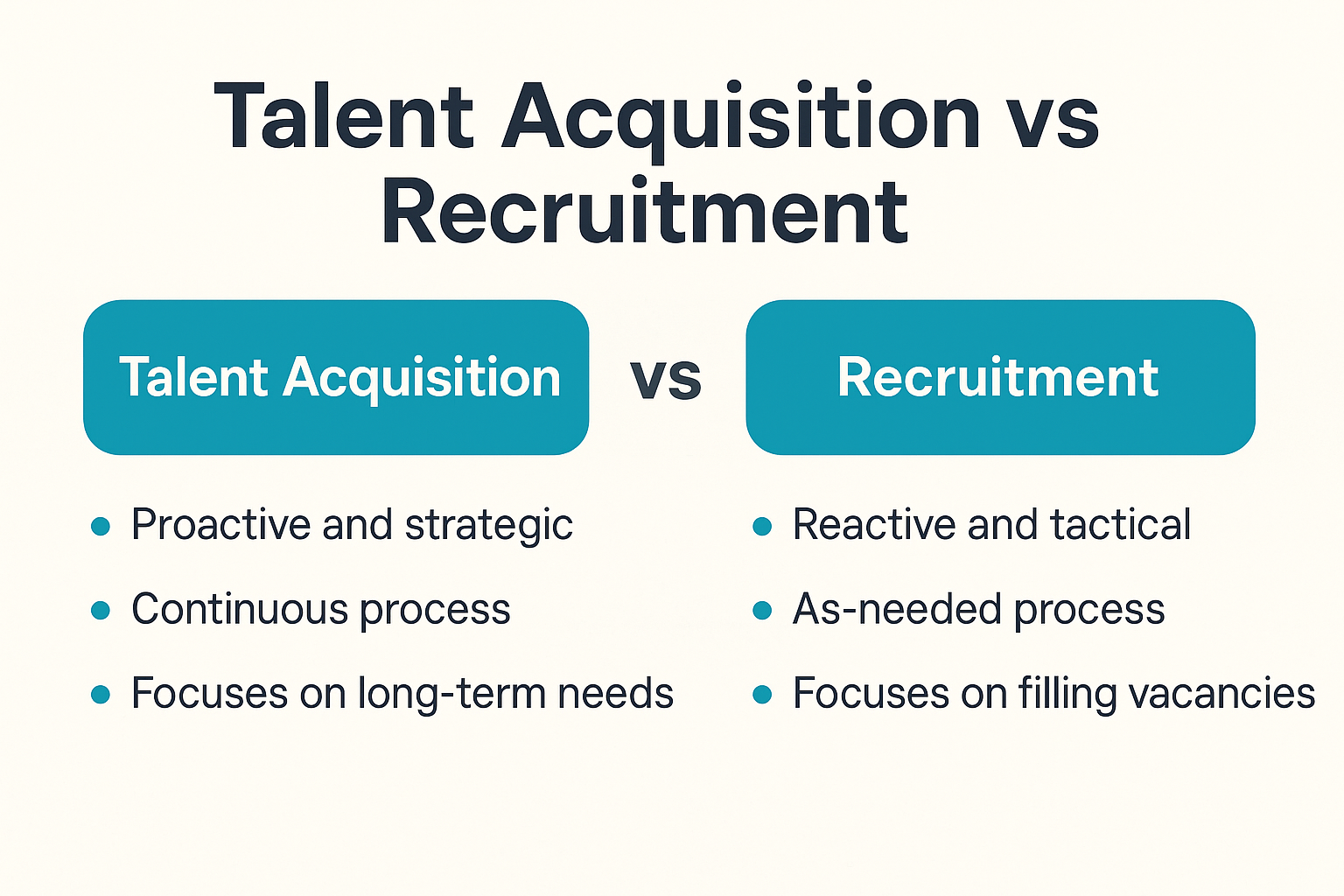
The difference between these two approaches goes beyond terminology; it significantly affects hiring outcomes and organizational agility. Recruitment, with its tactical emphasis on filling current vacancies, primarily addresses short-term operational needs. Success is usually gauged by metrics such as time-to-fill and cost-per-hire. While this focus is important, relying solely on reactive recruitment can leave organizations exposed to future skills shortages and shifts in the market.
On the other hand, talent acquisition adopts a strategic and long-term perspective. It encompasses ongoing market analysis, proactive talent pipeline development, skills forecasting, and cohesive employer branding. This strategic approach enhances long-term quality of hire, internal mobility, and an organization’s capacity to respond to evolving skill requirements, ultimately fostering sustained business growth and resilience. Recognizing the right approach—or a combination of both—helps determine the most effective recruitment models.
Side-by-Side Comparison Table
The core differences in the talent acquisition vs recruitment approaches can be summarized across several key dimensions:
Dimension | Talent Acquisition | Recruitment |
|---|---|---|
Time Horizon | Long‑term, continuous pipeline | Role‑by‑role, reactive |
Focus | Skills & future needs | Filling current vacancies |
Metrics | Quality‑of‑Hire, internal mobility | Time‑to‑Fill, cost‑per‑hire |
Tools | TI platforms, CRM, skills graphs | ATS, job boards |
Employer Brand Role | Central, deeply integrated | Supportive, often tactical |
Typical Users | Growth, skills‑scarce organizations | High‑volume, steady‑state roles |
When to Use Talent Acquisition vs Recruitment
The optimal approach depends heavily on the specific organizational context and hiring objectives.
Choose Talent Acquisition for Strategic Growth
Adopt a talent acquisition model when prioritizing long-term objectives, such as substantial expansion, entering new markets, developing capabilities in emerging or scarce skill areas (like AI or green technology), or significantly enhancing your employer value proposition (EVP). This proactive strategy is crucial for creating talent pipelines for future leadership roles, essential technical positions, or any field with intense competition and lengthy lead times. It necessitates investment in talent intelligence, customer relationship management (CRM), and employer branding.
Choose Recruitment for Immediate Hiring Needs
Employ a recruitment-focused model when the primary need is to quickly and efficiently fill existing, well-defined roles. This is often suitable for handling backfills due to attrition, managing seasonal hiring surges, or staffing high-volume entry-level positions where the required skills are readily available in the market. The emphasis here is on process efficiency, speed, and cost management, often relying heavily on job postings and applicant tracking systems (ATS).
Key Metrics to Compare Performance
While some overlap exists, the primary KPIs differ, reflecting the distinct goals of each approach:
Metric | Typical Focus in Talent Acquisition | Typical Focus in Recruitment | Formula / Description |
|---|---|---|---|
Time‑to‑Fill | Monitored, but speed less critical than quality / fit | Primary efficiency metric | Days from requisition approval to offer acceptance |
Cost‑per‑Hire | Considered, but ROI viewed longer‑term | Primary cost‑efficiency metric | Total recruitment costs ÷ number of hires |
Quality of Hire | Central strategic metric | Important, but often secondary to speed / cost | Blend of new‑hire performance, retention, and manager satisfaction scores |
Source Effectiveness | Analyzed for pipeline building & long‑term ROI | Analyzed for immediate applicant volume / speed | % of hires or qualified candidates originating from each source channel |
Internal Mobility Rate | Key indicator of pipeline success | Less direct focus | % of roles filled by internal candidates |
Candidate Pipeline Health | Critical metric for future readiness | Less emphasized | Size and engagement level of nurtured talent pools |
Integrating these metrics into a unified dashboard (e.g., using Google Looker Studio or similar BI tools) provides a holistic view of hiring performance across both strategic and tactical activities.
How Technology Differs in Each Approach
The supporting technology stacks often reflect the strategic focus. Talent acquisition typically relies on a broader, more integrated set of tools: Talent Intelligence platforms for market mapping and skills analysis, robust Candidate Relationship Management (CRM) systems for pipeline nurturing, skills assessment tools, and employer branding platforms, often integrated with an ATS. Recruitment can often function effectively with a strong Applicant Tracking System (ATS) as the core, supplemented by job board aggregators and basic communication tools. AI sourcing tools are increasingly used in both approaches. Still, they might be leveraged more strategically in TA for identifying passive candidates with future-potential skills versus primarily screening active applicants in recruitment.
Hybrid Approach: Combining Both for Optimal Results
A purely TA or purely recruitment model is insufficient for many organizations, particularly larger ones with diverse hiring needs. A hybrid approach often delivers the best results, blending recruitment efficiency for immediate needs with the strategic foresight of talent acquisition for critical future roles. This might involve:
Using efficient recruitment processes for high-volume or replacement hires.
Simultaneously running strategic talent acquisition initiatives (e.g., pipeline building, employer branding campaigns, university relations) focused on critical skill areas or future leadership needs.
Implementing a phased model: focus on immediate recruitment needs this quarter while actively building TA pipelines for anticipated needs next quarter or next year.
Best Practices for Transitioning/Blending:
Clearly define which roles fall under which approach.
Ensure technology stacks support both (e.g., an ATS with strong CRM capabilities).
Train teams on both strategic sourcing/nurturing and efficient recruitment processing.
Align metrics and reporting to reflect the goals of both approaches.
FAQ: Talent Acquisition vs Recruitment
Is talent acquisition the same as recruitment?
No, talent acquisition is a long-term strategic approach focused on future needs, employer branding, and pipeline building. At the same time, recruitment is typically a shorter-term, tactical process focused on filling immediate open vacancies.
Which approach is cheaper?
Recruitment often appears cheaper on a per-hire basis due to its focus on immediate cost-per-hire metrics. Still, strategic talent acquisition can deliver higher long-term ROI through better quality of hire, improved retention, and proactive pipeline management, potentially reducing future emergency hiring costs.
Can small companies run talent acquisition?
Yes, while extensive TA functions are standard in larger firms, small companies can apply TA principles by focusing on long-term needs for critical roles, building local talent networks, emphasizing their unique EVP, and nurturing potential future hires, even with limited resources.
How do AI tools fit into each?
AI tools can support both; in recruitment, they often automate screening, scheduling, and job posting optimization for efficiency. In talent acquisition, AI might additionally power talent intelligence platforms, predictive analytics for skills forecasting, personalized candidate nurturing, and strategic sourcing of passive candidates.
From recruiting candidates to onboarding new team members, MokaHR gives your company everything you need to be great at hiring.
Subscribe for more information
© Copyright 2025 MokaHR - All Rights Reserved.