A leading energy company undergoing rapid expansion found itself at a critical inflection point in its hiring operations. As the organization scaled across regions, recruitment demand surged dramatically, driven by engineering projects, infrastructure growth, and global talent needs.
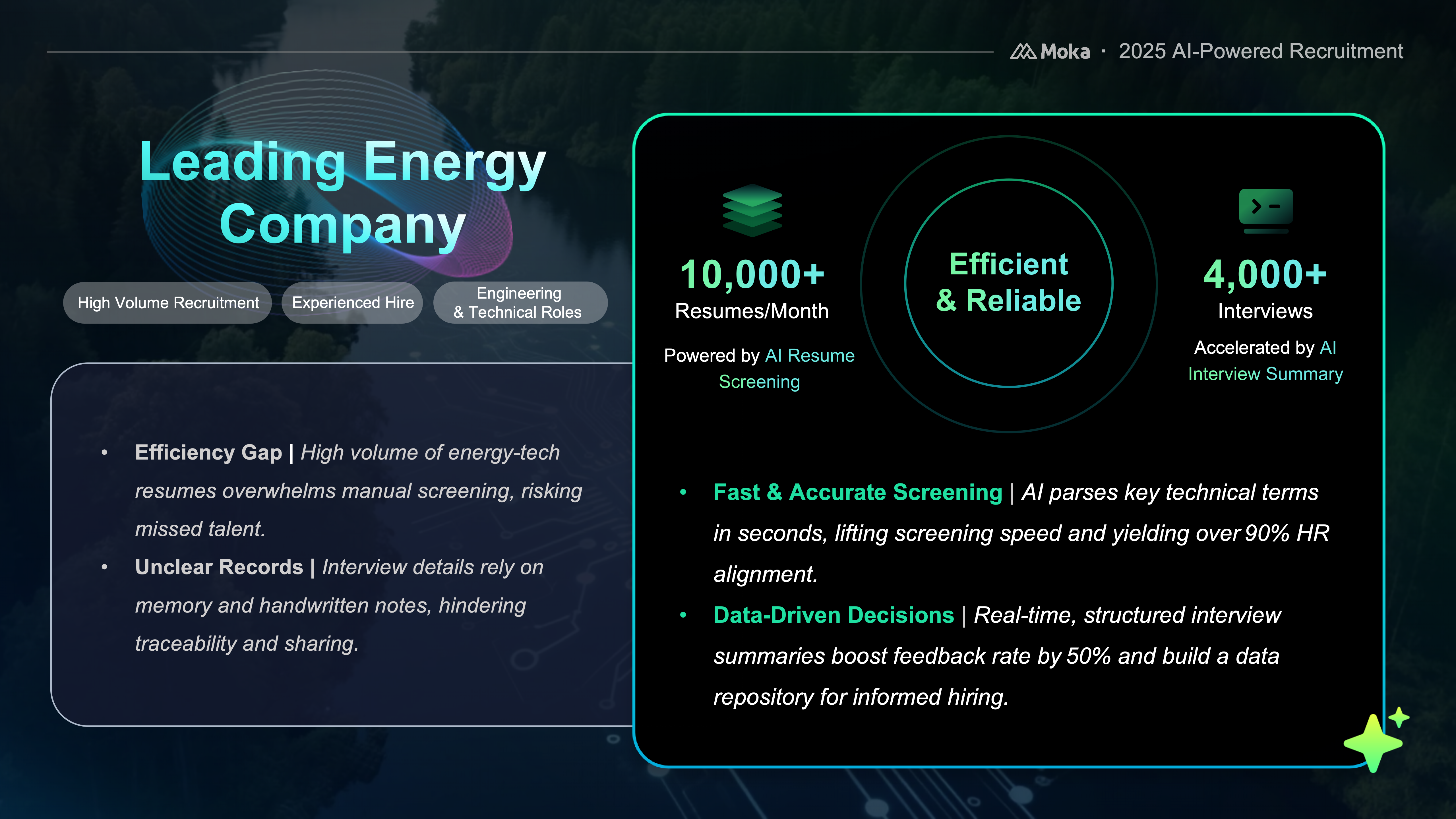
Within a short period, the hiring team was processing over 10,000+ incoming resumes monthly and coordinating thousands of interviews across multiple time zones. While demand for talent increased, the underlying hiring infrastructure had not evolved at the same pace.
What was once a manageable recruitment workflow had turned into a fragmented, high-pressure system where speed and consistency were increasingly difficult to maintain.
At this stage, the company began evaluating AI recruiting approaches to bring structure and scalability back into their hiring process.

Challenge
As hiring volume increased, three structural issues began to emerge across the recruitment lifecycle:
Excessive Resume Volume and Limited Signal Extraction
Recruiters were spending a disproportionate amount of time filtering large volumes of applications. With thousands of resumes flowing in, identifying high-quality technical candidates became increasingly difficult, and strong profiles were often missed in the noise.
In the absence of a unified AI ATS (AI Applicant Tracking System), screening remained largely manual and difficult to scale consistently.
Inconsistent and Biased Interview Practices
With multiple interviewers operating across different teams and regions, interview standards varied significantly. Feedback quality depended heavily on individual note-taking styles and experience levels, resulting in inconsistent evaluation signals and potential bias in hiring decisions.
This lack of standardization made it difficult to establish a reliable foundation for AI recruiting-driven decision-making across global teams.
Slow and Fragmented Hiring Decisions
Interview scheduling, feedback collection, and approval workflows were largely manual. This created delays between each hiring stage, slowing down decision-making and increasing the risk of losing high-demand candidates to faster-moving competitors.
Overall, the organization faced a familiar enterprise hiring challenge: high volume, low consistency, and limited visibility across the pipeline.
Solution
To address these challenges, the company implemented the Moka AI-powered recruitment platform, with Moka Eva as the core intelligence layer across screening, matching, and interview management.
Rather than replacing existing workflows, the platform was embedded directly into the hiring process to standardize decision-making and strengthen the foundation of their AI ATS and AI recruiting transformation.
AI-Powered Resume Screening at Scale
The first bottleneck addressed was resume overload. Moka’s AI screening system was deployed to automatically analyze incoming applications based on energy-sector technical keywords, role requirements, and structured qualification criteria.
This allowed the organization to shift from manual filtering to an AI ATS-driven screening model, significantly improving both speed and consistency in early-stage candidate evaluation.
Precision Matching for Technical Hiring
To improve hiring accuracy for specialized engineering roles, Moka Eva introduced AI-driven candidate-role matching.
Instead of relying on keyword scanning alone, the system evaluated structured candidate profiles against role-specific requirements, helping recruiters quickly identify the most relevant candidates for technical positions.
This AI recruiting layer improved alignment between job requirements and shortlisted candidates, particularly for high-skill engineering roles where precision is critical.
Structured, Data-Driven Interview Process
One of the most transformative changes came in the interview stage.
Moka Eva introduced AI-assisted interview summarization and structured feedback capture, enabling interviewers to focus on conversations while the system automatically generated consistent, structured evaluation notes in real time.
This reduced variability in interview documentation and ensured that hiring decisions were based on comparable, standardized data rather than fragmented human notes—strengthening the downstream effectiveness of the AI ATS workflow.
Results
After implementing Moka’s AI-powered recruitment system, the company achieved measurable improvements across speed, quality, and operational efficiency:
- 63% reduction in time-to-hire, significantly accelerating hiring cycles across global teams
- 10,000+ resumes processed monthly with improved screening efficiency and consistency through AI ATS capabilities
- 10,000+ Resumes Processed Automatically: The unified AI ATS effortlessly absorbed massive monthly application spikes without expanding HR headcount.
- 4,000+ Interviews Structured by AI
- 90%+ Precision in Screening Recommendations: The quality of shortlists delivered to engineering department heads improved dramatically, reducing resume rejection rates at the business-unit level.
- 50% Higher Interview Feedback Quality
Beyond metrics, the most notable shift was operational: recruitment moved from a reactive, manual process to a structured, data-driven system powered by AI recruiting principles at scale.
Conclusion
For high-growth organizations, hiring challenges are rarely about lack of talent—they are about signal extraction, process consistency, and decision speed. By embedding Moka AI into its recruitment workflow, the energy company operationalized AI ATS and AI recruiting capabilities to standardize evaluation, reduce manual overhead, and improve hiring quality at scale.
The result was not just faster hiring, but a more reliable and defensible recruitment system—one that could support continued expansion without compromising on quality.

Author
Damon Liu
Marketing Manager
Hello everyone! I'm part of the Editorial Team at Moka AI, where I focus on global content, including writing and editing in-depth insight articles. I love exploring new ideas, discovering new tools, and finding fresh perspectives. My goal is to create content that’s genuinely valuable and helpful for HR professionals, while keeping it engaging, relatable, and fun to read!