Key Takeaways
-
Measure AI's impact by quality, not just speed. Faster screening is easy to see, but the outcome that matters is quality of hire: how a new employee performs, stays, and fits the role over the first 6 to 12 months.
-
The mechanism is an evaluation framework. AI turns a recruiter's judgment into structured, role-specific criteria and applies them consistently. Techniques like Retrieval-Augmented Generation (RAG) can ground assessments in company data and past decisions.
-
Four scenarios show where AI can improve hiring quality: multi-role, frontline, multi-market, and specialized hiring. The challenge varies across the number of roles, stores, markets, and the depth of expertise required.
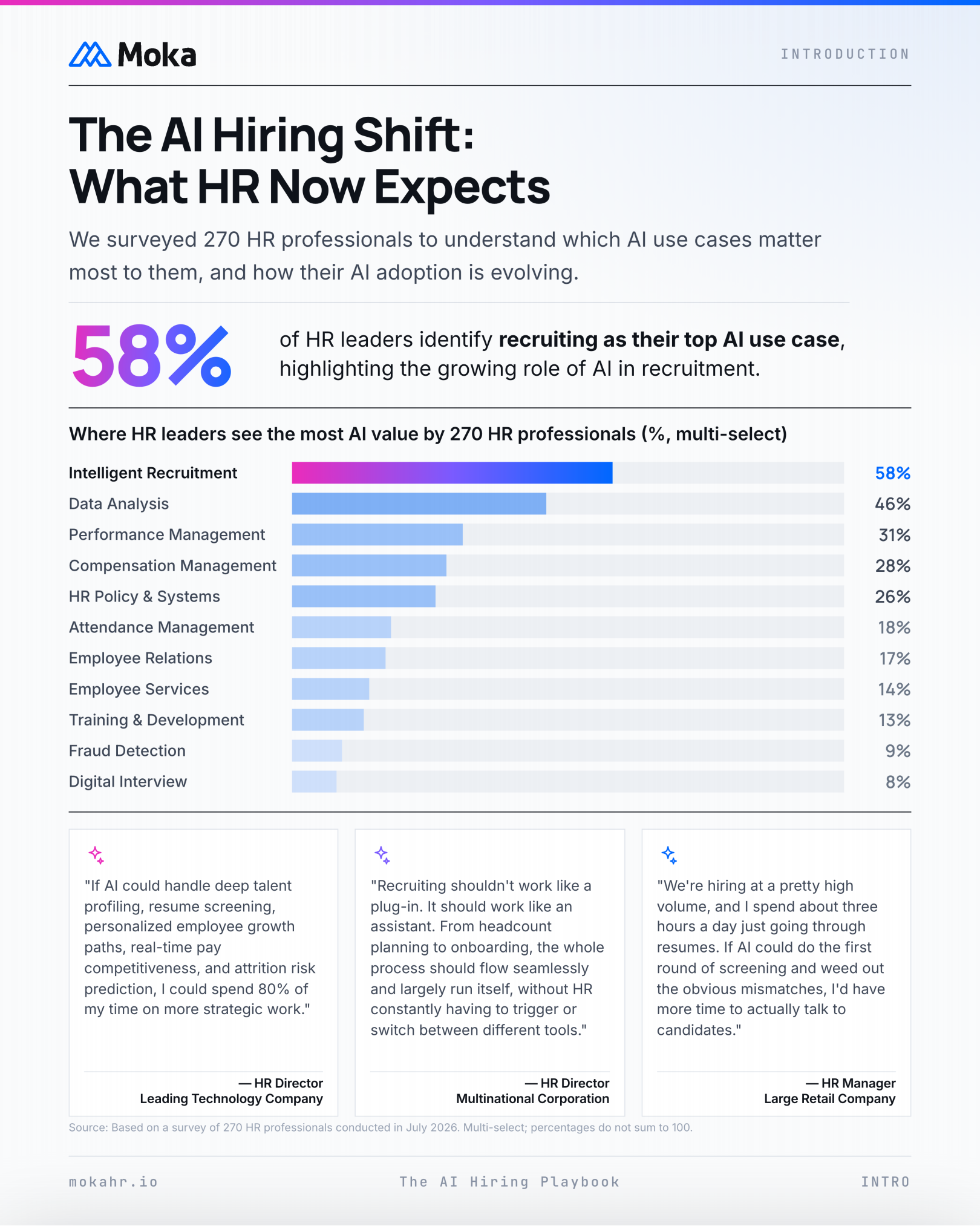
AI adoption in hiring is no longer a question of if, but of where and how it creates value. Our latest 2026 survey found that 58% of HR leaders see recruiting as their top use case for AI. The next question is how.
The AI Hiring Playbook 2026 answers it, bringing together 11 real cases from global enterprises.
These cases show how companies apply AI to different hiring challenges. This article looks beyond what they do to the insights and approaches that apply across key recruiting scenarios.
From Hiring Faster to Hiring Better
AI's most visible impact on hiring is often measured in efficiency: faster screening, shorter time to fill. But for businesses, the more important question is whether AI can improve quality of hire.
Quality of hire is one of the hardest outcomes to measure, because the evidence only appears once a new hire is on the job. While speed metrics show how quickly the process moves, quality of hire reveals what happens after: how well a new employee performs against the expectations set for the role.
It is typically assessed over the first 6 to 12 months through factors such as performance, retention, time to productivity, and hiring manager satisfaction.
Talent leaders regularly rank quality of hire as the outcome they most want to improve, yet few teams can measure it with confidence (LinkedIn, SHRM).
It also maps more directly to ROI, because it links hiring decisions to business outcomes. Because the full picture takes months to form, stronger hiring shows up first in leading signals like evaluation consistency and decision alignment.
Moka's cases show AI improving those very signals, turning faster hiring into better hiring.
Behind these results is a common mechanism. AI turns recruiters' experience and judgment into structured, reusable evaluation frameworks. At stages like screening and interviews, hiring teams define the ideal candidate profile and scoring criteria, and AI then applies them consistently through the assessment process.
Strengthened by technology like Retrieval-Augmented Generation (RAG), it pulls from company data, past decisions, and trusted sources to ground assessment in evidence.
The payoff is more consistent evaluation and signals that would otherwise be missed. That helps recruiters choose candidates who truly fit the role, improving quality of hire.
Across the 11 cases, we found four recruiting scenarios where AI makes the biggest difference to hire quality.
Four Scenarios Where AI Elevates Hiring Quality
Multi-Role Hiring at Scale
When companies operate multiple product lines and hiring demand grows, recruiter capacity runs short. Manually reviewing large volumes of candidates then fragments evaluation standards. It's also harder to identify the right candidates for each role at scale.
Tesla, Trip.com, and ZhongAn Insurance address this challenge through AI Resume Screening. Recruiters define the ideal profile and evaluation criteria for each role upfront, and AI applies the role-specific criteria consistently across applicants. AI also tags top talent, making strong candidates easier to identify and prioritize. This helps teams increase the conversion of qualified candidates.
Tesla screened sales and R&D pipelines in parallel, increasing resume conversion by 75%+ and reaching 90% agreement with recruiter decisions.
Frontline Hiring
For retail companies, frontline hiring runs large volumes of candidates across many stores. Manual screening is slow and error-prone, and hiring can vary across locations. Inconsistent hiring then shows up where it matters most: frontline performance and employee retention.
Decathlon and Luckin Coffee tackled these challenges through AI adoption. Decathlon uses a WhatsApp Agent to reduce repetitive tasks and improve the efficiency and accuracy of first-round screening.
Luckin Coffee uses AI Interview Summary to make store-level evaluation more consistent. AI surfaces key signals from every interview, helping recruiters make more data-backed hiring decisions. These insights can then inform more consistent standards across stores.
Luckin Coffee drove a 30% increase in 3-month employee retention with AI Interview summary.
Multi-Market Hiring
Hire quality matters most to multinational companies, yet a consistent standard is hardest to hold when hiring spans several markets. The gap widens at the interview stage: with no shared bar, evaluation falls back on each interviewer's personal judgment.
AI closes that gap by standardizing the questions for Traveloka and Bitget. For each role, AI Interview Questions generates a structured set based on the job requirements, giving interviewers across markets a consistent framework for evaluating candidates.
At Traveloka, AI Interview Questions improved interview efficiency by 90% while helping ensure more consistent evaluation across markets.
Specialized Talent Hiring
Hiring for specialized roles often relies on the expertise of a few senior professionals. The challenge is turning their knowledge into a clear, reusable framework that hiring teams can apply consistently.
Without this, teams may struggle to hire the right talent for specialized roles, such as crypto and fintech or manufacturing engineering.
For Hytech, AI encodes its technical expertise into a structured rubric for fintech roles. AI Resume Screening and AI Interview Questions apply that rubric to every candidate, scoring both technical skills and soft competencies. Their critical roles stay filled without compromising the standards, keeping specialized teams and their projects on schedule.
Using AI, Hytech supported 4,320 interviews and reduced cost per hire by 25% for key roles.
Final Thought
The value of AI in hiring is not simply how much faster recruiters can move through the process. It is whether the technology helps teams make better, more consistent decisions, and ultimately bring the right people into the right roles.
Across these 11 cases, the path to better hiring quality looks different by scenario. What connects them is less about the technology itself than how AI strengthens the decisions behind every hire.
How to use AI well is still being figured out, case by case. It will take more HR teams running their own experiments and sharing what holds and what breaks.
That is how these early wins become shared practice, and how hiring moves from filling roles to shaping the workforce a business needs.