Every week, we see headlines about layoffs and restructuring across major tech companies. Companies like Meta are aggressively reducing 20,000+ headcounts while accelerating AI adoption, and they are racing to improve productivity and redesign workflows around AI.
On the surface, these changes may appear to signal the arrival of a new organizational era. AI tools are rapidly entering daily operations, teams are becoming leaner, and companies are increasingly shifting toward AI-assisted execution.
Yet beneath these visible changes, have companies fundamentally transformed the way their organizations operate?
Probably not.
AI adoption is not organizational transformation. While companies have integrated LLMs and AI tools into daily workflows, most organizations still operate within traditional structures. Teams remain trapped in repetitive coordination cycles.
The real challenge is deeper than productivity. Companies are beginning to realize that the old organizational model may no longer fit the AI era, yet the new model has not fully emerged. In many ways, the industry is still experimenting without a clear blueprint for what an AI-native organization actually looks like.
This article explores the idea of AI-native organizations, the future of organizational transformation in the AI era.
What Defines an AI-Native Organization?
An AI-native organization is still an emerging concept, though the concept is gaining broader recognition across the industry. It is believed that it is an entity fundamentally becoming queryable and continuously evolving with:
- Automated Coordination: The heavy human interactions, scheduling, status reporting, and context-gathering will be eliminated by autonomous agents.
- Intelligence Layers: It is built on intelligent layers, consisting of AI systems across different departments and functions. Information will flow smoothly through an intelligence layer.
- The Closed-Loop Ecosystem: Every decision, meeting, and code commit inside the company is ingested into a unified brain. Data is never lost, and serves as fuel for future iteration.
In many ways, they are not like traditional corporations anymore. Institutional knowledge no longer lives inside scattered human conversations.
Is Transformation Inevitable?
The answer is likely yes.
History suggests that technological revolutions inevitably reshape how organizations operate. The internet in the early 21st century brought us SaaS and Cloud, giving rise to digital workflows and highly digitized companies. Each major technology wave changes not only the tools, but how people collaborate. AI can trigger an even deeper transformation.
The transformation is already happening, even if most companies have not fully recognized it yet. Small AI-native teams are building globally distributed SaaS products, solo founders are launching products at unprecedented speed, and lean startups are operating with levels of leverage that previously required much larger organizations. AI reduces the coordination overhead, allowing companies to move faster with fewer layers and less friction.
These signals suggest AI-native companies are becoming structurally faster. And when the speed gap between organizations becomes structural rather than incremental, entire markets begin to shift. Companies that fail to adapt may find themselves unable to compete.
How to Transform into an AI-Native Organization?
There is still no universal blueprint for what an AI-native organization should look like. The industry itself is actively experimenting, and many ideas will continue evolving as AI capabilities mature.
The perspectives below are not definitive answers, but rather emerging observations and directional thinking based on how organizational systems may evolve in the AI era.
One core idea: the organization must become queryable. In the old operating model, every decision is preceded by a costly, manual cycle of context-gathering. To break this cycle, organizations must pivot from treating output as archives to viewing it as computable context.
Building the Intelligence Foundation (The Context Graph)
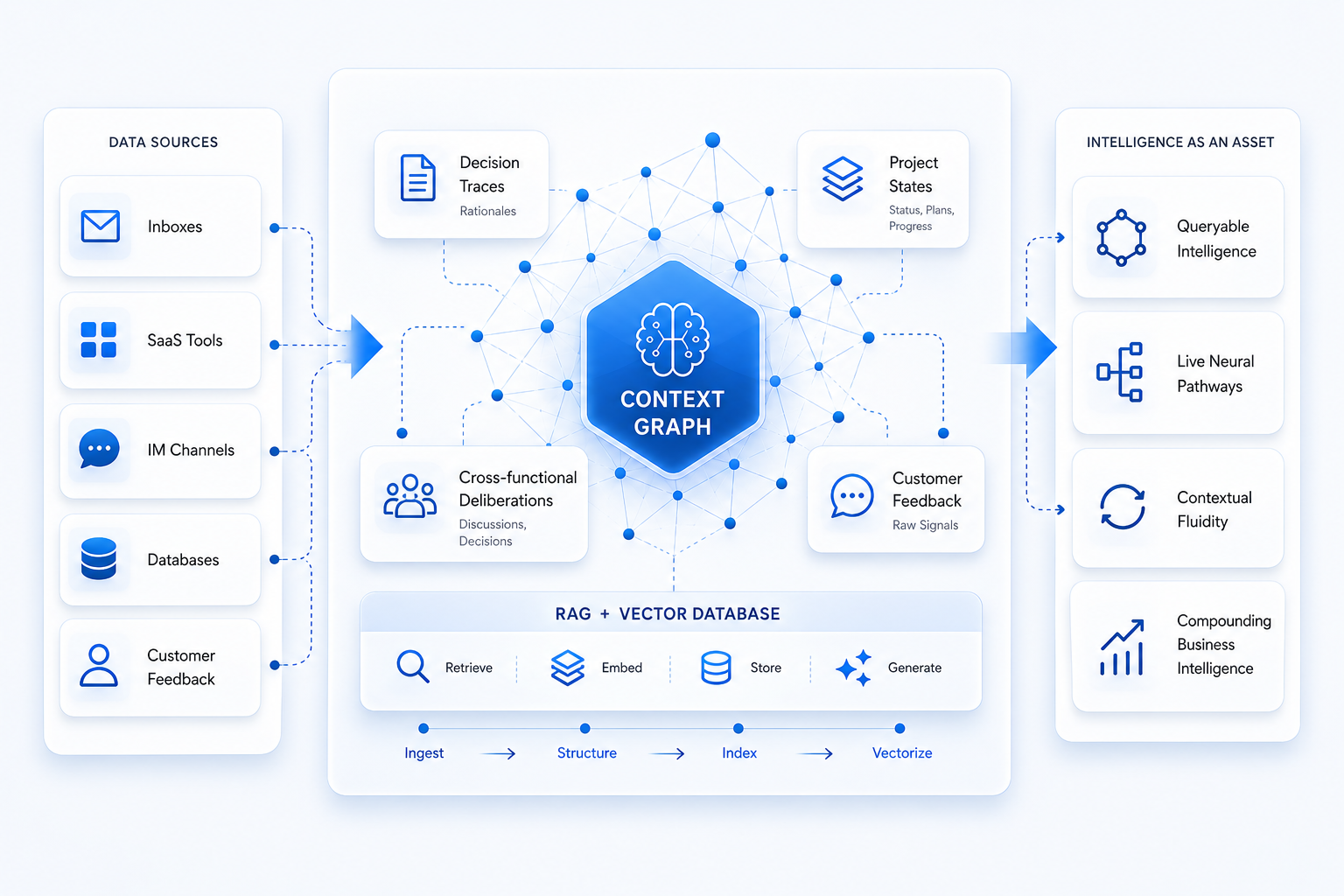
The first step is to dismantle the barriers between the core operational data: inboxes, SaaS tools, and IM channels by implementing __an AI-native middle layer. __
Start treating them as components of a unified Context Graph. By utilizing RAG (Retrieval-Augmented Generation) and vector databases, companies can ingest and structure every pulse of business, including decision-making rationales, project states, cross-functional deliberations, and raw customer feedback.
This middle layer acts as the organization's nervous system, turning disorganized, historical data into a high-fidelity, queryable asset.
Once these disparate threads are indexed and vectorized, they become live neural pathways rather than stagnant archives.
This unlocks one of the most important advantages in the AI era: contextual fluidity. Every meeting and workflow execution becomes an investment in the company's evolving intelligence system.
Deploying the Autonomous Layer (AI Agents)
Next, deploying AI agents across functions and workflows could be necessary.
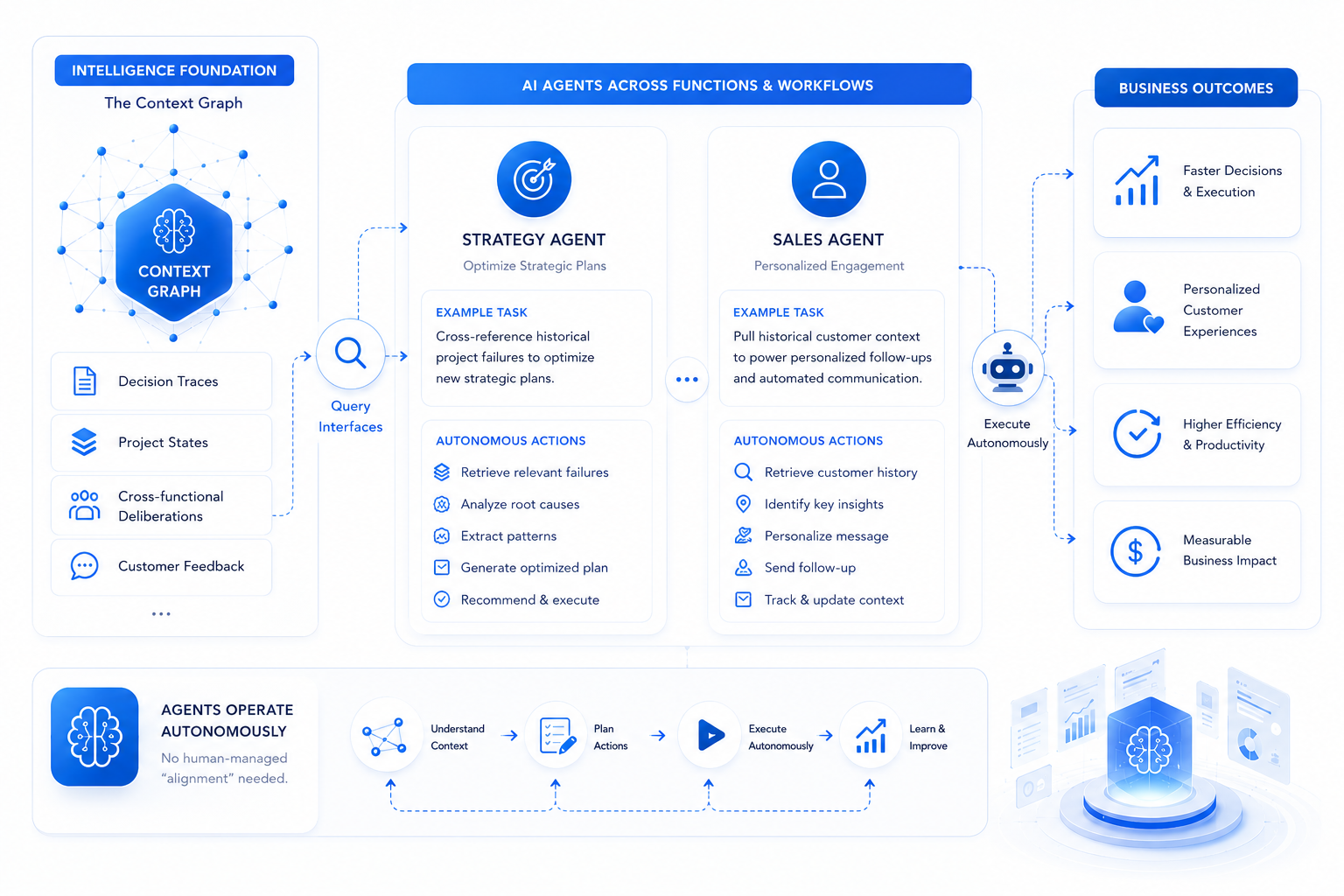
With the Context Graph in place, organizations can shift from using AI as a passive copilot to deploying it as an active driver of business outcomes. This is where you can implement role-specific AI Agents that plug into the newly established intelligence layer.
Instead of merely offering suggestions or summarizing documents, these agents utilize query interfaces to execute tasks autonomously. An AI agent can cross-reference historical project failures to optimize new strategic plans.Or, a sales agent can automatically pull historical customer context to power personalized follow-ups and automated communication. These agents eliminate the need for human-managed alignment.
Redefine Team Roles
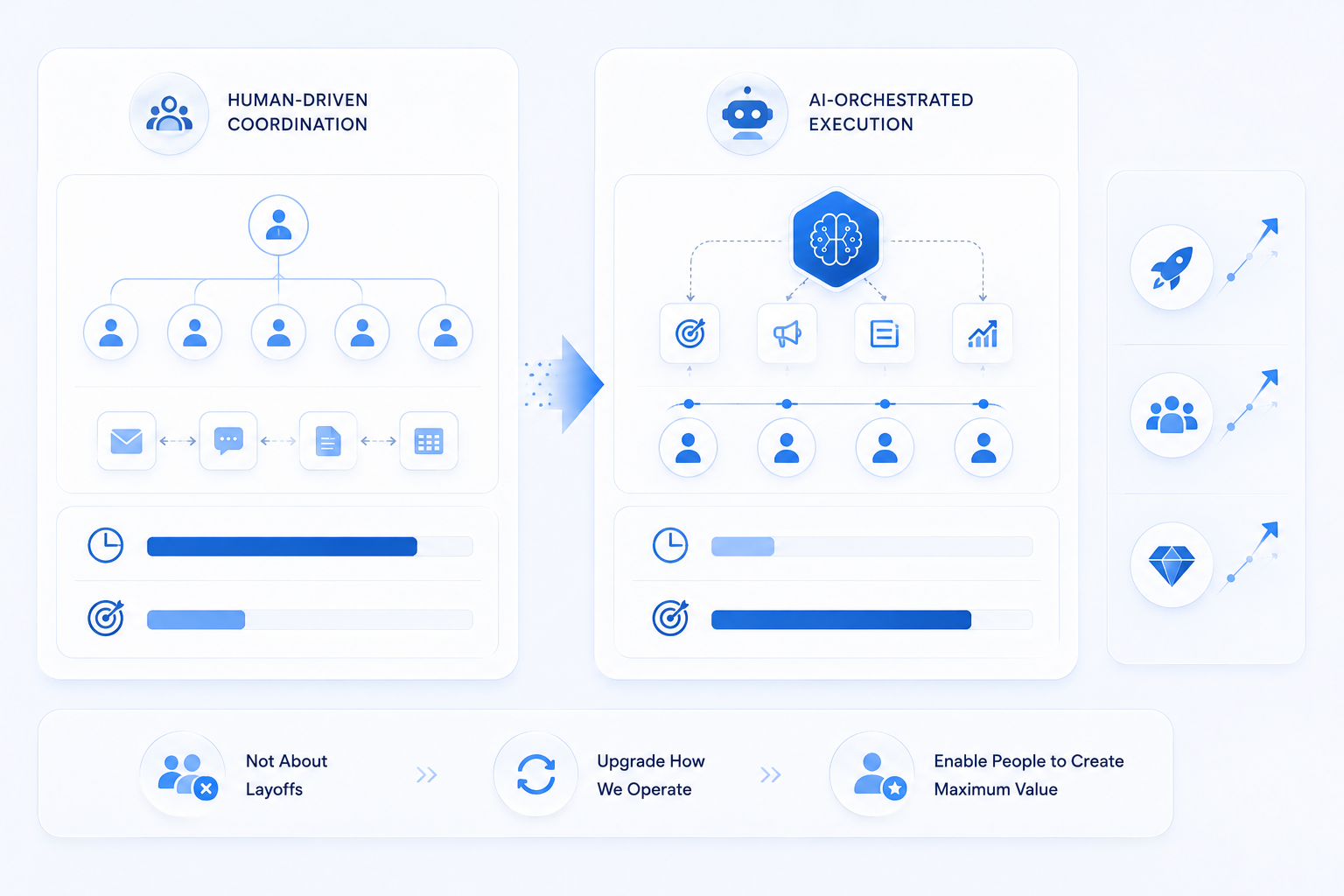
As workflows and organizational structures evolve, executives will inevitably face team redesign. The organization gradually shifts from a human-driven coordination model to an AI-orchestrated execution model. Generally, teams will spend less time on repetitive alignment and more time on high-leverage strategic work.
However, companies should remember that layoffs are not the core purpose of organizational transformation. The real challenge is not simply reducing headcount, but fundamentally upgrading how the organization operates and enabling people to contribute at their highest level of value.
Early Examples of AI-Native Organizational Shifts
Several large companies are already showing early signs of AI-native organizational change. These examples do not mean they have fully completed the transformation, but they show how AI is beginning to reshape workflows, roles, and operating models.
Amazon
Amazon is one of the clearest examples of a company linking AI adoption with organizational redesign. In a 2025 memo, CEO Andy Jassy wrote that generative AI and agents are already being used across shopping, advertising, AWS, customer service, fulfillment, inventory placement, demand forecasting, and robotics.
More importantly, he argued that AI agents would “change the way our work is done,” allowing Amazon to focus less on repetitive work and more on strategic invention. He also stated that Amazon expected AI-driven efficiency gains to reduce its total corporate workforce over the next few years.
This shift later became visible in Amazon’s restructuring actions. In October 2025, Amazon announced an overall reduction of approximately 14,000 corporate roles, describing the move as part of an effort to reduce bureaucracy, remove layers, increase ownership, and become organized more leanly in response to the speed of the AI era. Media reports also connected the cuts to Amazon’s broader AI push and its attempt to operate with fewer layers and faster execution.

Duolingo
Duolingo offers a more direct example of an "AI-first" organizational shift. In April 2025, the company publicly described itself as becoming an AI-first company and said it would gradually stop using contractors for work that AI could handle. Reports also noted that Duolingo planned to make AI usage part of hiring and performance evaluation, signaling that AI was becoming part of the company’s operating expectations rather than just a product feature.
Soon after, Duolingo announced the launch of 148 new language courses, more than doubling its course offerings. The company said generative AI, shared content systems, and internal tooling allowed it to create nearly 150 courses in about a year, compared with roughly 12 years to build its first 100 courses. (Duolingo official announcement, )
After public backlash, Duolingo's CEO clarified that he did not see AI as replacing employees and said the company was still hiring. Still, the case shows how AI can restructure the production model of a company: content creation, quality validation, and operational workflows were redesigned around AI-enabled systems.
Together, Amazon and Duolingo show that AI-native transformation is emerging unevenly. It is not simply a matter of adding AI features to products. The deeper shift is happening inside the organization: fewer layers, more automated workflows, new expectations for employees, and operating systems built around AI-assisted execution.
Rethinking Organizations for the AI Era
The transition toward AI-native organizations is a fundamental rethinking of the "firm" as a concept. It will not happen overnight, but for leaders, they should begin preparing now.
Companies must start rethinking:
-
workflows
-
decision systems
-
management structures
-
operational transparency
-
information architecture
-
talent expectations
In the AI era, competitive advantage may no longer stem primarily from company scale, but from organizational velocity. Ultimately, this velocity depends on how efficiently information flows through the system.
Those who master this flow will not just operate faster, they will redefine what is possible in business. But as organizational speed and adaptability become increasingly important, companies that rethink their workflows early may gain meaningful long-term advantages.
Whether the shift feels daunting or exciting, the transformation is already unfolding around us. It is an invitation to rethink how we collaborate and to embrace the future of organizational intelligence.

Author
Damon Liu
Marketing Manager
Hello everyone! I'm part of the Editorial Team at Moka AI, where I focus on global content, including writing and editing in-depth insight articles. I love exploring new ideas, discovering new tools, and finding fresh perspectives. My goal is to create content that’s genuinely valuable and helpful for HR professionals, while keeping it engaging, relatable, and fun to read!