Key Takeaways
- Customer: Bayer is a global life science company headquartered in Germany, with Pharmaceuticals, Consumer Health, and Crop Science divisions and approximately 88,000 employees worldwide.
- Challenge: Bayer's specialist roles lacked clearly defined and shared evaluation criteria. Recruitment data was disconnected from Bayer's Workday HRIS, compliance records and candidate consent were tracked by hand, and screening, interview notes, and reporting relied heavily on manual work.
- Solution: Bayer uses Moka AI's AI Interview Questions and AI Interview Summaries to capture interview evidence and refine role-specific evaluation criteria, and AI Screening to rank CVs against each role's criteria. Moka ATS integrates two-way with Workday, supports dedicated compliance fields and configurable candidate consent settings, and centralises recruitment reporting.
- Result: With Moka AI, Bayer has built shared, reusable hiring standards for specialist roles, reduced manual work across screening, interview feedback, and data entry, and gained clearer visibility of hiring progress across business divisions, while supporting the responsible use of AI in a regulated industry.
Background
Founded in 1863 and headquartered in Germany, Bayer is a global life science company focused on healthcare and agriculture. Its business spans three divisions: Pharmaceuticals, Consumer Health, and Crop Science, serving patients, consumers, and farmers worldwide.
Bayer combines a strong global presence with a sustained commitment to innovation. In the first nine months of 2026, Bayer generated €34.3 billion in sales and invested €4.4 billion in research and development, according to its Q3 2026 Quarterly Statement. With a global workforce of approximately 88,000 full-time equivalents, Bayer operates at substantial scale across healthcare and agriculture.
As Bayer's business grew, its recruiting teams faced a range of operational challenges, from establishing clear hiring standards to connecting recruitment with existing HR systems. To address these challenges, Bayer turned to Moka AI.
What Hiring Challenges Did Bayer Face?
Recruitment Data Was Disconnected from HRIS
Bayer's recruitment data and its Workday HRIS were not connected, leaving HR to reconcile data manually. When organizational and employee data fell out of sync with Workday, mismatched department, position, and approver details could send approvals to the wrong person or cause errors in offer letters. At onboarding, data had to be entered into Workday again, adding work and increasing the risk of errors in onboarding and reporting.
Specialist Hiring Lacked Clear, Shared Standards
Many roles Bayer recruits for are highly specialized, such as Medical Science Liaisons. These roles require multiple interview rounds to assess distinct competencies.
However, the insights HR and hiring managers gained from assessments were not systematically captured, so the capabilities, proficiency levels, and ideal candidate profile for each role were never clearly defined.
Without shared criteria, interviewers struggled to align their evaluations. HR also had to repeatedly clarify requirements with hiring managers when considering candidates for other roles, slowing candidate matching. Workflows, interview questions, and evaluation criteria had not been organised into reusable role templates either. Hiring for similar roles meant repeating the setup, adding work and delaying recruitment.
Compliance Records Were Hard to Track and Verify
In the highly regulated pharmaceutical industry, certain roles, such as medical representatives and practising pharmacists, may require professional licences, registration details, or training certificates, depending on local requirements. Bayer's teams maintained role-specific compliance information separately by hand. Records were easy to miss and hard to retrieve for verification or audits.
Bayer also needed a consistent way to inform candidates about AI use and record their consent. Without standardised notices and consent records, securing internal compliance approval for AI use remained a challenge.
Manual Work Slowed Screening, Feedback, and Reporting
Bayer's hiring process relied heavily on manual work, creating bottlenecks from initial screening to management reporting.
Screening large volumes of resumes left HR less time to engage candidates and work with hiring managers. Interviewers also had to write up their notes manually, delaying feedback and leaving candidates waiting longer for updates.
HR teams had to compile reports by hand, so HR leaders lacked timely hiring data, limiting their ability to track progress across business divisions and quickly identify issues.
How Did Moka AI Help Bayer?
Keeping Hiring Data in Sync with Workday
Moka AI was integrated with Workday through a two-way connection that automatically synchronises organisational and candidate data, with sync frequency adjustable to Bayer's operational needs.
This kept recruitment records aligned with Workday and reduced manual checks between systems. Bayer could configure local requirements directly in Moka ATS, including internal candidate handling, work-location mappings, and referral protection periods. These rules then applied automatically within the recruitment workflow.
Turning Hiring Experience into Clear Evaluation Criteria
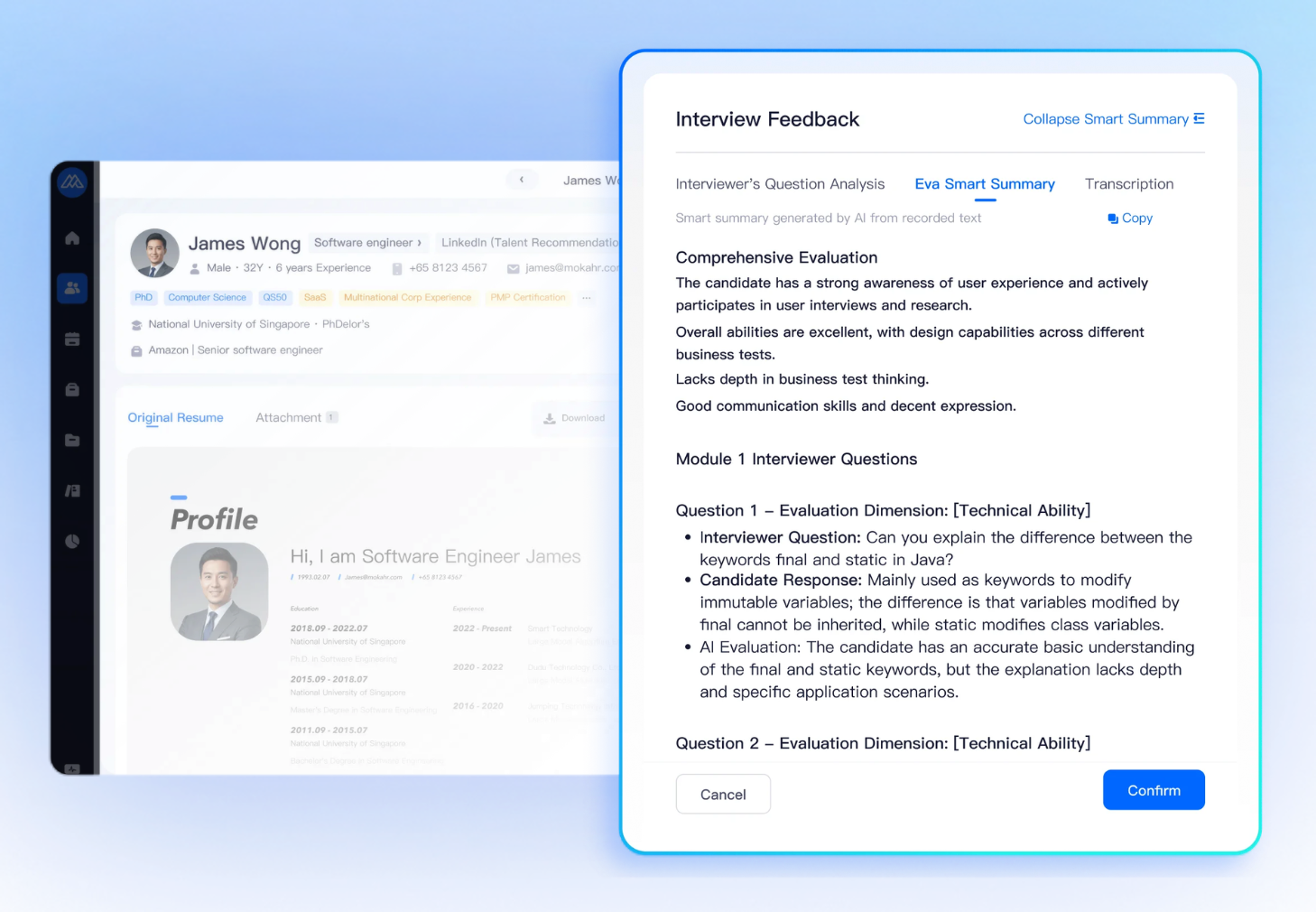
Moka AI helped Bayer develop shared evaluation criteria through AI Interview Questions and AI Interview Summaries. For specialist roles, AI Interview Questions helped interviewers assess role-specific competencies. AI Interview Summaries documented the assessment dimensions and competencies explored in each interview, preserving insights for future hiring.
The ATS stored interview records and feedback. HR and hiring managers could use this evidence to refine each role's evaluation criteria, clarifying the capabilities and proficiency levels expected of an ideal candidate. Over time, insights from individual assessments could evolve into clear, shared standards.
It also made other work easier. With assessment dimensions aligned across roles, HR could review a candidate's profile and feedback to judge their suitability for other positions, without checking with hiring managers. Building on the refined criteria, each business division could save workflows, interview questions, and evaluation criteria as reusable role templates, reducing setup time for similar openings.
Standardizing Compliance Records and Candidate Consent
Moka AI added dedicated fields for role-specific compliance information, such as medical representative registration details where applicable. Bayer teams could maintain and retrieve these records, reducing reliance on separate manual records. This supported Bayer's compliance processes for regulated roles.
Moka AI also provided configurable candidate consent settings, allowing Bayer to present privacy notices and AI usage explanations clearly to candidates and record their agreement. With documented consent available for internal compliance reviews, Moka AI underpinned Bayer's responsible use of AI in recruitment.
Accelerating Hiring with AI-Powered Capabilities
Moka AI helped Bayer reduce manual work at key stages of hiring, combining AI Screening and AI Interview Summaries with centralised reporting.
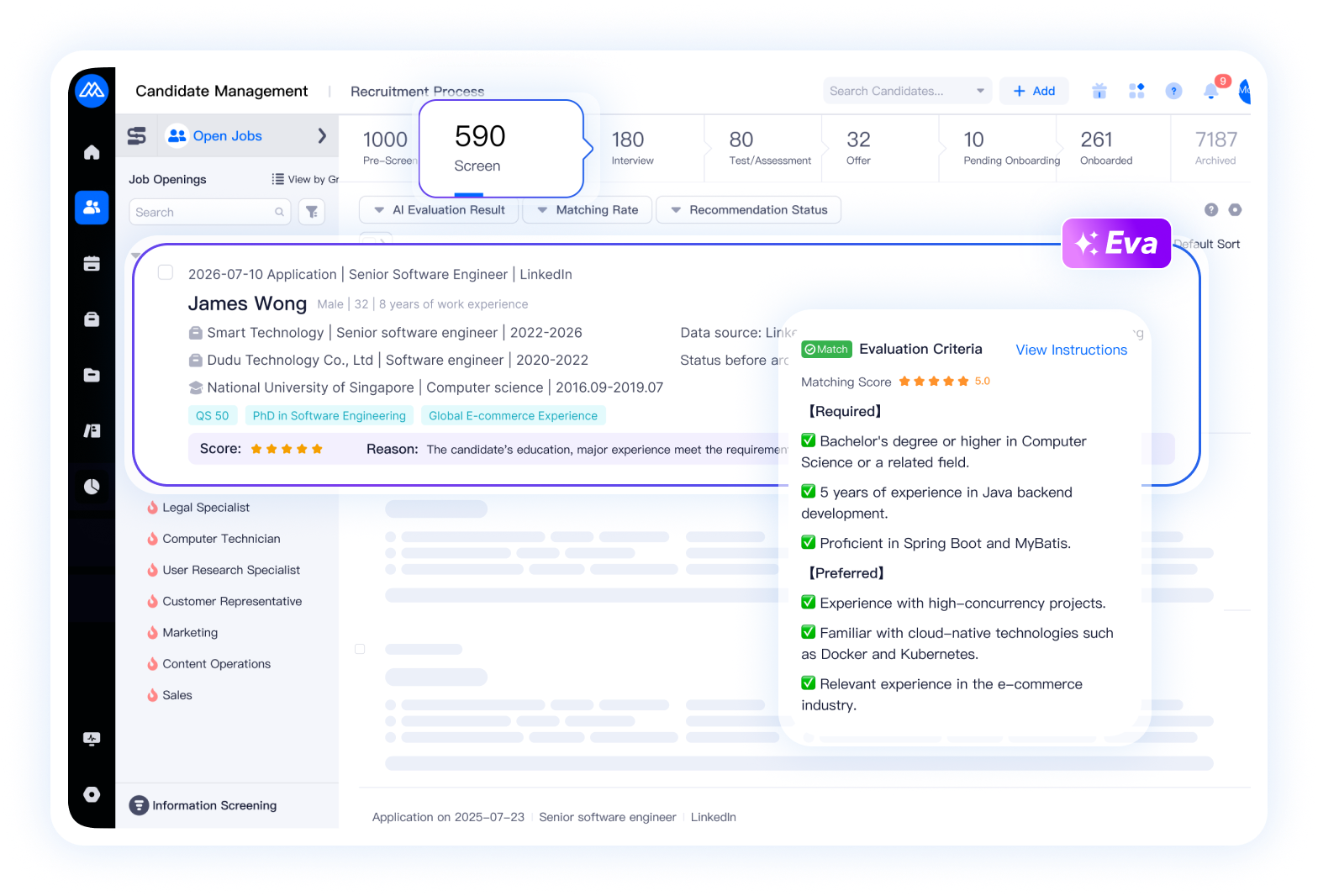
Bayer used AI Screening to review resumes against each role's established criteria and rank candidates by fit. This helped HR identify strong candidates and spend less time on initial screening.
AI Interview Summaries cut the time interviewers spent writing up notes. Interviewers could review the summaries and submit feedback on mobile, so candidates received updates sooner.
Bayer also brought interview scheduling, assessments, and reporting together on one platform. With less data to compile by hand, HR leaders gained a consolidated view of hiring progress across business divisions and could identify issues earlier.
What Changed for Bayer's Recruiting Teams?
Bayer brought recruitment across Pharmaceuticals, Consumer Health, and Crop Science together on Moka AI, connecting every stage from job posting to offer. By keeping organisational and candidate data aligned with Workday, teams reduced manual reconciliation and duplicate entry, freeing time for hiring.
Shared evaluation criteria, reusable role templates, and consolidated reporting further improved coordination and visibility across divisions. Together, these improvements provided a stronger recruitment foundation aligned with Bayer's Dynamic Shared Ownership (DSO) transformation.
What Can Other Companies Learn from Bayer?
In specialist hiring, an organisation's most valuable asset is often the judgement its interviewers build over time, yet that judgement rarely outlasts a single hiring decision. Bayer's experience points to a different role for AI in recruitment: not replacing human judgement, but making it visible, consistent, and reusable across teams.
For organisations in regulated industries, the lesson is clear: the real return on AI comes not only from saving time, but from turning individual expertise into lasting organisational capability.

Author
Damon Liu
Marketing Manager
Hello everyone! I'm part of the Editorial Team at Moka AI, where I focus on global content, including writing and editing in-depth insight articles. I love exploring new ideas, discovering new tools, and finding fresh perspectives. My goal is to create content that’s genuinely valuable and helpful for HR professionals, while keeping it engaging, relatable, and fun to read!