Open engineering roles are up 44% since January 2024, while engineering hires are down 17%. That gap is the clearest signal in the latest tech job market data for hiring teams planning 2027.
This article reads the data, which runs to late 2026, from the employer side and asks what it means for tech hiring trends in 2027. It is written for tech employers and recruiters, not for job seekers.
The data comes from Lenny Rachitsky's report State of the tech job market: late 2026, published in Lenny's Newsletter on November 10, 2026.
It draws on two datasets: TrueUp, which tracks global job openings at more than 9,000 tech companies, and Live Data Technologies, which tracks hires, departures and promotions for 124 million professionals. The report's hiring figures are for the U.S.
We answer five questions in order: what the late-2026 data shows, what it means for tech companies in 2027, how it applies to tech hiring in APAC, where the tech job market is heading, and what recruiters and hiring teams can do next.
 Hiring plans for 2027 start with reading the latest market data against your own.
Photo: Vitaly Gariev on Unsplash, Unsplash License (https://unsplash.com/photos/3-gj1U72tiQ)
Contents
- What the late-2026 tech job market data shows
- What these numbers mean for tech companies in 2027
- What this data means for APAC tech hiring in 2027
- Where the tech job market is heading in 2027
- Five moves for tech hiring teams in 2027
- The planning question for 2027
1. What the late-2026 tech job market data shows
The six visible findings point the same way: demand is moving toward product managers and AI skills, and away from specialist roles, remote work and locations outside the Bay Area. All numbers below come from the report and describe the market as of late 2026. The Scope column shows whether a figure counts global openings, U.S. hires or job description text.
| Finding | Key number | Scope |
|---|---|---|
| PM demand is rising | More open PM roles than at any point in nearly four years; PM share of hires up from 16% (2021) to 21% | Openings global; hires U.S. |
| Engineering demand has stalled | Openings grew 29% through 2024, 15% through 2025, 2.5% over the past year; about 113,000 software engineers hired in the 12 months to April 2026, vs 239,000 at the 2022 peak | Openings global; hires U.S. |
| Design and UX research are shrinking | About 1,900 open product design roles, down 28% in a year; UX research hires down 66% from 2022 | Openings global; hires U.S. |
| AI skills appear in every role's job descriptions | "LLM" is the most-mentioned skill in PM job descriptions and has passed Java in engineering postings | Job description text |
| Roles are concentrating in the Bay Area | 15% of open tech roles; open Bay Area jobs up 43% in a year | Global openings |
| Remote roles are at a record low | 14% of open tech roles offer a remote option, down from 21% in late 2022 | Global openings |
Data as of late 2026. Source: Lenny's Newsletter, TrueUp, Live Data Technologies.
The report has a seventh finding: the tech job market is growing fast, but mostly outside of software. Its detail sits behind the paywall, so this article does not cover it.
2. What these numbers mean for tech companies in 2027
The next three sections read the table row by row: first the mix of roles, then the skills employers ask for, then where the jobs are. Sentences that start with "We expect" are our inference, not the report's.
2.1 PM up, engineering flat, design down: the role mix is shifting
Read together, the first three rows describe a change in the mix of roles, not only in volume. Tech companies are adding people who decide what to build and cutting specialist execution roles. Product management is the only one of five core roles whose share of U.S. hires grew, from 16% in 2021 to 21% in the latest data.
The gap with design keeps widening. Globally, there were 1.9 open PM roles for every open design role in early 2023, 2.6 earlier in 2026 and 3.8 now. In U.S. hiring, companies hired 2.9 PMs for every designer over the past 12 months, up from 1.9 in 2022. User research has shrunk further: about 1,800 U.S. hires over the past year, down 66% from 5,300 in 2022, and only 108 open roles at tech companies globally.
Engineering is changing from the inside. Demand for mobile and front-end engineers nearly halved in the past year, and the report's author attributes this to siloed disciplines collapsing as smaller teams take broader ownership, thanks to AI. New roles are appearing: forward deployed engineer openings rose 4.6x in a year to about 1,500, though the author notes some are rebranded sales engineer roles. Security engineering is one of the fastest-growing specialties, so specialists are not disappearing. The mix is changing.
For a company of 200 to 1,000 people, where every requisition counts, a role defined against the 2022 mix can tie up recruiting time on a profile the business no longer needs. We expect fewer requisitions for narrow specialist roles in 2027, and broader scope in each role that remains.

Smaller product teams are taking on broader scope. Photo: Mimi Thian on Unsplash, Unsplash License (https://unsplash.com/photos/IPBGKYnuz8Y)
2.2 AI fluency has become a baseline requirement in every function
AI skills now sit near the top of job descriptions in all three functions the report tracks, and the biggest change is in product management. Two years ago, the most-mentioned skills in PM job descriptions were SQL, Jira, AWS and Python. Today "LLM" is the most-mentioned skill, "Claude" is third, Cursor, OpenAI and MCP are in the top eight, and "evals" is in the top ten.
In engineering and design, the core skills kept their place and AI terms moved in beside them. Python is still the most-mentioned engineering skill and is still growing, while "LLM" has just passed Java, which is declining, and Kubernetes is holding its ground.
In design, Figma is still first, but Claude became the second most-mentioned skill in spring 2026, passing CSS, and Cursor has also edged past CSS. These rankings count mentions in job description text, not the skills people actually have.
All three functions use tool names to say the same thing: the role now involves working with AI. That suggests many companies have not yet turned "uses AI" into a concrete output for the job. Here is one example definition (ours, not the report's): for a PM, "writes and runs the evals that decide whether an AI feature ships." We expect the tool names to keep changing in 2027, and requirements written around them to date quickly.
2.3 Location is a hiring constraint again
Location is back as part of the role definition. Just 14% of open tech roles offer a remote option, the lowest on record and down from 21% in late 2022. Engineering fell from 25% in late 2022 to 14%, and design from 34% to 19%, while PM has held at about 21% for two years.
Roles are concentrating at the same time. The Bay Area holds 15% of open tech roles, and the number of open jobs there is up 43% from a year ago. One in four open PM and design roles, and one in five engineering roles, are based there. There are now more open PM, engineering and design roles in the Bay Area than remote roles globally. Four years ago, remote led by almost two to one.
For hiring teams, the location policy now belongs in each role definition, because it sets the size of the candidate pool. We expect office-centred hiring to remain the norm in 2027.
3. What this data means for APAC tech hiring in 2027
The previous section covered what kind of people tech companies need. This one asks what changes when you hire them in APAC. The report has no APAC breakdown, so everything below is our inference, and each point comes with a way to check it against your own data.
3.1 How far the data applies in APAC, and what is different here
The report measures two different things.
Openings come from TrueUp, which tracks global job openings at more than 9,000 tech companies. Hires come from Live Data Technologies, and the report states that its hiring numbers are for the U.S. There are no figures for Singapore, Malaysia, Indonesia or Hong Kong.
Our reading is that two signals are likely to carry over. The skill rankings come from job description text across global openings, and the author attributes the shift in role mix to AI letting smaller teams own more, a cause that does not depend on geography. Bay Area concentration and U.S. hire counts should not be applied to APAC directly.
APAC hiring also differs from the market the report describes in four ways. It is several markets, not one: talent pools and employment rules differ across Singapore, Malaysia, Indonesia and Hong Kong. Candidates, CVs and interviews run in English, Chinese, Malay, Indonesian and other languages. Hiring someone in another country usually needs a local employing entity or an employer of record, and a work pass if the person relocates.
And regional teams often reuse headquarters' job description and assessment templates, while each country's hiring data sits with its local team. The next three sections use these differences to read the data.
To check, pull three numbers from your ATS for each country rather than the region as a whole: open requisitions by job family, hires by job family over the past 12 months, and the share of remote roles. If each country keeps its data in a different system, align the definitions first.
 Singapore is one of several APAC markets, each with its own talent pool and employment rules.
Photo: j. (@ja_heic) on Unsplash, Unsplash License (https://unsplash.com/photos/MoHiHN4mmOE)
3.2 PM up, engineering flat, design down: what to expect in your 2027 hiring plan
Product managers. Global PM openings have grown 56% since the start of 2023, against 43% for engineering, and there are more open PM roles than at any point in nearly four years. The author reads this as growing demand, with great PMs getting harder to land. In APAC, product roles that serve local users usually also need knowledge of that market and its language.
For APAC teams, one plausible reading is that the pool of qualified PMs is narrower than the global figures suggest, so PM requisitions may stay open longer. To check, compare average days open for your PM and engineering requisitions, and see whether PM roles with a language requirement stay open longest.
Engineers. Global engineering openings grew 29% through 2024, 15% through 2025 and 2.5% over the past year, and the report counts more than 65,000 open engineering roles. Demand is flat, not falling, and engineering talent pools differ in size from city to city across the region.
For APAC teams running regional R&D, we would expect slower headcount growth and a higher bar per role, with specialist roles such as mobile and front-end the first to review (see the role mix). The same role may fill differently in different cities. To check, track engineering requisitions over the past four quarters by city, and the share that are specialist roles.
Designers. Global product design openings stand at about 1,900, down 28% in a year. For APAC teams, the likely effect is that experienced designers are easier to reach than in 2022, an opportunity for employers still hiring them. The role has changed too, with AI tools now in design job descriptions (see AI as a baseline). To check, look at applicant numbers and seniority for your design roles over the past two quarters.
For your 2027 plan, set time to fill expectations by job family, then by market, rather than using one regional average.
 Set hiring expectations by job family and by market, not by one regional average.
Photo: Van Tay Media on Unsplash, Unsplash License (https://unsplash.com/photos/Hh-PIe3qIug)
3.3 AI skills in every job description: should AI fluency be a core hiring criterion?
Yes, as one of the core criteria for product, engineering and design roles. All three functions now put AI terms near the top of their job descriptions: "LLM" leads PM listings and has passed Java in engineering, and Claude ranks second in design (details above).
It should be one criterion, not the only one. Python is still the top engineering skill and still growing, and Figma still leads in design. AI skills sit on top of each role's core skills, so a scorecard needs both.
For APAC teams, our reading is that headquarters templates will carry these requirements into the region, because the rankings come from global job descriptions and regional teams often reuse those templates.
AI tool access can differ by market and by employer, so copying tool names from a headquarters JD risks screening out qualified people. Write the criterion as a capability, such as "uses AI to draft and check a product spec," not as a list of tools.
Language matters as well. CVs and interviews run in several languages, and matching on English tool names is less reliable on non-English CVs, so assess AI skills in the language the job is done in. To check, count how many of your JDs in each market include AI requirements, whether they came straight from a headquarters template, and whether your scorecards have a matching dimension.
We expect AI fluency to become one of the main things that separates candidates for the same role in 2027.
 Assess AI skills in the language the job is done in.
Photo: Muhammad Faiz Zulkeflee on Unsplash, Unsplash License (https://unsplash.com/photos/alw-CwGFmwQ)
3.4 Fewer remote roles: what it may mean for APAC talent supply
Globally, just 14% of open tech roles now offer a remote option, down from 21% in late 2022, while the Bay Area alone holds 15% of open roles (details above).
Heading into 2027, one possibility is that fewer overseas remote roles are open to APAC candidates, and more people with experience in international teams look to local employers. This is our inference: the report has no data on APAC remote workers or where they move next.
For companies hiring in Singapore, Kuala Lumpur, Jakarta and Hong Kong, location was never optional. Hiring across borders in the region usually needs a local employing entity or an employer of record, and a work pass for anyone who relocates, so a "remote" role in APAC rarely means you can hire in any country.
A global shift back to offices therefore changes less for these teams, but each requisition should state the work location and the country of the employing entity. To check, review applicants in each market over the past two quarters and see whether the share whose last job was remote for an overseas employer is rising.

Hiring in another APAC market usually needs a local entity or an employer of record. Photo: Muhammad Faiz Zulkeflee on Unsplash, Unsplash License (https://unsplash.com/photos/Id8nQt_plK8)
4. Where the tech job market is heading in 2027: three shifts to plan for
The three shifts below do not belong to any one role. They are changes in how the whole market hires. As in section 2, sentences that start with "We expect" are our inference.
 Each shift comes with a question you can answer from your own hiring data.
Photo: UX Indonesia on Unsplash, Unsplash License (https://unsplash.com/photos/8mikJ83LmSQ)
4.1 More open roles, fewer hires: strong candidates are harder to land
Since January 2024, open engineering roles have risen 44% while engineering hires have fallen 17%. The author's conclusion is that even as demand slows, landing great engineers is getting harder.
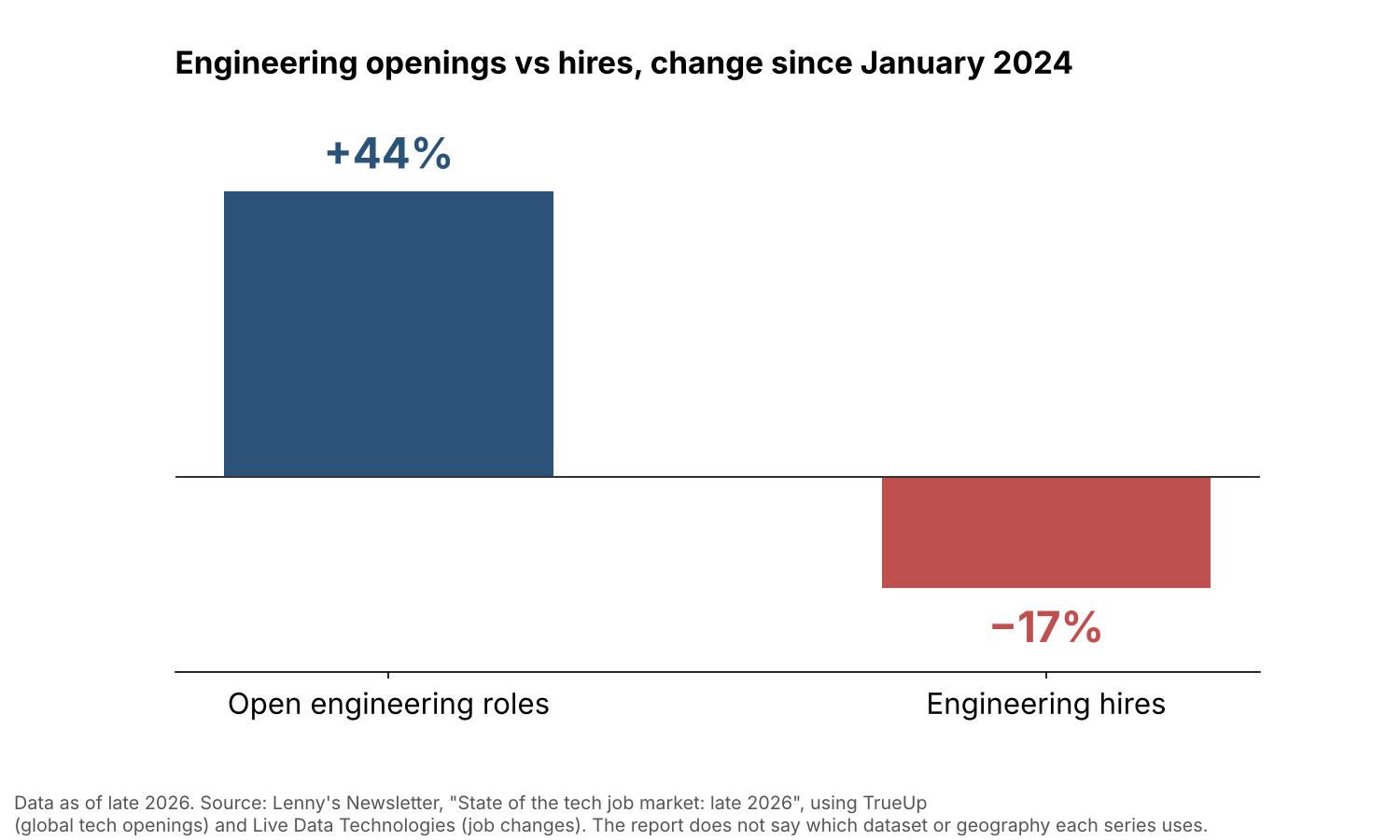 Engineering openings and hires since January 2024. Data as of late 2026; source: Lenny's Newsletter.
PM shows a similar gap. There are more open PM roles than at any point in nearly four years, while hiring for every core product role has been flat or declining, with PM holding up best. The author reads this as growing demand for PMs, with great PMs harder to land.
The report does not explain the gap. It also does not say whether both series cover the same geography (see how far the data applies).
One reading consistent with the data is that part of the gap is a matching problem. We expect technical roles to stay hard to fill in 2027 even if demand stops growing. At least three explanations fit the numbers: requisitions stay open without pressure to close them; requirements have changed, so fewer candidates qualify; or hiring processes have become longer.
Requisitions staying open longer is only one of these possibilities, and the report cannot tell you which applies to your team.
Many teams cannot say where a requisition is stuck, because their funnel data has gaps between tools and stages. To check: how many days does a technical requisition stay open now, compared with 12 months ago, and at which stage does it stall?
4.2 Keyword screening fails when every JD and every CV says "LLM"
On the employer side, AI terms now sit near the top of job descriptions in product, engineering and design (details above).
On the candidate side, a Gartner survey of 3,290 job candidates in late 2024 found that 39% used AI during the application process, most often to generate CV text. Gartner also predicts that by 2028, one in four candidate profiles worldwide will be fake (Gartner, July 2025). In a Gartner survey of 3,000 job candidates in the second quarter of 2025, 6% admitted to taking part in interview fraud.
We expect keyword screening to lose more of its value in 2027. Candidates read the same job descriptions, so their CVs repeat the same terms back. When the JD says "LLM" and the CV says "LLM," a keyword match tells you little about who can do the work. The report does not discuss CV fraud; linking the two trends is our reading.
In our view, structured scoring and work samples now separate candidates better than keyword matches. As roles broaden, gut feel gets less reliable, and interviewers without a shared rubric score the same answer differently. To check: last quarter, how many candidates who passed CV screening were rejected in the first technical interview?
4.3 Recruiter capacity becomes the bottleneck
Companies are hiring recruiters again. Open recruiter roles are up nearly 300% since mid-2023, and the author reads this as a possible leading indicator that engineering hiring will pick up.
Even on a plateau, engineering hiring is large. More than 120,000 engineers were hired in the U.S. in 2025, and the report counts more than 65,000 open engineering roles.
We expect experienced recruiters to get harder to hire in 2027. That has two consequences for mid-sized companies. Adding recruiters will cost more and take longer. And if engineering hiring does pick up, capacity needs to be in place before the requisitions arrive.
For most teams, part of that capacity already exists but goes to admin: switching between tools, copying data, chasing interview slots. Every hour moved off admin goes back to sourcing and candidate conversations. To check: how many hours a week do your recruiters spend on scheduling and status updates?
5. Five moves for tech hiring teams in 2027
The order matters: first see where things stand, then change how roles are defined and assessed, then free up capacity. Start before your 2027 headcount plan is final.
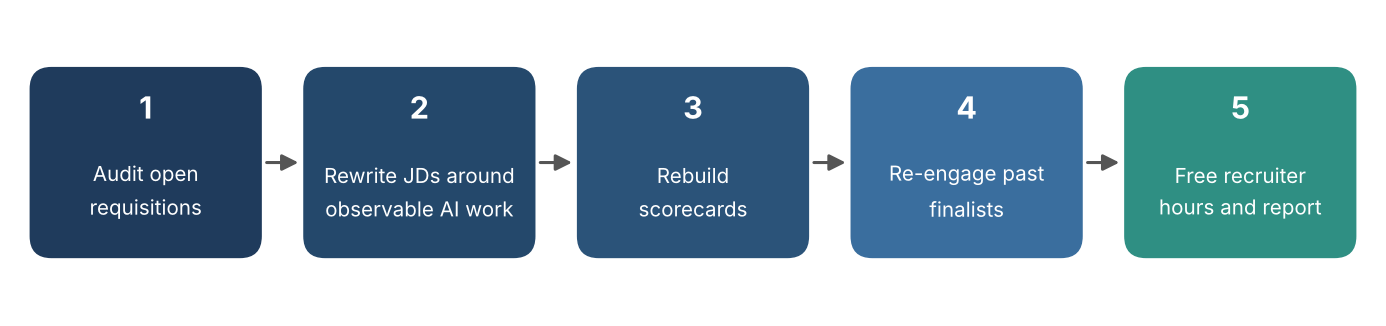 Five moves, in the order to run them.
5.1 Audit every open requisition by age and stall stage
This audit comes first because it sets the priority for the other four moves.
What to do: Export every open requisition, sort by days open, and note the stage each one is in and how long it has sat there.
How to read it: Requisitions stuck before screening point to the candidate pool or the JD. Requisitions stuck after interviews point to the assessment criteria or the hiring decision. Close any requisition that is no longer a real hire.
What you get: A one-page table for the business and finance that shows each stalled requisition and turns the delay into cost, such as weeks of unfilled work. If your ATS has recruitment analytics and reporting, build the table there so it updates itself.
Where it goes wrong: Averages hide the few requisitions that have been open for months. Read the list line by line.
5.2 Rewrite job descriptions around observable AI work
Replace tool lists with observable outputs, and your screening criteria will separate candidates again.
What to do: Start with the requisitions from your audit that stall at screening, and check each AI requirement. Begin with PM roles, where section 3.2 suggests qualified candidates may be hardest to find in APAC (see above).
Data you need: Your current JDs, and the screening pass rate for each requisition from the audit.
How to rewrite it (an example, not from the report):
-
Before: "Experience with LLMs."
-
After: "Has shipped at least one feature that uses an LLM, defined how output quality was measured, and can walk us through the evaluation results."
Where the line sits: Tool names can stay as nice-to-haves, never as screening criteria. The tools will change; the output you need will not.
To start from a draft, a free JD generator writes a job description in seconds for you to edit, and can publish it to job boards across Southeast Asia and Hong Kong.
5.3 Rebuild scorecards for broader roles
Broader roles need new scorecards, plus one work sample that shows how a candidate works with AI.
What to do: For each role you rewrote, list the scoring dimensions and write down what "strong" and "not enough" look like for each one.
Data you need: Interview feedback on recent hires and rejections for each role, to see which dimensions actually predicted the outcome.
Add a work sample: Give candidates one task to complete with AI tools during the interview. Score their judgment and how they check the output, not how fluent they are with a particular tool.
Run it the same way every time: Every interviewer uses the same scorecard and submits it on the day of the interview. AI interview tools that let you define competencies once per role can keep first rounds consistent.
Where it goes wrong: Scorecards with too many dimensions get ignored or filled in by habit. Keep them to four or five.
5.4 Re-engage past finalists before opening new sourcing
Your fastest source of candidates is the people who already reached your final round.
What to do: Find candidates from the past 12 to 18 months who reached the final round but were not hired, and reassess them against your new role definitions.
Data you need: Final-round candidates in your ATS, with the reason each was not hired and whether they agreed to be contacted again.
Why now: U.S. design hires over the past year were less than half the 2022 level, and UX research hires were down 66%, so experienced people are on the market (our inference; see the role types).
How to do it: Tell them what has changed in the role instead of sending a template. Contact them on the channel they actually use, which in APAC is often instant messaging rather than email, and log the outcome in your system.
 Past finalists already know your company and your process.
Photo: Vitaly Gariev on Unsplash, Unsplash License (https://unsplash.com/photos/jEpZNyFSQwQ)
5.5 Free recruiter hours and report the cost of open roles
Hand repeat work to automation, keep hiring decisions with people, and report the cost of open roles every month.
What to do: List the tasks your recruiters repeat each week, such as interview scheduling, status updates and checking details during first-round screening, and decide which ones can be automated.
Data you need: One week of recruiter time logged by task, plus the table from your audit.
Where the line sits: People keep the hiring decision. Automation moves candidates through the process; it does not decide who gets hired.
What to report: Each month, share open requisitions, average days open and where requisitions stall with the business and finance, using the table from your audit.
Moka AI's hiring agent, Moka Eva, parses resumes in 19 languages across APAC and includes a WhatsApp Agent for candidate engagement. Eva is designed as decision support: final hiring decisions stay with people.
The planning question for 2027
The late-2026 data does not tell tech employers to hire more or to hire less in 2027. It tells them roles have changed: broader scope, AI as a baseline, location back in the job definition. Hiring processes built for the 2022 role model will keep producing long-open requisitions and weak screening signals until they change as well.
If you do only one thing, start with the requisition audit. It shows which of the other four moves is most urgent for your team.
To rewrite your first JD around observable AI work, try the free JD generator. To see how recruiter admin can be automated while people keep every hiring decision, request a Moka AI demo.

Author
Damon Liu
Marketing Manager
Hello everyone! I'm part of the Editorial Team at Moka AI, where I focus on global content, including writing and editing in-depth insight articles. I love exploring new ideas, discovering new tools, and finding fresh perspectives. My goal is to create content that’s genuinely valuable and helpful for HR professionals, while keeping it engaging, relatable, and fun to read!