Your 2026 HR Leadership Priorities: Know and improve Hiring Velocity Metrics

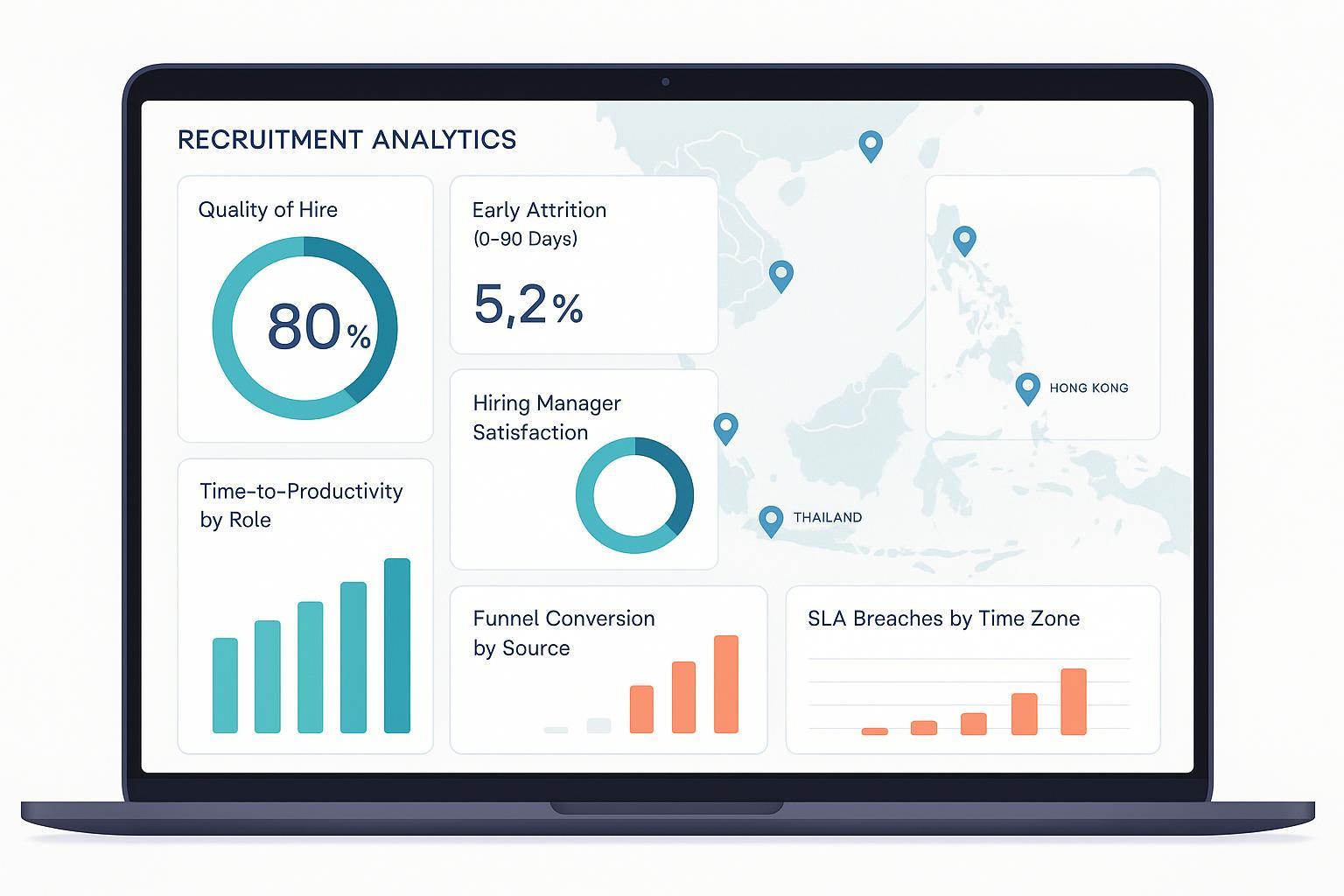
How is your future plan for the 2026 hiring going? It is absolutely difficult for some of the newly-promoted CHROs to manage between loads of hiring metrics. Hiring velocity, however, after your reading this passage, must have become one of the priorities that matter a lot.
Does Hiring Velocity = Time-to-Hire?
Okay, here is the question: Does the hiring velocity have the same meaning as the other hiring metric, for example, Time-to-Hire?
Do some counting and measure the hiring velocity
From Ben Schwencke, you can get a formula:
Hiring Velocity=Hiring-Numbers/ Time-to-hire
That is to say, if your teams had 550 openings, and you had to fill them in four months, while the time-to-hire was 40 days, then the hiring velocity would be 550/40=13.75.
And, as he said, the lower the number, the slower the hiring process.
Another counting way that has been noticed was from Julija Veljkovic. This one would be easier to reach, as it only relates to subtraction. It looks like this:
Hiring Velocity=Filled positions - Open positions
In the example above, the hiring velocity needs to be counted after making clear how your team's process is going. If you successfully hired 30 people with 520 positions opening, then your hiring velocity would be -490. The bigger the number, the higher the hiring velocity.
There are multiple ways to do countings like these, but you can simply choose one that looks more accurate and reliable for you.
For C-suits: learn about hiring velocity meanings
Leaving all numbers and countings aside, the differences between hiring velocity and time-to-hire are more likely to refer to different brackets.
When you turn to time-to-hire metrics, you simply notice the time it takes to fill a position, and also, how much time your team spent in sourcing suitable candidates for ONE position.
When you look for hiring velocity(also known as "recruitment velocity"), you will put more attention on the broader trends, making you better prepared for the next to-do lists and hiring priorities.
Tips: It is more about whether the talent is acquired quickly enough to meet your TA team's goals and aligns with your ROI.
How Can a CHRO Improve Hiring Velocity

Technology aspect to improve recruitment velocity
Introducing technology, of course, you will jump to this conclusion. As the ATS(applicant tracking system) service is no longer a novel choice, it is an absolutely quick and safe way to do.
But is that enough?
More PRAGMATIC ways for HR Leaders
For a hiring staff, whose job is to prompt better job descriptions, reach for possible candidates, and parse resumes, introducing an automated ATS would be a great idea for a C-suite or a hiring manager, who often requires deeper thoughts.
Passages tell you about improving candidate experience, building a stronger employer brand, or looking for recruitment agencies that are qualified. No clear instructions, no new ideas or sustainable tips, especially for team leaders.
Let's start with refining your hiring process.
As you already know thoroughly about your existing hiring process, list all the steps your team used in choosing and reaching a candidate.
Then choose a random step, ask yourself a question: why should we use this step to rank/evaluate/choose/reach a candidate? Rethink about the whole process if you can't answer it, as this step might be inappropriate or less accurate.
After that, turn to the interview structure.
If your team has already integrated with MokaHR, then it should have been an AI Interview Summary. Check the latest summaries from different team members, and pay attention to the interview structure, especially. If you found questions creating less suitable or less compatible effects for your recruiting profile and requirements, it's time to think about updating the team's interview structure, especially when multiple summaries have the same problem.
Finishing the steps above, it's time to inform your team.
Once you have decided to improve the process, you need to pay extra attention to notice all of your team members. The updates can only take off after comprehensive discussions. All small changes can make a huge difference, so keep an eye on the following progress and also your team to see if anyone has a problem in developing new ways.
Set periodical meetings or schedule to check and re-evaluate the hiring velocity after completing all these steps. But do not kick it excessively, as hiring velocity may not change sharply, and you need to find your own steps that depend on your company's hiring needs.

Summary
All in all, hiring velocity is a key TA metric, and compared to the time-to-hire, it provides further about the hiring demand and future trends. Finding suitable ways to improve your hiring velocity can undoubtedly help outperform last year's you and your team in 2026. Thus, the steps and tips above must be at the top of your HR priorities in this new, brave year.
With suitable technology hiring tools, including AI ATS like MokaHR, you can even reach better results in renovating your hiring process. See how MokaHR helps different enterprises with AI tech in our blogs.
Trusted by 30%+ of Fortune 500 for supporting 10+ hiring scenarios, MokaHR is serving 3000+ companies across industries like retail, biopharma, and smart manufacturing with tailored hiring solutions. Try to get a demo for your team.
FAQs
Does Hiring Velocity mean the same thing as Time-to-Hire?
No. Time-to-Hire: Measures the time spent filling one specific position.
Hiring Velocity: Measures broader trends, focusing on whether talent is being acquired fast enough to meet overall team goals and business ROI.
How can I calculate Hiring Velocity?
Two methods or more, depending on your preference: The Ratio Method by Schwencke or The Subtraction Method by Veljkovic, and so on.
How can leaders improve Hiring Velocity beyond just using software?
Focus on refining the human process:
Audit Steps: Review every hiring step; remove any that don't help you accurately rank or evaluate candidates.
Check Interview Structure: Review AI interview summaries to identify and fix questions that result in poor candidate matches.
Communicate: Ensure the whole team discusses and adopts these process updates together.
Why should C-Suite executives care about Hiring Velocity?
It moves the focus from operational details to strategic planning. Unlike simple time tracking, Hiring Velocity indicates if the company is scaling its workforce quickly enough to meet future demands and 2026 growth targets.
See Also
What Are Hiring Velocity Metrics and Why They Matter
Balancing Speed and Precision in Mass Hiring: How AI-Powered ATS Transforms Recruitment
The Ultimate Guide to AI ATS Solutions for Remote Teams in 2025
Understanding Job Satisfaction and Its Role in the Workplace
How Do Modern ATS Platforms Improve Hiring Speed and Candidate Quality
From recruiting candidates to onboarding new team members, MokaHR gives your company everything you need to be great at hiring.
Subscribe for more information

© Copyright 2025 MokaHR - All Rights Reserved.