Talent & Culture Strategy at DBS Bank: Building Asia's AI Workforce

This article is part of MokaHR's Talent & Culture Strategy series, which profiles how leading companies build their people strategies.
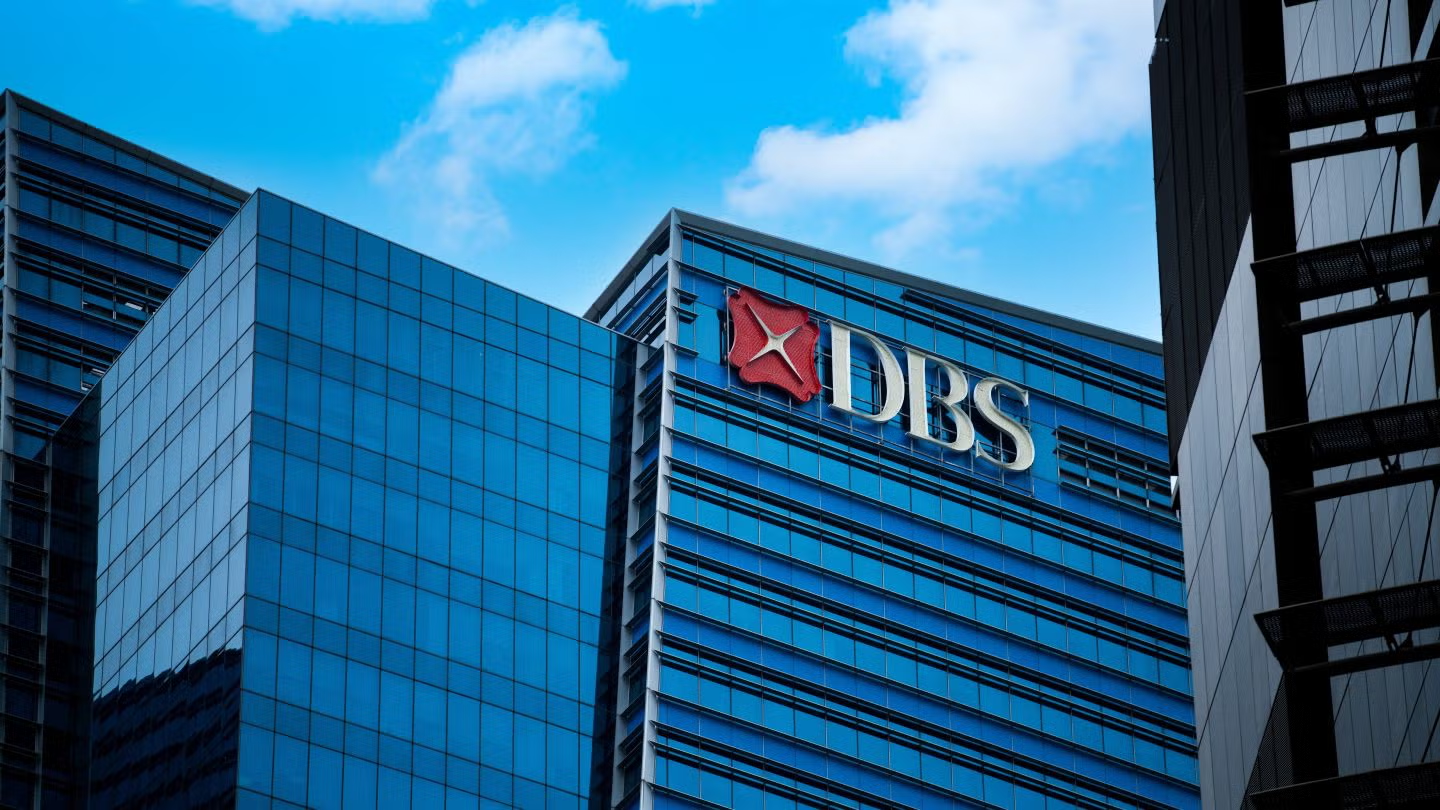
In 2009, DBS Bank ranked last among Singapore's major banks in customer satisfaction surveys. Staff called it "Damn Bloody Slow." When Piyush Gupta arrived as CEO that year, he identified the problem clearly: the bank's culture, technology, and talent strategy were all built for a world that no longer existed. Over the next fifteen years, what followed became one of the most studied corporate transformations in Asian banking history.
By 2024, DBS had posted a record net profit of SGD 11.4 billion — up 11% year on year — with a return on equity of 18.0%, among the highest for any developed-market bank globally. Total income reached SGD 22.3 billion, driven by wealth management fees, net interest income, and a rebound in markets trading. The bank had been named World's Best Bank by both Global Finance and Euromoney, World's Best Digital Bank by Euromoney, and World's Best AI Bank in 2025 by Global Finance. Its employee engagement score hit 90% in 2023, exceeding the Kincentric Best Employer benchmark. LinkedIn named it Singapore's top company for career growth for the second consecutive year. And in 2025, Tan Su Shan — the bank's new CEO and first female leader — took over a franchise that had grown its net profit fivefold and quadrupled its market capitalisation since 2009.
The through-line connecting all of this is not product strategy or interest rate cycles. It is a deliberate, CEO-sponsored decision to rebuild the bank's talent infrastructure around digital and AI capability — and to treat the workforce as a technology asset that requires the same investment rigour as any software platform.
Detail | Data |
|---|---|
Founded | 1968, Singapore |
Headquarters | Marina Bay Financial Centre, Singapore |
Employees | ~41,000 (2024) |
Net profit (FY2024) | SGD 11.4 billion (record; up 11% YoY) |
Total income (FY2024) | SGD 22.3 billion (up 10% YoY) |
Presence | 19 markets across Asia |
Employee engagement (2023) | 90% (Kincentric MyVoice; Best Employer benchmark exceeded) |
DBS's employer recognition reflects the breadth of its people investment. Beyond the Kincentric Best Employer designation for four consecutive years, the bank placed 12th on Singapore's Best Employers 2024 list by The Straits Times and Statista, was named Best Bank for Diversity and Inclusion 2024 in India by Euromoney Awards for Excellence, and was listed among India's Best Companies for Women by Avtar and Seramount for the ninth consecutive year.
How does DBS Bank attract and hire talent?
The talent philosophy: "act like a tech company"
DBS's hiring philosophy flows directly from a strategic framing that Gupta articulated in the mid-2010s: "At DBS, we act less like a bank and more like a tech company." The phrase was not marketing language. It corresponded to a genuine restructuring of how the bank competed for talent — no longer primarily against other banks, but against technology firms, fintechs, and consulting organisations for a pool of digital-native professionals who had little interest in traditional financial services careers.
This reframing required DBS to change what it was selling to candidates. Rather than competing on the traditional banking proposition of prestige and job security, the bank invested in creating a work environment that offered the challenge, autonomy, and technical resources that high-calibre technology professionals expected. The establishment of three technology hubs across Asia, the adoption of agile squad structures imported from software development, and the launch of annual hackathons that drew internal and external participants were all designed to signal credibly that DBS was a place where technical talent could do consequential work.
The succession of Gupta by Tan Su Shan in March 2025 is itself a talent signal. DBS ran a decade-long succession process that benchmarked internal candidates against external competitors, ultimately concluding that its strongest available leader had grown within its own walls. Tan Su Shan, who first interned at DBS before her career at ING Barings, Morgan Stanley, and Citigroup, rejoined the bank in 2010 and progressively expanded its wealth management, consumer banking, and institutional banking businesses before being named Deputy CEO in 2024. The process demonstrated what DBS preaches: that sustained internal development produces leadership quality that external search cannot easily replicate.
JIM: AI-native recruitment at scale
In 2018, DBS deployed what became Southeast Asia's first AI-powered virtual recruiter. Jobs Intelligence Maestro — JIM — was co-developed with Singapore startup impress.ai to address a specific problem: the bank needed to scale high-volume hiring of wealth planning managers across Asia at a quality bar that traditional screening could not maintain efficiently. The solution automated pre-screening questions, conducted psychometric assessments 24/7, handled 97% of candidate queries without human intervention, and generated a qualified shortlist for recruiter review.
The results were substantial. JIM reduced time-to-hire by 75%, saved the talent acquisition team up to 40 hours of recruiter time per month, and cut candidate dropout rates from 15% to 3% through a more seamless application experience. Resume assessment time fell from 30 minutes to 8 minutes per candidate. Candidate satisfaction with the process averaged 4.7 out of 5. The platform has since been deployed across six markets including Singapore, Hong Kong, China, Taiwan, Indonesia, and India, and has been extended beyond wealth planning roles to include the bank's Graduate Associate and SGUnited programmes.
Alongside JIM, DBS's HR team developed an AI-driven attrition prediction model that analyses data points including an employee's training activity, compensation history, leave patterns, and performance trajectory to identify early signals of departure risk — enabling proactive retention intervention. This was not built by a data science team handed a brief from HR. It was initiated by the head of HR, who had no technical background, creating an internal skunkworks group to identify where AI could add value in people operations. The outcome — cited by MIT Sloan Management Review as an example of senior leadership enabling functional AI experimentation — illustrates DBS's broader approach: digital transformation is not a technology project, it is a cultural instruction issued from the top.
This contrasts with the more centralised hiring model at Grab, which built its talent acquisition function around structured four-stage pipelines and brand-driven sourcing. Both approaches generate measurable outcomes, but DBS's AI-first method addresses the particular challenge of high-volume screening at multinational scale.
Internal mobility as retention infrastructure
In 2023, 30% of job openings at DBS were filled internally. This figure reflects a deliberate architecture — the bank's iGrow platform uses AI and machine learning to analyse each employee's skills profile and career aspirations, then recommends tailored development paths drawn from a catalogue of over 10,000 internal courses. The platform also surfaces job exposure opportunities and facilitates manager-led development conversations. Since its launch in India in 2023, iGrow has achieved a 77% employee adoption rate in that market, with over 85% of employees group-wide engaging with its career advisory functions.
The bank also operates iCoach, a generative AI tool that helps employees chart personalised upskilling roadmaps aligned to their current role and future career goals. These platforms collectively create a talent ecosystem in which the cost and friction of internal mobility are significantly lower than external hiring — which in turn raises retention by making growth within DBS a credible alternative to leaving for a competitor.
📄 2025 AI Recruitment Casebook DBS pioneered AI-powered recruitment in Asia — reducing time-to-hire by 75% and cutting candidate dropout rates from 15% to 3%. To see how companies across 10 industries are deploying AI in their hiring processes at scale, download MokaHR's full AI Recruitment Report. Download the free report →
Trusted by: Tesla · NVIDIA · McDonald's · Nestlé · Schneider Electric
How does DBS Bank develop and manage employee performance?
DigiFY and the digital literacy imperative
DBS's L&D infrastructure reflects the same logic as its recruitment strategy: building digital capability at scale is not an HR function, it is a strategic investment in the bank's core product. The DigiFY programme — launched as the foundational layer of DBS's workforce digitalisation — offers modular courses across three competency levels covering agility, big data, journey thinking, AI, blockchain, and operational risk and control. The curriculum is accessible via the DBS Learning Hub mobile app, allowing employees to progress at their own pace regardless of role or location.
DigiFY operates alongside DBS Academy, which provides more advanced, DBS-specific technical training for the bank's technologists. The Academy's curriculum is not a generic certification programme — it is built around DBS's actual infrastructure, codebase, and product architecture, making it a direct investment in the bank's institutional knowledge base rather than in individual employees' external market value. In 2024, DBS provided bespoke AI and data training to over 5,000 employees through tailored programmes, and has identified 12,000 staff for further AI and data upskilling in 2025.
The economic returns from this investment are now measurable. DBS reported that its use of AI across operations generated SGD 750 million in economic value in 2024, with the bank projecting this to exceed SGD 1 billion in 2025. By early 2025, the bank had deployed over 1,500 AI and machine learning models across more than 370 distinct use cases — from an 81% reduction in system incidents caused by technology changes (through AI-powered risk scoring of every change request) to personalised customer nudges reaching 13 million customers across the region with over 1.2 billion interactions.
Performance management: accountability embedded in leadership
DBS's approach to performance management attracted public attention in February 2024 when the bank disclosed that it had collectively reduced the variable compensation of its CEO and Group Management Committee by 21% following a series of digital service disruptions in 2023 — despite the bank recording record profits that year. The CEO's variable pay was cut by 30%, equivalent to SGD 4.14 million. The bank simultaneously committed SGD 80 million to a technology resilience roadmap to address the root causes of the disruptions.
This accountability architecture — where leadership compensation is directly linked to operational outcomes, not just financial ones — reflects a performance management philosophy that extends well beyond individual employee reviews. It signals to the organisation that accountability for customer experience failures is a leadership matter, not a technology team matter.
DBS HR metric | Data |
|---|---|
Employee engagement score (2023) | 90% (Kincentric MyVoice) |
Internal mobility (2023) | 30% of vacancies filled internally |
AI/data training (2024) | 5,000+ employees (bespoke programmes) |
iGrow platform adoption (India, 2024) | 77% of employees |
AI economic value generated (2024) | SGD 750 million |
AI/ML models deployed (early 2025) | 1,500+ across 370+ use cases |
JIM: time-to-hire reduction | 75% |
JIM: candidate dropout reduction | 15% → 3% |
At the employee level, DBS operates a continuous feedback mechanism called Anytime Feedback, which allows peers and managers to exchange developmental input without waiting for annual review cycles. The bank's Employee Experience Council, established in 2023, focuses on wellbeing, workload management, and assimilation support for new staff. Over 1,200 DBS employees serve as designated "culture-builders" — a network that communicates, gathers feedback, and organises programmes aligned to the bank's values and strategic goals.
What can HR leaders learn from DBS Bank's approach?
DBS's talent strategy is built for the specific conditions of a large financial institution undergoing technology transformation. But several of its underlying principles translate directly to HR teams in organisations of all sizes and sectors.
Treat digital upskilling as product development, not training administration. DigiFY and DBS Academy were not conceived as employee benefits or retention tools — they were conceived as infrastructure investments with expected returns. When Piyush Gupta set out to make every employee in a 40,000-person organisation capable of talking intelligently about AI and data, he was solving a product problem: the bank's competitive advantage increasingly depended on technology fluency distributed across the entire organisation, not concentrated in a data science team. HR leaders who frame L&D investment in the same economic terms — what capability gaps does this close, what business outcomes does that translate to — are more likely to secure the budget and leadership commitment that makes programmes like DigiFY possible. Platforms that provide workforce analytics and skills reporting can help HR teams build this business case by mapping current competency baselines against future role requirements.
Deploy AI in recruitment where it removes friction, not where it replaces judgement. JIM succeeded because it was applied to a well-defined problem: high-volume initial screening of candidates for structured roles in which evaluation criteria could be specified clearly. DBS did not attempt to automate senior hiring or cross-functional leadership assessment. The 75% reduction in time-to-hire and the 3% candidate dropout rate emerged from a narrow, deliberate implementation — not from an ambition to automate recruitment broadly. AI-powered screening tools produce the most reliable outcomes when the underlying role requirements and assessment criteria are defined with the same rigour that DBS applied to its wealth planning manager pipeline.
Use attrition prediction as a proactive retention system, not a reactive metric. DBS's AI-driven attrition model analyses training activity, compensation, leave patterns, and performance data to surface departure risk before it becomes a resignation. Most organisations measure attrition retrospectively — by counting people who have already left. The difference in these two orientations is the difference between a weathervane and a weather forecast. Building a predictive capability requires having the underlying data integrated in one place, which is why the quality of an organisation's ATS and HRIS data architecture determines how far it can advance on this trajectory. Recruitment analytics capabilities that connect hiring data with post-hire engagement metrics are the foundation layer for this kind of workforce intelligence.
Build succession as a decade-long process, not a crisis response. The Tan Su Shan succession is one of the most instructive aspects of DBS's talent strategy precisely because it received almost no coverage until the announcement. A ten-year internal development process, benchmarked against external candidates, produced a successor who had built three of the bank's major business lines and personally driven its digitalisation strategy. Organisations that begin succession planning when a vacancy appears are not doing succession planning — they are doing emergency recruitment with an internal bias. The DBS model requires sustained investment in identifying, developing, and stretching high-potential leaders across different functions and geographies — a process that cannot be shortcut.
What is it like to work at DBS Bank?
DBS's employee proposition has evolved significantly from its pre-transformation era. The bank's FutureForward Week, an annual event focused on innovation, learning, and employee development, reflects the extent to which workforce capability has become part of DBS's public brand. The 2024 edition featured engagement from Singapore government ministers alongside internal leadership, positioning digital and AI readiness as a shared national and organisational priority.
Day-to-day, DBS operates through agile "squads" — cross-functional teams that combine business, technology, and operations capabilities around specific customer journeys or product areas. This structure, adopted from software development methodology, is designed to accelerate decision-making and reduce the organisational silos that characterised DBS's pre-transformation culture. For employees with engineering or product backgrounds, the squad model offers the pace and cross-disciplinary collaboration of a technology company within the stability of a major bank.
The bank's benefits package includes banking privileges at preferential rates, a flexible spending wallet, share ownership schemes, sabbatical leave, job sharing options, and a suite of wellness programmes. The iTQ ("I Thank You") and WeTQ ("We Thank You") recognition platforms allow peer and leadership acknowledgement to circulate in real time rather than being confined to annual reviews.
The honest complexity in DBS's employee experience is the pressure of a high-performance, fast-moving environment. The digital service disruptions of 2023 — for which leadership accepted both public accountability and compensation reductions — also imposed significant stress on the technology and operations teams responsible for resolution. The 90% engagement score and the 30% internal fill rate suggest that most employees find the environment rewarding. But DBS's ambition to deploy AI across 370+ use cases simultaneously, while maintaining the operational stability that banking regulators and customers require, creates structural tension that is not always easy to navigate at the working level.
In 2025, DBS identified 12,000 employees for further AI and data upskilling — roughly 29% of its global workforce — signalling that the pace of capability transformation is expected to accelerate rather than stabilise. For employees who embrace that trajectory, DBS offers a career environment that is genuinely at the frontier of what enterprise AI adoption looks like. For those who find the pace demanding, the bank's internal mobility infrastructure and iGrow platform provide structured paths to roles that match different development priorities.
Frequently asked questions
How does DBS Bank hire employees? DBS uses a combination of AI-assisted screening and human evaluation across its recruitment pipeline. Its Jobs Intelligence Maestro (JIM) platform — co-developed with Singapore startup impress.ai — automates early-stage candidate screening, conducts psychometric assessments 24/7, and handles the majority of candidate queries without human intervention. For senior and specialist roles, DBS conducts structured interviews and cross-functional panel evaluations, assessing both technical capability and alignment with DBS's values and digital mindset.
What is the DBS DigiFY programme? DigiFY is DBS's bank-wide digital literacy curriculum, launched as part of its digital transformation from 2014. It offers modular courses across three competency levels — Novice, Novice Plus, and Intermediate — covering topics including agile methodology, big data, AI, blockchain, and journey thinking. Accessible via the DBS Learning Hub mobile app, the programme allows employees to learn at their own pace and has been supplemented by more advanced AI-specific training, with over 5,000 employees receiving bespoke data and AI training in 2024 alone.
Who is the CEO of DBS Bank? DBS Bank's Chief Executive Officer is Tan Su Shan, who succeeded Piyush Gupta in March 2025 following the conclusion of a decade-long succession process. Tan Su Shan is the first female CEO of DBS and previously served as Group Head of Institutional Banking and Deputy CEO. She joined DBS in 2010 and has been credited with driving its wealth management and consumer banking expansion, as well as operationalising the bank's digitalisation strategy.
What is DBS Bank's employee engagement score? In 2023, DBS recorded a Kincentric MyVoice employee engagement score of 90%, outperforming the benchmark for Kincentric Best Employers. The bank has been recognised as a Kincentric Best Employer for four consecutive years and placed 12th on Singapore's Best Employers 2024 list by The Straits Times and Statista. LinkedIn named DBS Singapore's top company for career growth for the second consecutive year in 2024.
Ready to build a data-driven talent acquisition and retention system at scale? MokaHR's AI-powered ATS enables structured screening pipelines, predictive recruitment analytics, and workforce visibility designed for enterprise HR teams. Book a personalised demo →
See also:
Talent & Culture Strategy at Grab: Data-Driven Hiring in Southeast Asia
Talent & Culture Strategy at TikTok Singapore: Hypergrowth Talent in Southeast Asia
Talent & Culture Strategy at Stripe: Engineering Culture and Analytical Hiring
From recruiting candidates to onboarding new team members, MokaHR gives your company everything you need to be great at hiring.
Subscribe for more information
© Copyright 2025 MokaHR - All Rights Reserved.