Key Takeaway
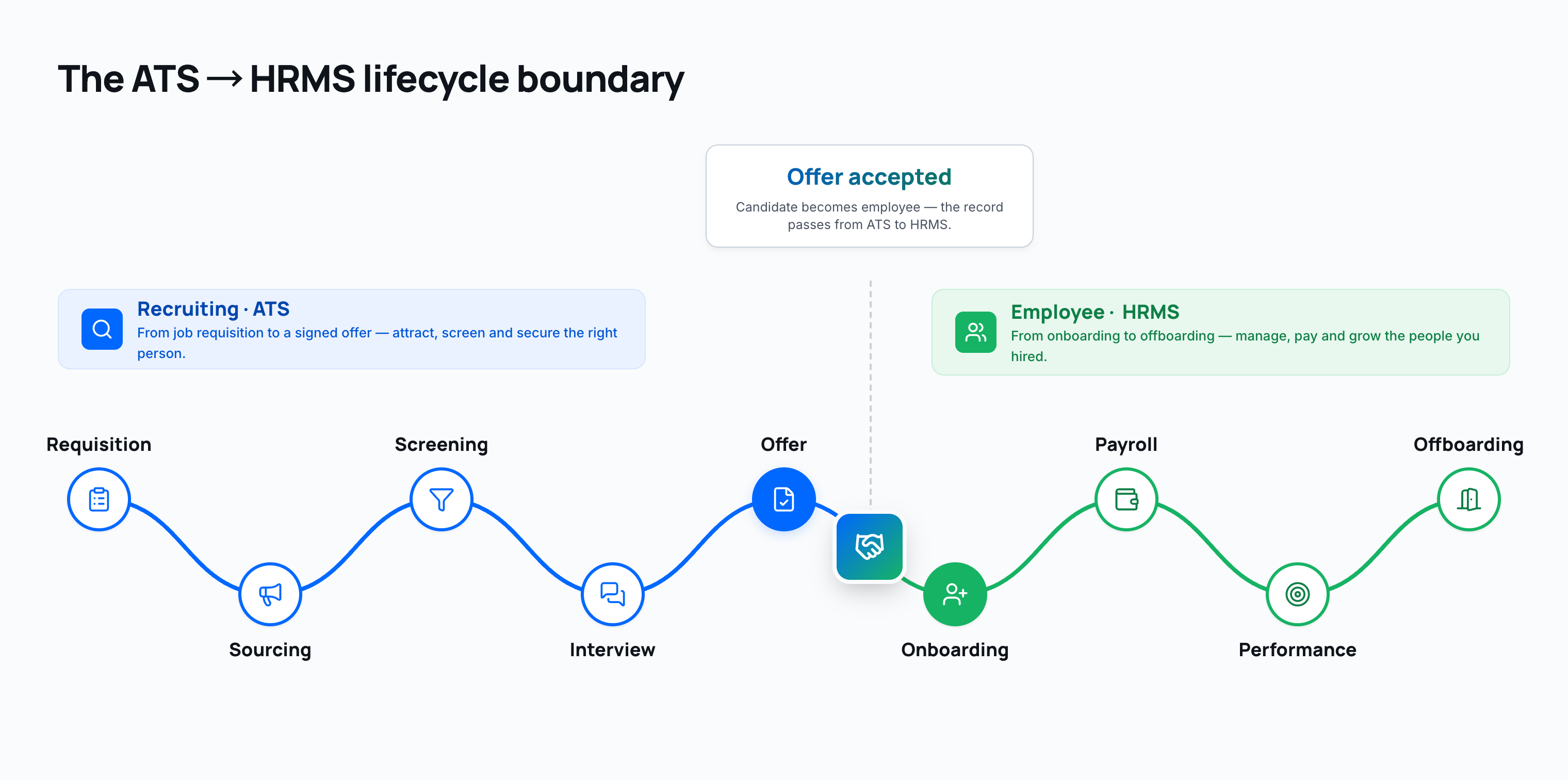
HRMS ≠ ATS. An HRMS administers employees you've already hired; an ATS runs everything before hire — sourcing, screening, interviews, and offers. Your HRMS begins where the ATS ends.
-
An HRMS recruitment module isn't a dedicated recruiting system. It handles basic hiring but may fall short at scale, where structured requisitions, multi-channel posting, AI screening, interview scorecards, pipeline visibility, and recruiting analytics matter.
-
Compliance now makes an ATS near-essential in Malaysia. Under the PDP (Amendment) Act 2025, penalties reach RM1 million, large or sensitive data volumes require a DPO, and qualifying breaches must be reported within 72 hours — making unmanaged CV folders a real liability.
-
The talent market is tightening as competition widens. Unemployment sits near 2.9% with ~195,000 vacancies, and Singapore draws from the same pool — so faster, more efficient hiring becomes a competitive advantage.
-
High-volume hiring in Malaysia is a different game, with frontline roles dominating and candidates arriving across fragmented channels and languages, requiring multi-language, multi-location, high-volume workflows.
-
The right ATS becomes a long-term hiring asset: A good ATS keeps candidate data secure, streamlines hiring, and adapts to Malaysia's multilingual, multi-location, high-volume hiring needs.
Your HRMS may already handle payroll, leave, and performance management. Once someone signs the offer letter, it takes over the employee lifecycle.
But what about everything that happens before they walk through the door?
Right now, your job requisitions might be sitting in an email thread. Your candidate lists are likely scattered across unformatted spreadsheets. Interview notes are probably buried in WhatsApp messages, while recruiters waste hours chasing managers for feedback — and hiring managers have zero visibility into where candidates actually stand in the pipeline.
👀 This is the blind spot many Malaysian employers overlook:
Your HRMS manages the employee lifecycle after they are hired, but the chaotic work of actually getting them hired happens entirely outside of it.
An HRMS manages your employees. An ATS helps you find and hire the right people. As hiring grows, having the right system becomes increasingly important for speed, security, and compliance.
This guide breaks down what your HRMS actually covers, why you need an ATS, and what to look for when choosing one in Malaysia.
HRMS vs. ATS: Where the Gap Begins
HRMS and ATS (Applicant Tracking System) are both part of the HR tech stack, but they solve different problems.
An HRMS focuses on workforce administration and the employee lifecycle. An ATS focuses on talent acquisition — helping companies find, evaluate, and hire talent more efficiently.
An HRMS manages people who are already yours. Everyone in it has an employee ID, a signed contract, an EPF number. The population is closed and verified, the data arrives once and changes slowly, and every record has to be exactly right — because payroll and statutory filings depend on it.
An ATS focuses on the other side of the equation: building your talent pipeline. It brings applications from every sourcing channel into one place. You can track every candidate from screening to interview to offer, while keeping their history for future roles. That means the talent you met last year is still within reach when the next opportunity opens.
Here's a quick look at the key differences between an HRMS and an ATS:
| Difference | HRMS | ATS |
|---|---|---|
| Purpose | Administering a workforce accurately and on time | Finding, moving, and keeping track of people you haven't hired yet |
| Focus | The employee lifecycle, from onboarding through payroll, leave, performance, and offboarding | The talent acquisition lifecycle, from attracting candidates through hiring |
| Core data | Existing employees and their employment records | Candidates, applicants, and prospective hires |
| What it optimises | Workforce administration and employee operations | Recruiting speed, candidate quality, collaboration, and hiring outcomes |
In Real Hiring Workflows
Many HRMS platforms include built-in recruitment modules. But a built-in module is not the same as a dedicated recruiting system. As hiring grows more complex and volumes increase, the gaps quickly become clear.
An all-in-one HRMS can handle the basics of employee management and recruitment. But real-world hiring demands purpose-built capabilities across screening, interviews, candidate engagement, and collaboration.
This is where an HRMS recruitment module may fall short, and a dedicated ATS makes the difference:
| Hiring Stage | HRMS | ATS |
|---|---|---|
| Job requisition | Basic approval or requisition workflows | Structured requisition, approval, hiring plan |
| Job posting | May support basic job posting | Multi-channel job posting and distribution |
| Candidate sourcing | Limited or basic | Sourcing across job boards, referrals, talent pools, etc. |
| Application management | Basic candidate records | Centralised candidate profiles and application tracking |
| Screening | Basic screening or resume review | Structured screening, automated workflows, AI screening |
| Interview management | Basic scheduling | Interview scheduling, scorecards, feedback collection |
| Hiring pipeline | Limited visibility | End-to-end pipeline tracking |
| Hiring manager collaboration | Often limited | Shared feedback, scorecards, approvals, and notifications |
| Recruitment analytics | Primarily headcount / workforce reporting | Funnel, source, time-to-hire, conversion, and recruiter metrics |
| Offer & handoff | Employee record becomes the focus | Offer management and handoff into HRMS |
When You Should Consider an ATS
You may not need a dedicated ATS — yet. If your hiring is limited and simple enough, an HRMS recruitment module may fit your need.
This may be the case if hiring decisions can be made by one or two people, roles rarely repeat, and you can more or less keep track of candidates from memory.
You may also not need to closely track hiring efficiency or cost if the numbers are small and easy enough to calculate manually.
But in the real world, things rarely stay this simple. As hiring volume grows, more people get involved.
If you've started running into these challenges, it's worth taking a closer look at whether your current HRMS can keep up. And this is where a dedicated ATS starts to make sense:
-
You lose visibility
You can't tell how many candidates are in the pipeline without checking several tabs, spreadsheets, or messages.
-
Candidates come from everywhere
Candidates arrive through WhatsApp, walk-ins, referrals, job boards, or a supervisor's phone — and none of it lands in one centralised workflow.
-
Hiring involves more people
Hiring managers and other stakeholders need to review candidates, but HR still has to chase feedback manually.
-
You keep starting over
Similar roles open repeatedly, but recruiters have to source and screen from scratch each time.
-
Hiring comes in waves
Seasonal hiring, store openings, graduate intakes, or shift-based recruitment suddenly create hundreds of candidates to manage.
The tipping point isn't a specific hiring volume. It's when your current system starts creating more work than it saves. If hiring becomes harder to track, coordinate, repeat, or measure, a dedicated ATS can help your team reduce manual work and scale hiring more efficiently.
Why ATS Is Becoming Non-Optional for Malaysia Employers
For Malaysian employers, choosing a dedicated ATS is rapidly shifting from a nice-to-have to a necessity.
Navigating Malaysia's hiring landscape involves far more than managing recruitment volume. Employers must balance evolving compliance requirements, fierce competition for top talent, and the complexities of hiring workers from different countries under Malaysia's labour regulations.
Your Old CV Folder May Be a Compliance Risk 🗂
A forgotten folder of 2022 CVs sitting in your Drive is now a data protection liability. Old candidate records still contain personal data — and keeping them without clear retention and deletion practices can create compliance risks.
Under Malaysia's Personal Data Protection (Amendment) Act 2010, penalties can reach RM1 million, while from 1 June 2025, organisations processing more than 20,000 data subjects, or sensitive personal data of more than 10,000 data subjects, are required to appoint a DPO. Old hiring habits can carry serious compliance risks.
For example, hiring 50 people a year with 70 applications per role creates 3,500 candidate records annually. Retain them for three years, and that's already 10,500 candidate records — before adding customer, vendor, or other personal data.
The risk rises when a data breach occurs. Malaysia's Data Breach Notification requirements require qualifying breaches to be notified to the Commissioner as soon as practicable and, in any event, within 72 hours of becoming aware of the breach.
That raises some basic but critical questions:
-
Who is responsible for the response?
-
Who maintains the required records?
-
And can the company demonstrate that appropriate data protection measures were in place?
Without clear ownership, proper records, and the right systems in place, poor candidate-data management can create compliance exposure, financial risk, and even reputational damage.
The Competition for Talent Is Getting Tougher 🔥
Malaysia's labour market is tightening. Unemployment sits at just 2.9%, while nearly 195,000 jobs remain vacant — leaving employers competing for a limited pool of available talent.
And the competition is not only coming from other employers in Malaysia. Singapore is drawing from the same talent pool. Of roughly 1.86 million Malaysians living abroad, about 1.13 million are in Singapore. They are not only senior specialists. According to a 2022 diaspora study by the Department of Statistics Malaysia (DOSM), 39% of Malaysians employed in Singapore hold skilled occupations and a further 35% hold semi-skilled roles.
The pool employers draw from is smaller than the headline numbers suggest: more than 480,000 Malaysians commute daily to jobs in Singapore (Asia News Network) — nearly two and a half times the total number of vacancies in Malaysia.
For Malaysian employers, the talent market cannot be changed. What you can change is how competitive your hiring team is within it. And in a market where good candidates have options, a faster, more efficient hiring process can become a real competitive advantage.
Hiring at Scale Is a Different Game in Malaysia 🧐
Malaysia's hiring market is heavily concentrated in frontline and operational roles. In 2025, semi-skilled workers accounted for 57.0% of total employment, while low-skilled workers made up another 12.9% — together representing nearly 70% of Malaysia's workforce. (LABOUR FORCE STATISTICS, MALAYSIA, 2025)
For employers hiring at scale, this often means managing large candidate volumes across roles that need to be filled quickly.
The workforce is also highly diverse. As of December 2024, foreign workers accounted for 14% of Malaysia's total workforce, with Bangladesh, Indonesia, and Nepal among the largest source countries. On the local side, Malaysia's workforce spans major language communities, including Malay, English, Mandarin, and Tamil.
This creates a different hiring reality from a typical white-collar recruitment process. Blue-collar candidates may come through WhatsApp groups, Facebook communities, referrals, job boards, or walk-ins, often in different languages.
For Malaysian employers, high-volume hiring is not just about processing more candidates. It is about reaching, screening, and engaging the right people across fragmented channels and languages.
What a Good ATS Should Do for Malaysian Employers
Choosing an ATS is about more than having the right recruitment features. It should help your team handle the realities of hiring in Malaysia — the ones described above.
Keeps Candidate Data Under Control 🔰
When evaluating an ATS, local data compliance comes first: a system that cannot support it is disqualified, no matter how well it handles recruiting. Hiring means collecting personal data from thousands of individuals, and those records cannot simply sit in forgotten folders forever.
A robust ATS helps you answer the fundamentals:
-
What data do we have?
-
Who can access it?
-
Where is it stored?
-
How long should we keep it?
-
When should it be deleted?
Answering these requires more than good intentions. It demands unified, searchable candidate profiles, strict role-based access controls, automated retention and deletion rules, and comprehensive audit trails.
While regulatory obligations ultimately rest with the employer, the software determines whether you can actually evidence them.
Helps You Compete for Talent ✅
A good ATS brings the entire hiring workflow into one place — from opening a requisition and publishing jobs across channels to screening, interviewing, feedback, and offers. It helps improve efficiency at every stage of the hiring process.
For instance, when several interviewers are involved, an ATS can coordinate schedules, keep everyone aligned, and collect feedback in one place — so candidates do not get stuck waiting between stages.
This means faster responses, less manual coordination, and a more consistent candidate experience. A smoother, more professional hiring process not only improves efficiency — it also strengthens your employer brand and helps you compete for the talent you want.
Works Across Malaysia's Hiring Reality 📍
Malaysia's hiring landscape is rarely one-size-fits-all. Recruiters may be hiring across different languages, locations, candidate profiles, and job markets. A good ATS should support that complexity without forcing recruiters to create workarounds for every hiring scenario.
-
Multi-language support: Engage candidates and manage hiring workflows across the languages your workforce actually uses.
-
Multi-location hiring: Manage hiring across cities, states, branches, and distributed teams from one system.
-
High-volume hiring workflows: Screen and manage large candidate volumes with bulk actions, automated screening, duplicate detection, and reusable talent pools.
-
Local job boards: Connect with the channels Malaysian candidates actually use, rather than relying on a single global source.
-
Different candidate profiles: Support everything from professional and specialist roles to high-volume frontline and hourly hiring.
Moka AI: Powering Your Hiring in Malaysia
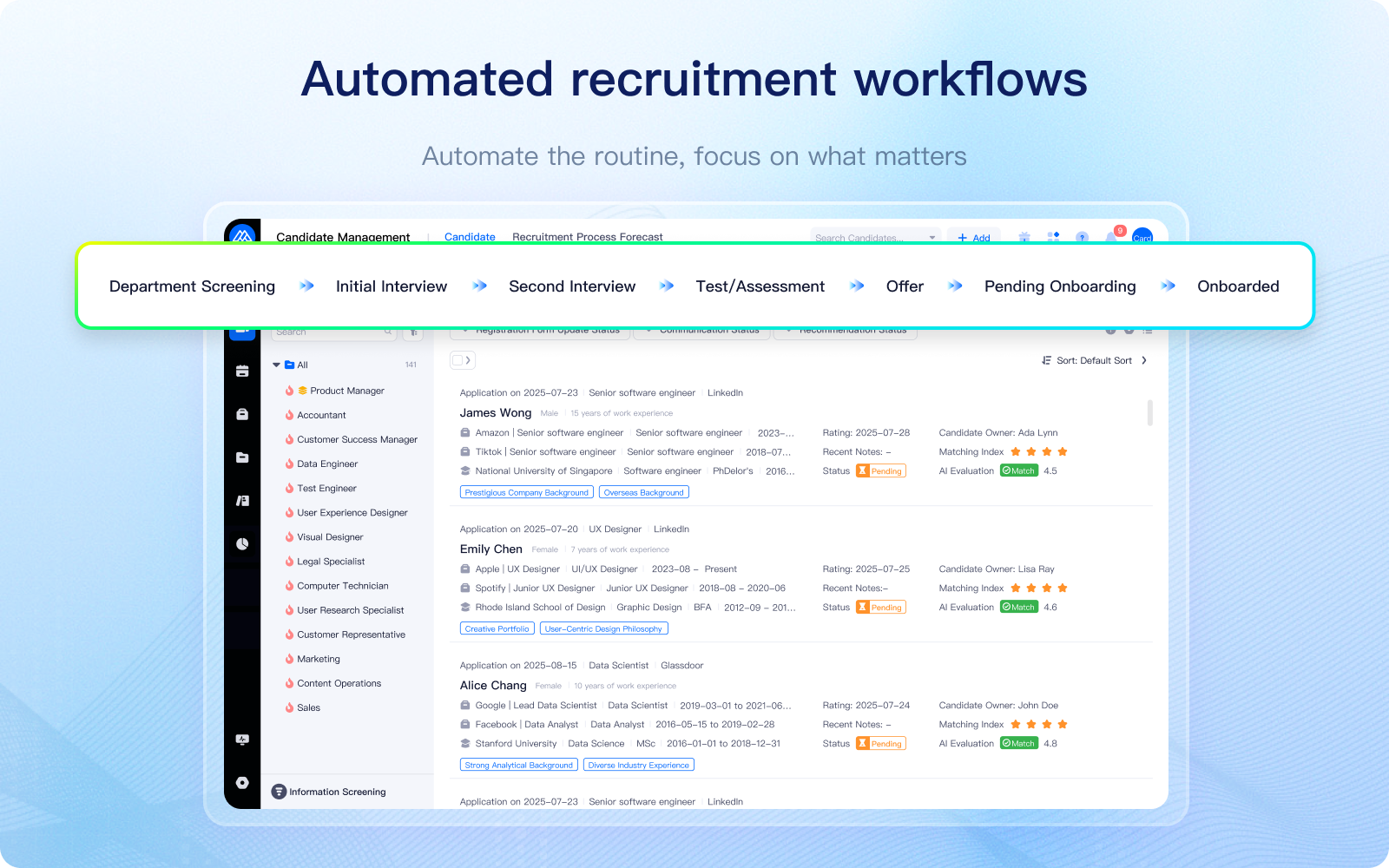
Moka AI is a dedicated ATS designed for modern hiring teams, with proven customer success across Malaysia, Singapore, and Indonesia. It brings sourcing, screening, interviews, candidate management, and hiring collaboration into one streamlined, multilingual workflow — helping teams hire faster and at scale.
Security and compliance are built into the hiring process. Moka AI hosts candidate data on Singapore servers and supports recognised security and privacy frameworks. This gives hiring teams greater control over candidate data while supporting secure and compliant recruitment as hiring grows.
More than a hiring tool, Moka AI gives teams a structured foundation for scalable recruitment. We help organisations build a more consistent, visible, and efficient hiring process — ready to support their next stage of growth.
Final Thought
Recognising that you need an ATS is only the beginning. The value of an ATS grows with time: every candidate profile, interview record, hiring outcome, and talent pool you build today becomes an asset for your next hiring cycle.
Start small. Look at where your candidate data sits today, and trace how one recent hire actually moved from application to offer. This will show you where your current process works, where it breaks, and what an ATS could improve.
The goal is not simply to add another HR tool, but to build a hiring process that is more organised, efficient, and ready to scale.
FAQ
Is an ATS the same as an HRIS?
No. An HRIS (also called an HRMS) is the system of record for people you already employ — payroll, statutory contributions, leave, performance. An ATS is the system of engagement for people you have not hired yet — sourcing, applications, screening, interviews, offers. They manage different populations under different obligations, and most growing companies end up running both.
Isn't an ATS just a job board like JobStreet?
No. A job board, such as JobStreet by SEEK, LinkedIn, or Maukerja and Ricebowl for high-volume blue-collar roles, is where you advertise a vacancy and collect applicants.
An ATS is what manages those applicants after they arrive: it pulls candidates from every board into one pipeline, tracks each person from screening to offer, gathers interview feedback, and keeps their history for future roles. Most Malaysian employers post to several boards at once — an ATS is what stops those applications from scattering across separate inboxes, portals, and spreadsheets.
Do I really need an ATS, or is my HRMS recruitment module enough?
It depends on your hiring pattern more than your company size. If you hire fewer than roughly 15 people a year, through one or two channels in a single language, and one or two people make every decision, the module is usually enough.
A dedicated ATS earns its place when hiring involves multiple stakeholders, arrives across many channels and languages, repeats for similar roles, or needs an auditable candidate-data lifecycle covering consent, retention, and deletion.
Can an ATS handle high-volume, multilingual, and foreign-worker hiring in Malaysia?
Yes — with one caveat. A capable ATS can support high-volume, multilingual, and foreign-worker hiring through multi-language workflows, bulk screening, multi-location hiring, and reusable talent pools. However, work-permit and quota processing still takes place through the relevant government systems, not the ATS.
Can I use HRD Corp levy to buy an ATS?
No. The levy funds approved training, claimed through e-TRiS with grant approval secured before the course begins, and only from an HRD Corp registered training provider, subject to the Allowable Cost Matrix. Some HR software vendors register as training providers — that makes their training programme claimable, not the software subscription. For the tool itself, look at the MSME Digital Grant MADANI instead.