Key Takeaways
Moka conducted a pilot study to assess AI organizational maturity across selected enterprises, mapping where organizations stood in their AI transformation journey and identifying the key barriers holding them back.
-
The assessment model — two dimensions: AI Nativeness (how deeply AI is embedded in operations and everyday workflows) × AI Readiness (whether the mechanisms, systems, and conditions to support AI are in place).
-
The four stages: Observers (low/low, barely started), Explorers (readiness built, but adoption not yet deep), Practitioners (pockets of skilled users that haven't scaled), Pioneers (high/high—AI is part of the operating infrastructure).
-
The results: 53% Observers, 29% Pioneers, 18% Explorers, and 0% Practitioners. The empty Practitioner box is the signal—high adoption doesn't hold without readiness beneath it.
-
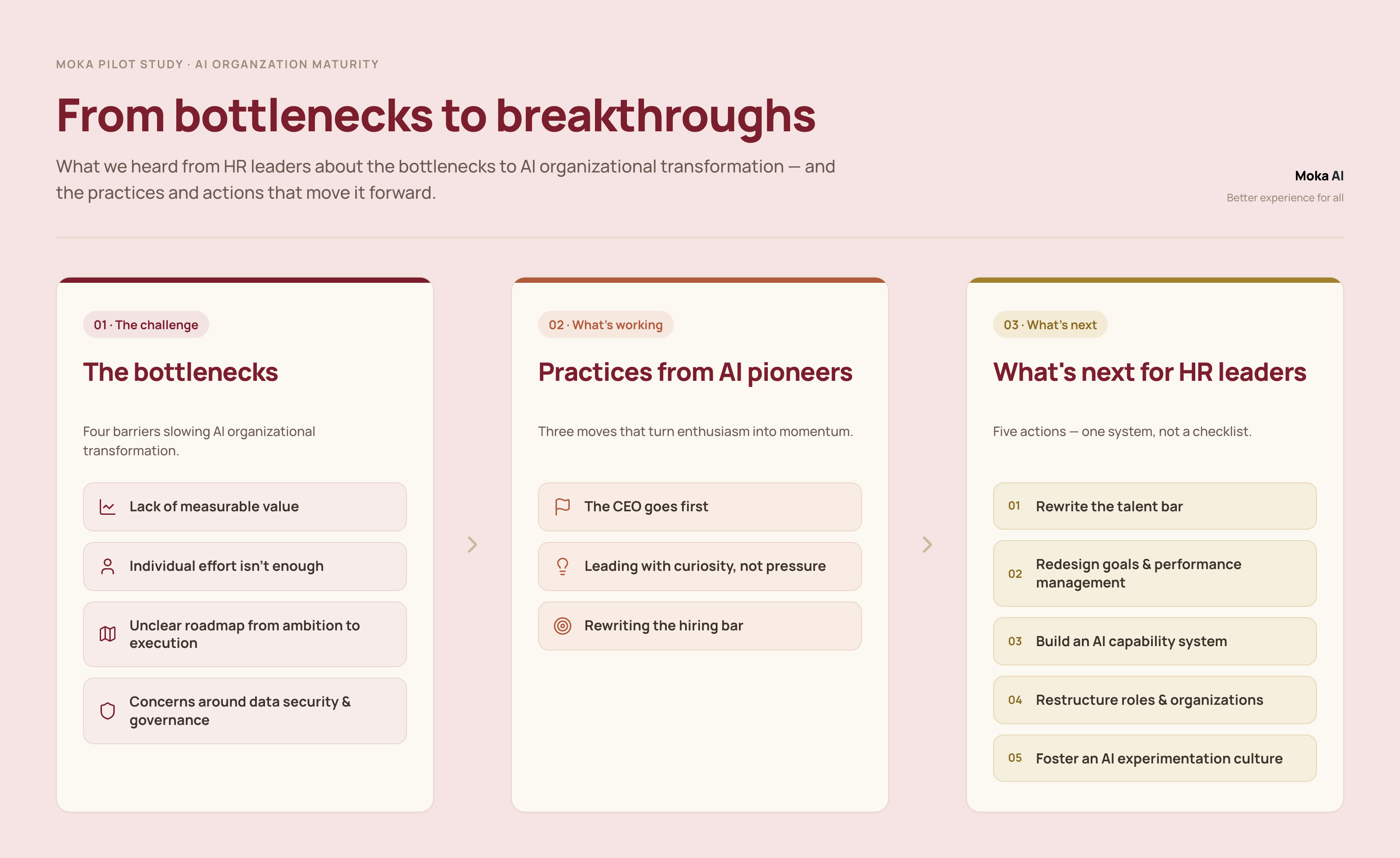
Four barriers HR leaders named: (1) impact is hard to measure (2) a few enthusiasts can't move the whole company without resources and top-down backing (3) the willingness is there but no practical roadmap (4) unresolved data security and governance problems
-
What pioneers do differently: the CEO goes first with adopting AI; lead with curiosity (a no-stakes hackathon) instead of fear of replacement; and they rewrite the hiring bar around AI fluency, creating a capability flywheel.
Introduction
Every technological revolution brings organizational transformation. Just as the Industrial Revolution and the Internet transformed productivity and organizational structures, AI is driving the next wave of organizational evolution.
Yet for most companies, two fundamental questions remain: How do we build an AI-native organization, and how far along are we on this journey?
To explore these question, Moka conducted a pilot study on AI Organization Maturity with HR leaders from leading enterprises through roundtable discussions.
In this article, we share the assessment model, the key findings, and practical insights from enterprise discussions on what it takes to build an AI-native organization.
AI Organization Maturity: Which Stage Is Your Organization In?
To build an AI-native organization, companies first need to identify where they currently stand in their AI transformation journey. Therefore, we introduced the AI Organization Maturity Assessment Model to help organizations evaluate their current level of AI maturity.
The model evaluates organizations across two dimensions:
- AI Nativeness
It assesses how deeply AI has been integrated into business operations and whether AI has become part of employees' everyday workflows.
- AI Readiness
It measures the extent to which an organization has established the mechanisms, systems, and conditions needed to support AI adoption and transformation.
Together, the two dimensions form the X and Y axes of the model. Four quadrants emerge—observers, explorers, practitioners, and pioneers—each representing four distinct stage of AI organizational development.
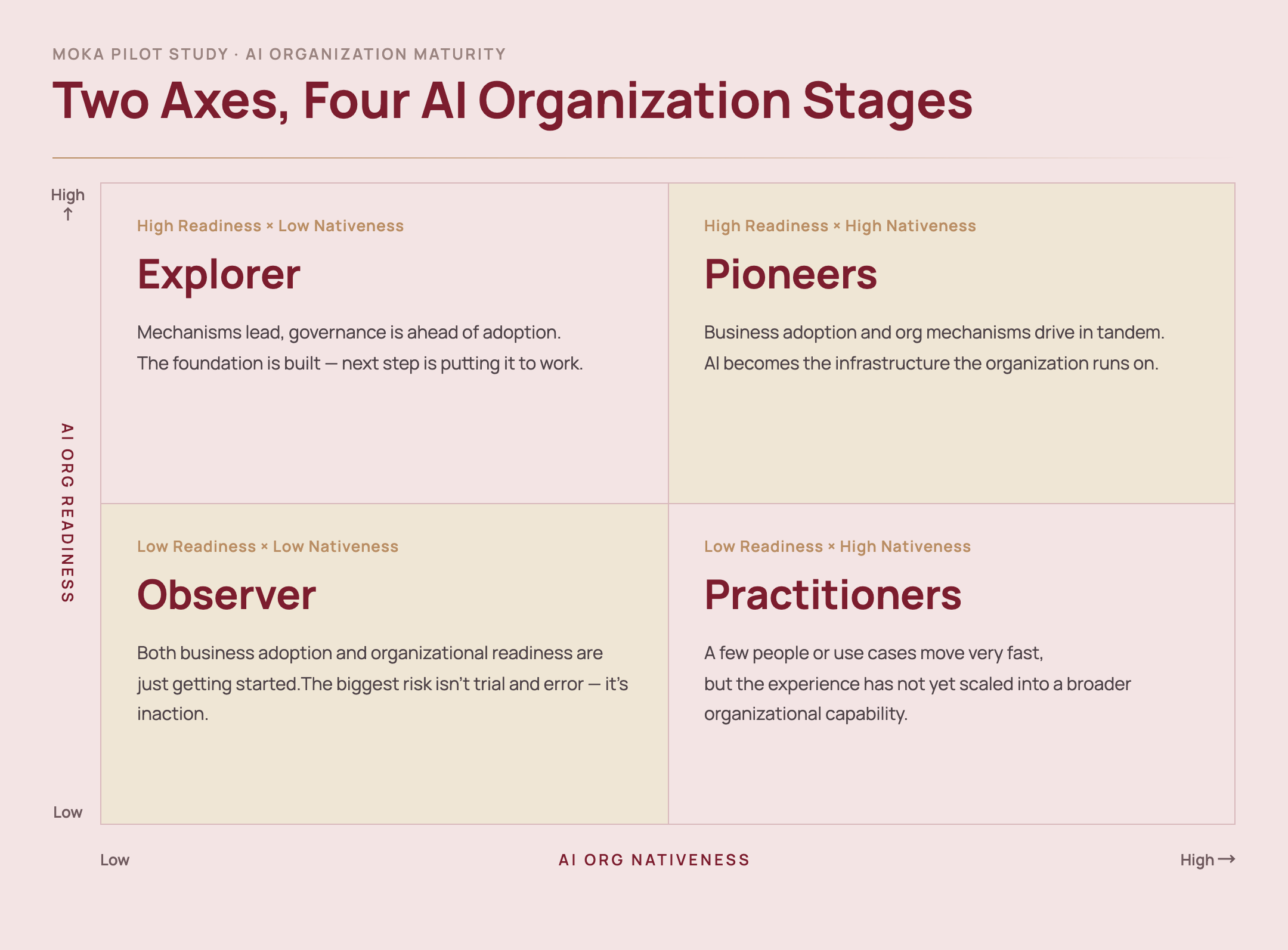
Observers
Low AI readiness · Low AI nativeness.
AI adoption is limited, and the organization has yet to prepare for AI-driven transformation.
Explorers
High AI readiness · Low AI nativeness
The organization has established mechanisms to support AI adoption, but AI has not yet been deeply integrated into business functions. The next step is to expand AI into real business scenarios.
Practitioners
Low AI readiness · High AI nativeness
A small group of employees or teams are proficient in using AI. However, these practices have not yet scaled into organization-level capabilities.
Pioneers
High readiness · High AI nativeness
AI is deeply integrated across business operations and has become part of the organization's operating infrastructure.
Findings
According to the survey results, 53% of organizations were classified as Observers, 29% as Pioneers, and 18% as Explorers. No organizations were identified as Practitioners.
These results show that more than half of organizations are in the early stage of their AI transformation journey, and they are still looking for a starting point and a clear path forward.
Meanwhile, a smaller group of companies has moved significantly ahead. These companies are actively embedding AI into their operations and leveraging it to build new organizational capabilities and competitive advantages.
Bottlenecks Holding Back AI Transformation
Conversations with HR leaders revealed four key bottlenecks slowing down AI organizational transformation.
Lack of measurable value
One of the hardest parts is proving it's worth it. Unlike traditional technology investments, AI's payoff is hard to measure in the early stages. A company can buy the tools, roll them out, get people using them, and run pilots—yet still have no clear value to put in front of the CEO. When ROI is difficult to quantify, securing further investment and scaling adoption become much harder.
Individual effort isn't enough
Several HR leaders described the same pattern: a few AI champions or early adopters are already experimenting with AI, but individual enthusiasm alone is not enough to drive company-wide transformation. A head of talent acquisition in manufacturing put it:
"Without real backing, the old systems and the way we run just don't change."
Without organizational support—including clear priorities, resources, and structures—even successful AI experiments can remain isolated rather than becoming scalable capabilities.
And that support has to start at the top. Leaders need to back it with real resources, not just words: making it a strategic priority, setting goals, allocating real resources, and building the mechanisms needed to make it work.
Unclear roadmap from ambition to execution
This was one of the most common challenges we heard. As one HR leader put it:
"We don't lack leaders who are interested in AI, or employees who are willing to experiment with it. What we lack is the mechanism that connects the two."
The willingness to change is there, but what's missing is a practical roadmap for turning it into action.
In practice, that roadmap will define the alignment of goals across teams, their integration into everyday work, and the measurement of results. It's exactly the part organizations need to think through most carefully. However, it's also the murkiest part today—the place where they still don't know where to begin.
Concerns around data security and governance
Moving into new territory without a playbook always comes with risk and uncertainty—and in AI transformation, that shows up most sharply around data.
For many HR leaders, these are the questions that worry them most:
Is our data safe to use with AI?
Where should the boundaries be?
How can we ensure responsible and compliant AI adoption?
Which data can AI process, and which data should remain off-limits?
Addressing these questions requires a clear governance framework. Without one, security concerns can slow AI adoption and prevent organizations from scaling their initiatives.
Practices from AI Pioneers
We spoke with several AI pioneers to hear how they are applying AI in their organizations. Here are three practices they shared.
The CEO goes first
At one fast-growing AI startup, the practice begins at the top.
The CEO incorporated AI into his own annual goal and OKR-setting process, with team leads to encourage broader adoption across the organization. He sets an example and signals that AI is a practical tool that everyone can embrace and use in daily work. Following his lead, more employees started actively experimenting with different AI tools.
Leading with curiosity, not pressure
This AI startup launched an AI hackathon where employees could build anything they wanted with AI in a single day.
They could experiment with any idea, create a demo, and share their work with the team. The best projects received cash rewards, but winning was never the main point.
The message was clear: exploring AI was encouraged. A fun, low-pressure event like this helped reduce concerns about AI replacing jobs and encouraged employees to actively engage with AI.
Rewriting the hiring bar
At another AI tech company, everyone codes with AI — even project managers use AI to build and validate their own project ideas. As a result, the company has raised its talent bar: The ability to effectively work with AI is no longer a nice-to-have, but a must-have capability.
When evaluating talent, education and past experience are no longer the only criteria. They look at how candidates use AI in their workflows, improve productivity, and deliver better outcomes.
This creates a flywheel effect. AI raises the company's overall capability, which raises the bar for who gets hired; stronger talent further enhances that capability, and the cycle continues.
So, What's Next for HR Leaders?
With these challenges in mind, HR leaders must first recognize their role in driving AI transformation — moving beyond a support function to become a driver of organizational evolution.
HR leaders need to work closely with business leaders and department heads, turning AI organizational transformation into a strategic initiative with clear ownership, resources, and executive support.
Moving forward, HR leaders need to focus on several key actions:
- Rewrite the talent bar
Make AI skills part of the criteria for hiring, promotion, and talent development. By encouraging employees to effectively use AI in their daily work, organizations can build stronger capabilities and drive continuous improvement.
- Redesign goals and performance management
Turn AI adoption into measurable goals by defining where AI can create value, how teams should apply it, and what results they aim to achieve. Regular reviews help organizations track progress and continuously improve.
- Build an AI capability system
Organizations should regularly collect successful AI use cases from internal champions, develop practical playbooks, and establish a scalable system to improve how work gets done.
- Restructure roles and organizations
Redefine the boundaries between humans, AI, and agents — and rethink how work should be allocated in an AI-enabled workplace.
- Foster an AI experimentation culture
Encourage employees to experiment with AI by providing the right resources, support, and opportunities to test new ways of working.
A key point to remember: these five actions are not a checklist to complete one by one — they work together as a system. When combined, they reinforce each other and create greater impact; when tackled separately, their impact is much more limited.
Final Thought
There's no one-size-fits-all answer to AI transformation. Every organization starts somewhere different, and the right move depends on where it is today.
But the survey from Moka AI makes one thing clear: no company reached deep AI adoption without first building the mechanisms to support it. (The "Practitioner" quadrant—high adoption, low readiness—sat empty.)
That same pattern explains how the pioneers got there. They didn't pull ahead on better tools or bigger budgets; they built the conditions first. And it reframes the challenge: AI transformation is an organizational problem more than a technical one—which makes it HR's to lead.
A diagnosis, though, is only the beginning. What carries an organization forward is acting on it—learning from those a step ahead, and building a path of its own.

Author
Damon Liu
Marketing Manager
Hello everyone! I'm part of the Editorial Team at Moka AI, where I focus on global content, including writing and editing in-depth insight articles. I love exploring new ideas, discovering new tools, and finding fresh perspectives. My goal is to create content that’s genuinely valuable and helpful for HR professionals, while keeping it engaging, relatable, and fun to read!