Skills mismatch just overtook local hiring as Singapore's #1 manpower headache
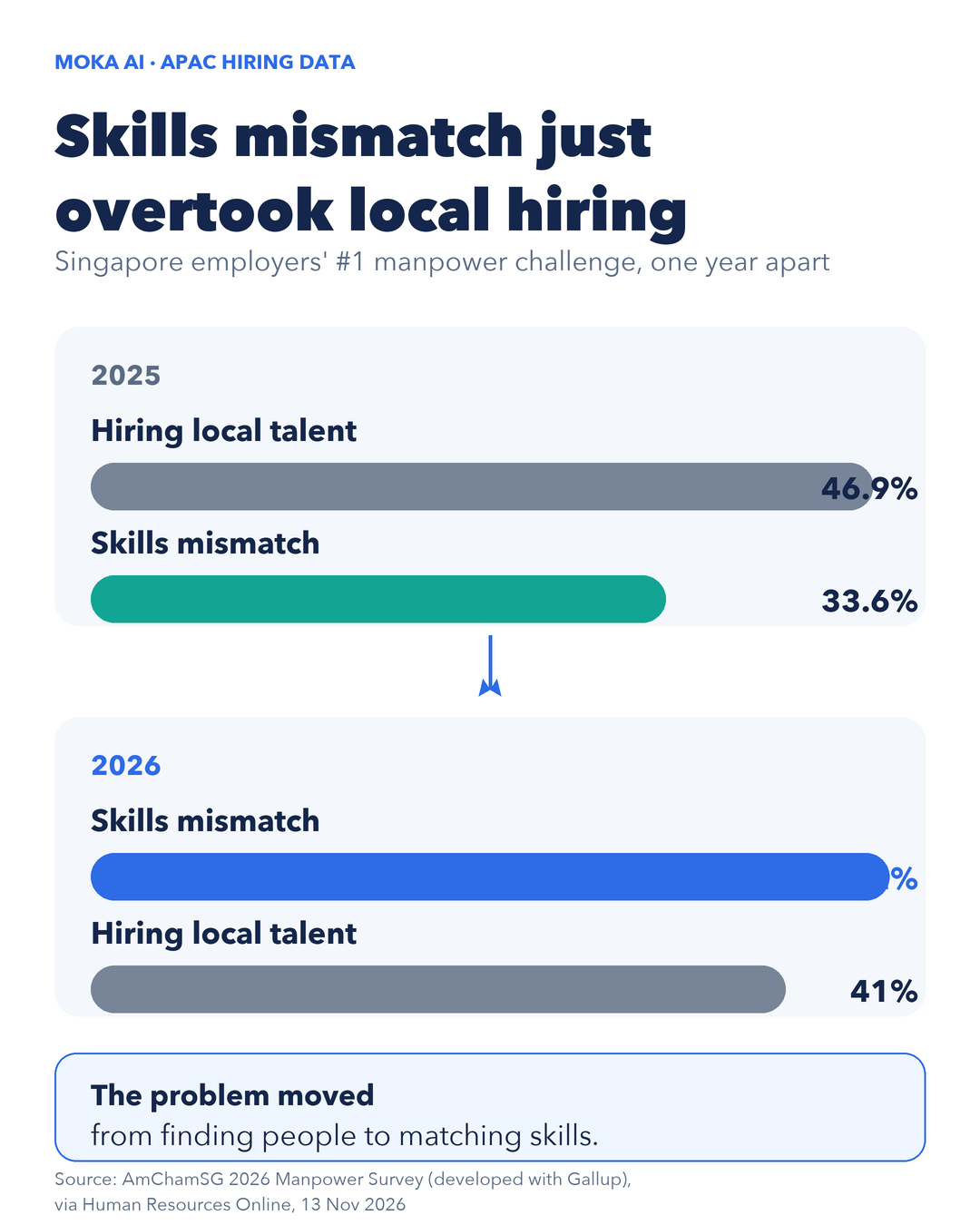
Two numbers, one year apart, tell most of the story. In 2025, 46.9% of Singapore employers called hiring local talent their biggest manpower challenge, and 33.6% pointed to skills mismatch. The 2026 edition of the AmChamSG Manpower Survey, developed with Gallup, flipped the order: 46.2% now name skills mismatch, and local hiring fell to 41%.
Headcount is not shrinking. 60.8% of employers plan to keep staffing steady, 25.8% plan to expand, and only 13.4% plan cuts. The shortage has moved from the number of candidates to the match between what a role needs and what applicants can prove.
Here is what changed, and three things you can do this quarter.
The numbers that flip the problem
Read past the headline and the pattern sharpens. Skills mismatch is up from 33.6% to 46.2% in a single year, while difficulty hiring locals dropped from 46.9% to 41%. Employers are not hiring less; they are hiring with the wrong filter. The shift changes which lever you pull: not more sourcing, but better matching.
The sample is mostly non-SME employers (71.4%), and 65.1% of surveyed HR teams carry scope beyond Singapore, across Southeast Asia, APAC, or global. This is not a small-company quirk. If your own dashboard shows roles staying open longer while headcount stays flat, you are looking at this pattern. Full figures: Human Resources Online, 13 Nov 2026, reporting on the AmChamSG 2026 Manpower Survey.
2025: local hiring 46.9% · skills mismatch 33.6% 2026: skills mismatch 46.2% · local hiring 41% Source: AmChamSG 2026 Manpower Survey
Why job titles stopped working
The aggregate hides a sharper split. The survey breaks hiring difficulty down by career stage, and each stage fails for a different reason.
For experienced hires with five or more years behind them, the hardest attributes to find are adaptability and resilience (46.7%), followed by creativity and critical thinking (30.4%). For senior roles at director level and above, 43.1% of employers struggle to find specialised skills, and 41.2% point to missing overseas or regional experience.
Notice what is not on that list: titles, tenure, and certifications. A job description that asks for "5+ years as a marketing manager" screens for years served, not for the ability to re-plan a launch when a channel collapses. That gap, between what the JD filters for and what the role actually needs, is exactly what the mismatch numbers describe. AI widens it, because the skills that matter change year to year while your JD template does not. The fix is not a better list of titles. It is a different matching surface.
Experienced hires: adaptability and resilience 46.7%, creativity and critical thinking 30.4%. Tenure is not proof of range. Senior hires: specialised skills 43.1%, overseas or regional experience 41.2%. Regional scope is a skill in itself.
Match on skills, not titles
If titles no longer carry the signal, replace the title screen with a skill screen. Three steps, all doable without new software.
- Rewrite the JD around skills and tasks. State the three skills a hire must demonstrate and the tasks they will own in the first 90 days. A job posting assistant can draft this in multiple languages and scan the wording for bias, but a plain text edit works too.
- Define an ideal candidate profile, then let AI score resumes against it with the reasons shown next to each score. The point is not to let AI decide. It is to turn 500 resumes into a ranked shortlist with evidence attached. On lean teams, screening can eat 23 hours a week, and more than three quarters of resumes get under ten seconds of attention (figures from Moka's public product pages). A ranked shortlist changes what those hours buy. Moka AI's resume screening matches recruiter decisions 92%+ of the time, builds shortlists 3x faster, and parses 98% of resumes correctly across 19 languages.
- Keep the final call human. The system ranks and explains. You decide.
Title-first JD: "5+ years as a marketing manager" Skills-first JD: "Ran a launch in 2+ markets and can show the numbers"
Title-first JD: "Regional experience preferred" Skills-first JD: "Worked with SEA teams: a campaign, a product, or a partnership to prove it"
Title-first JD: "Strong communication skills" Skills-first JD: "Can explain a campaign decision to a CFO in one page"
Activate the talent you already have
Before you pay for a new pipeline, check the pool you already own. In a mismatch market, sourcing costs more and returns less, and more than 20% of the resumes teams pay to see are duplicates of ones they have already seen.
Call it talent rediscovery. Your silver medalists, the runners-up from the last round, and your past applicants already passed some version of your bar. If they carry the same skill tags you now screen on, every new requisition can re-match them automatically. When your next market expansion adds twenty requisitions in one quarter, the cheapest place to look is the pool you already screened.
Moka's Talent CRM re-matches past applicants, silver medalists, and referrals to new roles with 90%+ accuracy, with consent tracking built in, and talent pool members fill 15%+ of our customers' hires. Referrals close 63% faster and cost 36% less per hire.
Consent is the part teams skip. When you re-approach people who applied two years ago, you need a record of who opted in, when, and for what. Build that before you need it, because it is the first thing a compliance team will ask for.
The close
The talent market moved. Your job descriptions are still standing where they were. Matching is now the scarce asset, not reach.
Three moves this quarter: write your next JD skills-first, check whether your ATS can rank by skill profile instead of keywords, and pull your last 12 months of silver medalists into one list.
If you are rethinking your screening stack, Moka AI's AI Screening and Talent CRM pages show how the matching above works in practice.
Follow Moka for more APAC hiring data like this.

Author
Moka AI Editorial Team
The Moka AI Editorial Team creates insightful, practical, and engaging content on HR, recruitment, and AI innovation. We explore emerging trends, share industry insights, and turn complex ideas into actionable knowledge to help HR professionals navigate the evolving world of work.