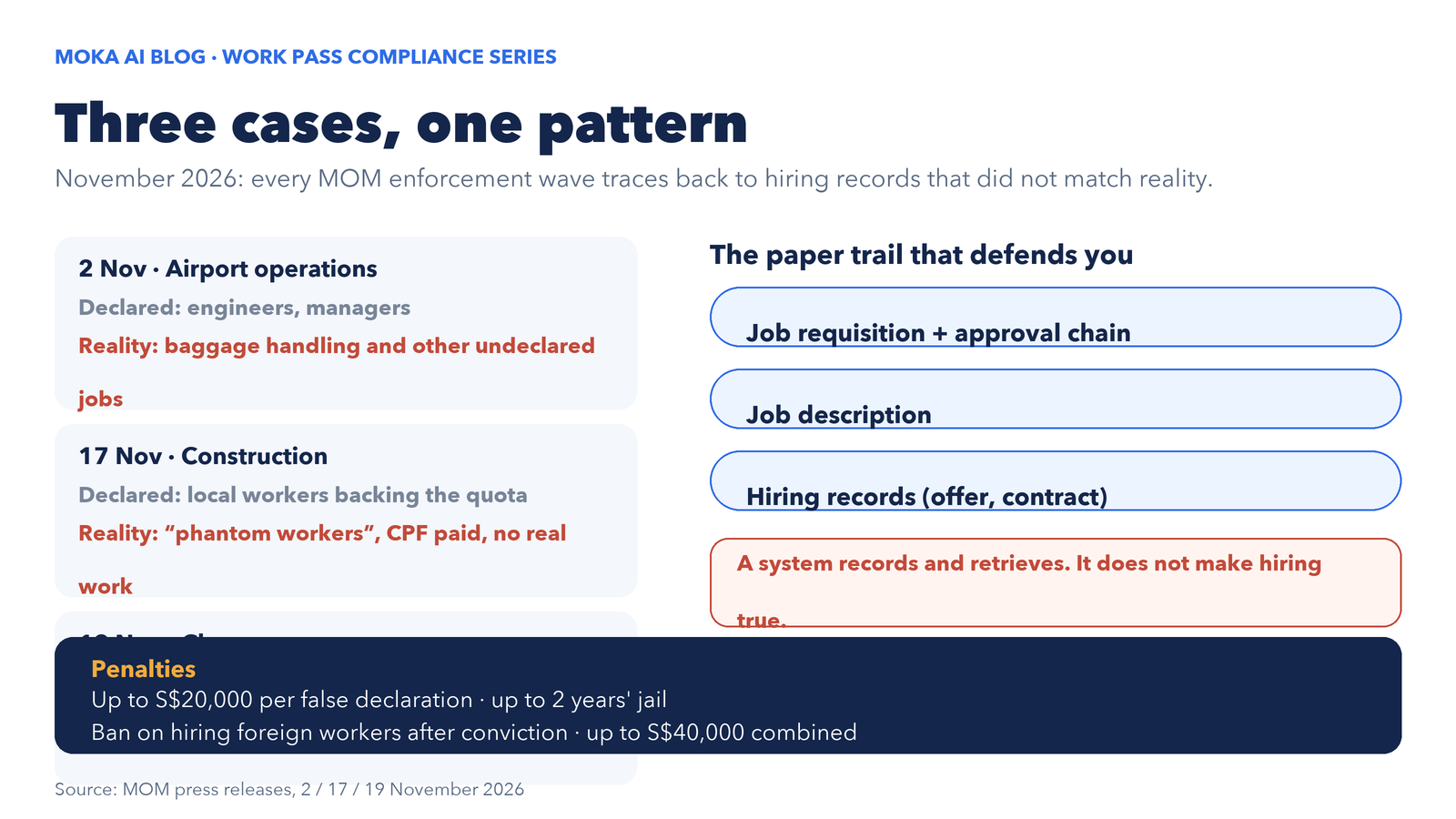
Three announcements from Singapore's Ministry of Manpower, three weeks in a row. On 2 November, an investigation into about 45 companies in airport operations and roughly 270 workers.
On 17 November, 13 individuals charged over "phantom workers" in construction. On 19 November, seven more individuals and a company charged for false declarations.
Different sectors, one pattern: declarations that did not match reality. Even if you never intend to file a false declaration, when declared jobs, quotas, and terms drift from what actually happens, your records are what you will be asked to produce.
Here is what the cases show, where that paper trail actually lives, and why a 2027 law makes it matter again.
Three cases, one pattern
Work pass compliance, at its core, is the discipline of declarations you can prove. Each case below is different in detail and identical in structure: something was declared, reality differed, and the paper trail could not reconcile the two. None of them required elaborate fraud. Each started with a declaration that drifted from day-to-day reality, and records nobody updated.
Lesson 1: the declared job must be the real job
The airport case (2 Nov): MOM is investigating about 45 companies involved in airport operations, with roughly 270 workers allegedly deployed against what their passes declared. Employment Pass holders declared as engineers or managers were allegedly put on baggage handling; others did work unrelated to their declared occupation. The 19 Nov charges repeat the pattern: EP applications declared one occupation, workers were deployed to aircraft cleaning and baggage handling, and false statements were allegedly made to inspectors.
The lesson: the job description and the declared occupation must describe the work that actually happens, and if the deployment changes, the declaration must follow.
Lesson 2: the quota must be backed by real employees
The construction case (17 Nov): 13 individuals were charged over "phantom workers", names placed on local payroll records, often with CPF contributions paid, for people who never worked. The effect: an inflated local workforce count, which lifts the foreign worker quota. Twenty-one alleged phantom workers may also face penalties.
The lesson: local hiring records must survive a check. A name on payroll with CPF contributions is not enough if there is no real person doing real work. Quota math is only as honest as the headcount behind it.
Lesson 3: the declared terms must be the real terms
The 19 Nov case also covered declared terms. One company allegedly declared fixed monthly salaries that included overtime, to meet a threshold, for 20 employees later deployed to cleaning roles. In a separate training permit case, workers declared as overseas trainees earning S$3,000 a month were allegedly paid S$1,300 and put to work in cleaning, dishwashing, and food packing.
The lesson: declared terms, from salary components to job scope, must match the contract and the reality. The penalty exposure for each case sits in the table below, and it is the Employment of Foreign Manpower Act that sets those numbers.
| Case (2026) | What was declared | What actually happened | Penalty exposure |
|---|---|---|---|
| 2 Nov, airport operations | EP roles like engineers and managers | Baggage handling and other undeclared jobs | Up to S$20,000 per false declaration; up to S$10,000 for illegal deployment; ban |
| 17 Nov, construction | Local workers backing the quota | Phantom workers, CPF paid, no real work | Up to S$20,000 per charge, up to 2 years, or both; ban |
| 19 Nov, charges | Occupations, salaries, trainee purpose | Different roles, lower pay, cleaning work | Up to S$20,000 per charge; up to S$40,000 combined |
Where the paper trail actually lives: the requisition
MOM's advisory: employers must make accurate, complete, and truthful declarations. Your declarations must be provable, and the proof lives in the recruitment process, starting at the job requisition, not at the application form.
The requisition and approval chain
Who asked for the role, who approved it, and on what business basis? Quota legitimacy and role authenticity are decided here, before any candidate is contacted. A role approved by someone who never manages it, or opened without a documented business need, already looks shaky under inspection.
The job description
Duties must equal the actual work. The training permit cases show why vague labels like "trainee", "consultant", or "manager" are the first place inspectors look. The JD is the basis of the declaration. It must survive a side-by-side comparison with what the person actually does.
The hiring records
Interview notes, the offer, and the contract must agree with the declared occupation and terms. If the offer letter says one role and the pass application says another, the mismatch was created inside your own process, before MOM ever asks a question. If three systems hold three versions of a hire's terms, you will spend any investigation reconciling them instead of answering.
A boundary worth stating plainly: an ATS or HR system records and retrieves. It does not make your hiring true. Real employment, real deployment, and real payment are operating obligations that belong to the employer. A system helps you produce the evidence in ten minutes when asked. It does not produce the truth.
For each record type, three tests: does it exist, does it match, can you pull it out?
| Record | Must exist | Must match | Must be retrievable |
|---|---|---|---|
| Requisition and approvals | Business need, approver chain | The role actually opened | Who asked, who approved, when |
| Job description | Duties for the real work | Actual deployment | Current version, on file |
| Hiring records | Interview, offer, contract | Declared role and terms | Per hire, within minutes |
The next compliance shift: Workplace Fairness in 2027
MOM enforcement is not the only reason your recruitment records matter. A second regime lands in 2027, and it reads the same paper trail.
The three-step dispute route
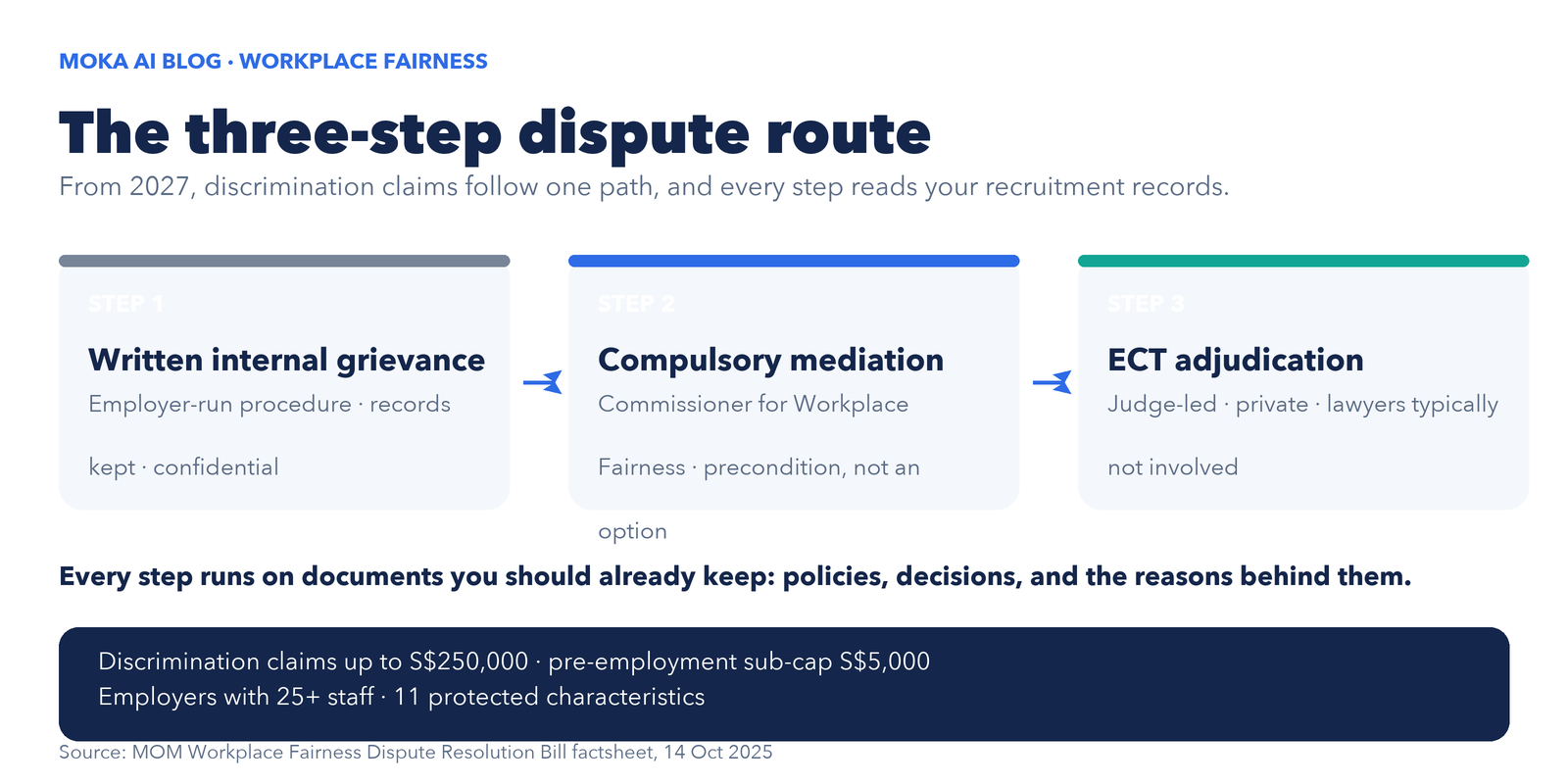
Under the Workplace Fairness framework, discrimination claims follow three steps. Step 1: the employer must run a written internal grievance procedure, with records kept and confidentiality respected. Step 2: if it is not resolved, the claim goes to compulsory mediation with the Commissioner for Workplace Fairness. Mediation is a precondition, not an option. Step 3: if still unresolved, an Employment Claims Tribunal judge hears the case. ECT proceedings are judge-led and generally private, and lawyers are typically not involved at that stage.
Notice where the evidence comes from at each step. The grievance step reads your internal records and policies. The mediation step reads the same records plus your communications. The tribunal reads everything, plus your decision trail. The process assumes a written trail exists, and for employers every step runs on documents you should already keep.
- Written internal grievance procedure (employer; records kept; confidential)
- Compulsory mediation (Commissioner for Workplace Fairness)
- ECT adjudication (judge-led, private; up to S$250,000, S$5,000 for pre-employment claims)
What the numbers mean
The Employment Claims Tribunal can award up to S$250,000 for discrimination claims, with larger claims moving to the High Court. Pre-employment discrimination claims are capped at S$5,000. The framework covers 11 protected characteristics and generally applies to employers with 25 or more employees. It takes effect in 2027; the exact commencement date will be set by gazette.
Why the requisition matters: discrimination claims turn on unfavourable treatment in hiring, assessment, promotion, and dismissal. Proving or defending against that treatment depends on the decision records you kept at each moment. For the first time, a Singapore tribunal can examine why a candidate was rejected, not just whether the paperwork was complete. Today's audit trail is tomorrow's evidence, on either side of the table.
A 10-minute requisition audit
None of this needs a project. Spend ten minutes this week checking six things. Each check asks the same three questions: does the record exist, does it match, can you pull it out?
| Check | Where to look | Red flag |
|---|---|---|
| 1. JD matches actual work | Latest JD vs what the team does | Vague labels with no duties |
| 2. Declared role equals hired role | Offer vs pass application | Two different titles |
| 3. Declared terms equal contract terms | Contract vs declaration | Components added to meet a threshold |
| 4. Local headcount is real | Payroll vs actual staff | Names with no work |
| 5. Approval chain complete | Requisition history | Missing approver or business case |
| 6. Grievance process written | HR policy | Nothing documented |
The close
Work pass compliance evidence does not live in the work pass application. It lives in the recruitment records behind it: the requisition, the job description, the approvals, the offer.
Moka's Recruitment Management carries the requisition and approval chain through to offers, and Recruitment Analytics records each stage automatically. They make your records retrievable. The accuracy of those records is your operating discipline, and no system replaces it.
Run the six checks above, fix the red flags before your next declaration, and let the records do the talking if MOM ever asks.
General information, not legal advice. Figures come from MOM's official press releases (2, 17, 19 Nov 2026) and the MOM Workplace Fairness factsheet; verify the current text before relying on them.
Want to see the trail in practice? Ask for a demo.

Author
Moka AI Editorial Team
The Moka AI Editorial Team creates insightful, practical, and engaging content on HR, recruitment, and AI innovation. We explore emerging trends, share industry insights, and turn complex ideas into actionable knowledge to help HR professionals navigate the evolving world of work.