Talent & Culture Strategy at Luckin: Building a Workforce at the Speed of Expansion

This article is part of MokaHR's Talent & Culture Strategy series, which profiles how leading companies build their people strategies.
Five years after filing for bankruptcy, Luckin Coffee spent $120 million on a roasting facility. The Kunshan plant, inaugurated in May 2024, spans 53,000 square metres and can process over 30,000 tonnes of coffee beans annually — among the largest such facilities in Asia. It is not the kind of investment a company makes if it expects to fail again.
The company behind that decision opened its first store in June 2018, was delisted from NASDAQ amid an accounting scandal in 2020, filed for bankruptcy, rebuilt itself, and then surpassed Starbucks in number of outlets in China in 2023. By end of FY2025 it operated 31,048 stores across China, Singapore, Malaysia, and Hong Kong — a store count that, at peak growth, required opening roughly eight new locations every single day.
The talent story behind that trajectory is just as striking as the financial one. By end of FY2025, Luckin served over 450 million cumulative transacting customers and employed 84,191 people. That workforce grew by nearly 9,600 employees in 2024 alone — the equivalent of a mid-sized company's entire headcount added in a single year. Managing that growth, maintaining operational standards across tens of thousands of outlets, and building a culture capable of surviving a corporate crisis and an aggressive international expansion represents a talent challenge with few analogues in the F&B sector.
The talent & culture strategy at Luckin is, in many ways, defined by scale. This article examines how the company hires and manages a predominantly frontline workforce at speed, what its approach to performance and development looks like in practice, what HR leaders can take from it, and — critically — where the model creates friction that the company has not yet resolved.
Detail | Data |
|---|---|
Founded | 2017, Xiamen, China |
Headquarters | Xiamen, China |
Total stores (FY2025 end) | 31,048 (20,234 self-operated; 10,814 partnership) |
Total employees (Dec 2024) | 84,191 (33,795 full-time; 50,396 part-time) |
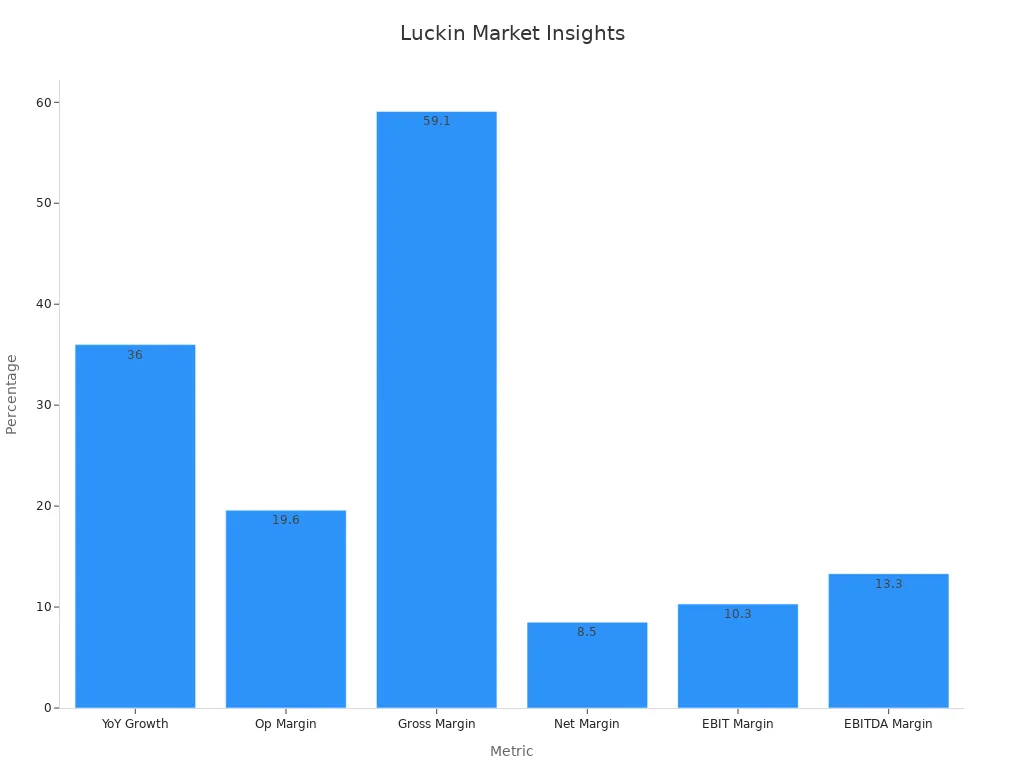
Revenue (FY2024) | RMB 34.47 billion (~US$4.72 billion), +38.4% YoY |
Monthly transacting customers (Q4 2025) | 98.4 million, +26.5% YoY |
Cumulative transacting customers (FY2025) | Over 450 million |
Core business | Tech-enabled quick-service coffee retail |
Luckin does not publish formal employer awards or HR recognitions in the manner of multinationals that maintain structured talent branding programmes. Its credibility as an employer is better understood through operational outcomes: the company added nearly 9,000 net new stores in 2024 alone, which required recruiting, onboarding, and retaining a commensurate number of frontline workers across dozens of Chinese cities and three international markets simultaneously. The HR function — led since October 2023 by Senior Vice President Tian Zang, who joined in May 2020 and previously reshaped the company's HR management system during its post-scandal recovery — has had to build hiring and retention infrastructure in real time against a backdrop of continuous expansion.
How does Luckin attract and hire talent?
A predominantly part-time, store-level workforce
Luckin's talent acquisition challenge is defined by its operating model. The company's stores are compact, technology-enabled quick-service outlets — often staffed by two to four people — that process orders primarily through a mobile app. The model is optimised for throughput and efficiency, which shapes how the company hires. Roughly 60% of Luckin's 84,191 employees are part-time, a proportion that reflects both the economics of running high-volume small-format stores and the reality that frontline coffee retail, particularly in China's price-competitive market, relies heavily on flexible scheduling to control labour costs.
Store-level recruitment is decentralised and volume-driven. Luckin typically hires baristas and store staff through job platforms and in-store postings, with screening focused on availability, reliability, and speed of onboarding rather than coffee expertise at entry level. The expectation is that product knowledge is taught on the job through standardised training protocols — each Luckin store operates with largely automated equipment, reducing the skill barrier for new hires while allowing the company to maintain consistency at scale.
For partnership stores — which accounted for 10,814 of Luckin's 31,048 outlets at end of FY2025 — the company provides structured pre-opening training covering operational procedures, the app-based ordering system, and customer service standards. This training is the primary mechanism through which Luckin extends its operational culture to a franchise network that it does not directly employ.
Building specialist depth at the centre
Against this predominantly operational workforce, Luckin has made deliberate investments in specialist coffee expertise at the corporate level. The company's R&D coffee team includes 48 professionals holding Q-Grader certification — one of the coffee industry's most rigorous sensory qualifications — and has signed partnerships with multiple World Barista Champions, including holders of the World Coffee Masters Championship title. These partnerships serve a dual purpose: they underpin product credibility in a market where coffee quality expectations are rising rapidly, and they provide a talent signal to a consumer base that increasingly reads coffee expertise as a marker of brand seriousness.
This two-track model — operationally standardised store staffing combined with concentrated specialist expertise at the centre — is characteristic of the broader fast-casual F&B sector. What distinguishes Luckin's version is the pace at which it must maintain both simultaneously.
The accounting scandal as a talent context
Any account of Luckin's talent strategy requires acknowledging the 2020 accounting fraud that led to NASDAQ delisting and US bankruptcy proceedings. The crisis resulted in the departure of its founding CEO and several senior leaders, and necessitated a full reconstruction of the company's governance and management infrastructure. SVP Tian Zang joined during this period and, according to Luckin's own investor communications, led the effort to reshape and upgrade the HR management system to support the company's post-recovery growth. The talent strategy being examined here is, in a meaningful sense, a post-crisis rebuild — which makes its subsequent performance metrics considerably more instructive than if they had been achieved from a standing start.
Starbucks has faced its own significant talent challenges in recent years — including union activity across hundreds of US stores and a leadership-driven overhaul of its barista experience — providing a useful contrast in how two of the world's largest coffee employers approach frontline workforce management from very different starting points.
The takeaway on acquisition: Luckin's hiring model prioritises speed and scalability over selectivity. That is a deliberate structural choice, not an oversight — and it has enabled the company to add roughly 8-9 new stores daily at its peak growth rate.
📄 2025 AI Recruitment Casebook Scaling high-volume frontline hiring the way Luckin has — adding thousands of store staff annually across multiple markets — is precisely where AI-powered recruitment tools have the most measurable impact. MokaHR's AI Recruitment Report covers real-world practices across retail, F&B, tech, and seven other industries. Download the free report →
Trusted by: Tesla · NVIDIA · McDonald's · Nestlé · Schneider Electric Trusted by 3,000+ enterprises | 30%+ of Fortune 500 companies
How does Luckin develop and manage employee performance?
Technology-driven performance management on the floor
Luckin's performance management system for frontline workers is, in essence, built into the operational infrastructure. Every order placed through the app generates a timestamp. Every drink prepared is tracked against a two-minute completion target. The "timeliness rate" — the proportion of orders completed within that window — is a core performance metric tied directly to barista compensation. Full-time baristas typically earn between RMB 3,000 and 4,000 per month; store managers earn up to RMB 10,000. Both figures are linked, in part, to operational performance data collected in real time.
This system has real strengths. It makes performance expectations transparent and quantifiable, removes subjective bias from operational assessment, and creates clear accountability for the speed and quality outcomes that drive Luckin's customer proposition. For a company managing over 20,000 self-operated stores, automated performance tracking is not a choice so much as an operational necessity — the alternative would be an unmanageable supervisory burden.
The limitation is equally clear: performance management designed around throughput metrics captures what employees produce in measurable terms, but not how they are developing, whether they feel supported, or whether conditions are sustainable over time. Luckin has built a highly efficient monitoring system; it has not yet built an equivalent feedback infrastructure.
Internal mobility and leadership development
Luckin's approach to career progression is structured around internal promotion. Research published in the Highlights in Business, Economics and Management journal notes that the company fills management roles primarily from within, using internal talent sharing as a mechanism to move experienced staff across stores and regions. The progression pathway for store staff — barista to vice manager to store manager — provides a visible career ladder in a sector where advancement is often opaque.
The R&D side of the business runs on a different logic. Luckin's coffee specialists, including its Q-Grader certified team members, operate in a domain where expertise takes years to develop and credentials carry genuine professional value. The company's partnerships with World Barista Champions are as much about knowledge transfer and internal capability building as they are about marketing.
McDonald's provides an instructive comparison here — its internal Hamburger University and clear progression paths from crew member to restaurant manager have long been cited as a differentiator in frontline F&B talent management. Luckin's model is less formalised at the store level, but the underlying logic — build managers from the people who already understand your operations — is consistent.
Key workforce and financial metrics
Metric | Figure | Source |
|---|---|---|
Total employees (Dec 2024) | 84,191 (+12.87% YoY) | Luckin Annual Report 2024 |
Full-time employees | 33,795 | Luckin Annual Report 2024 |
Part-time employees | 50,396 (~60% of total) | Luckin Annual Report 2024 |
FY2024 total revenue | RMB 34.47 billion (+38.4% YoY) | Luckin FY2024 Earnings |
Q4 2024 revenue | RMB 9.61 billion (+36.1% YoY) | Luckin Q4 2024 Earnings |
Monthly transacting customers (Q4 2025) | 98.4 million | Luckin FY2025 Earnings |
Total stores (FY2025 end) | 31,048 | Luckin FY2025 Earnings |
Barista monthly salary range | RMB 3,000–4,000 | Sixth Tone investigation, 2024 |
Store manager monthly salary | Up to RMB 10,000 | Sixth Tone investigation, 2024 |
Q-Grader certified R&D staff | 48 | Academic research, ICBBEM 2024 |
The honest tension in Luckin's performance management approach: a timeliness-rate system works as a performance tool when staffing levels are sufficient to meet demand. When they are not — and at a store producing 1,000 drinks daily with two to four workers, the margin is thin — the same system becomes a source of chronic stress rather than a productivity driver. This distinction matters, and it is addressed further in the employee experience section.
What can HR leaders learn from Luckin's approach?
Luckin is not a talent strategy benchmark in the way that Google or Adobe are. It has not published research on management effectiveness or redesigned its feedback architecture. What it offers is something different: a real-time case study in how to build and manage a very large frontline workforce very quickly, with the trade-offs that involves.
Build the performance infrastructure before you need it. Luckin's decision to embed performance tracking directly into its app-based ordering system meant that when the company scaled from 16,000 to 22,000 stores in a single year, it had performance data on every outlet without requiring a proportional expansion of its management team. HR leaders scaling frontline operations should think about measurement architecture early — recruitment analytics platforms that capture hiring velocity, onboarding completion rates, and early turnover by location can serve a similar function, making scaling visible and manageable without requiring constant supervisory intervention.
Part-time flexibility is a structural tool, not a stopgap. Luckin's 60% part-time workforce is not a cost-cutting compromise — it is a deliberate model that allows the company to match staffing to demand patterns across thousands of locations with highly variable footfall. HR leaders in high-volume retail and F&B contexts who resist part-time models for cultural reasons often end up with higher fixed costs and lower scheduling flexibility. The question is not whether part-time employment is desirable in principle but whether the employment conditions are structured fairly. Recruitment automation tools that manage high-volume, high-frequency hiring and scheduling at scale can reduce the administrative burden of running a large part-time workforce without sacrificing consistency.
Internal promotion is not a sentiment — it is a pipeline decision. Luckin's practice of filling management roles from within is not primarily an engagement initiative; it is a practical response to the reality that the company opens stores faster than it can recruit trained managers externally. If your organisation is growing quickly enough that external hiring for management roles creates bottlenecks, internal mobility tracking and structured promotion criteria become operational necessities. Building the data infrastructure to identify promotion-ready employees before vacancies arise — rather than after — is the difference between a functioning pipeline and a reactive scramble.
The challenge that Luckin hasn't yet solved: engagement at scale. Operational performance data tells you what is happening; it does not tell you why, or what it is costing the people producing it. The gap between Luckin's throughput metrics and its frontline employee experience is a genuine strategic risk. As the company expands internationally — including announced plans for US market entry, focusing on cities like New York with high concentrations of Chinese students and tourists — it will encounter labour markets with different expectations around working conditions, union organising rights, and employer transparency. The playbook it has used in China will require adaptation.
Grab's approach to talent management in Southeast Asia offers a useful contrast in how a tech-enabled, high-growth company has tried to balance operational speed with employee experience — particularly relevant given Luckin's own SEA expansion through Singapore and Malaysia.
What is it like to work at Luckin?
The honest answer is that it depends significantly on which part of Luckin you work in.
For corporate and R&D employees at Luckin's Xiamen headquarters and regional offices, the picture is of a fast-moving technology company with genuine career development infrastructure, competitive compensation for specialist roles, and the professional energy that comes from working at a company in sustained hypergrowth. The company's investment in coffee science — its Q-Grader team, its World Barista Champion partnerships, its new Kunshan roasting facility — signals a seriousness about craft that makes it an attractive employer for people who combine commercial ambition with genuine coffee expertise.
For frontline store staff, the picture is more complicated. Luckin's operational model generates real intensity. Each drink must be produced within two minutes of ordering. High-volume stores — particularly in office districts during morning rush — can produce over 1,000 drinks per day with two to four workers on shift. A single barista may prepare up to 500 cups in a day. The timeliness rate system, which ties pay to throughput, means that the pressure does not ease when it is busy; if anything, the stakes increase.
In 2024, a hashtag describing Luckin store workers as "Luckin Slaves" (瑞幸打工人) accumulated over 11 million views on Xiaohongshu, China's lifestyle platform. The term was used by employees across dozens of posts describing exhaustion, understaffing, and the unrelenting pace of the ordering system. This is not an isolated complaint — it reflects a structural feature of a model built for efficiency in a price-competitive market.
Luckin's base salaries for baristas — RMB 3,000 to 4,000 per month — are in line with industry norms in China's quick-service F&B sector, but they do not place the company at the premium end of the employer market. Store managers earning up to RMB 10,000 receive compensation that reflects the operational complexity of running a high-volume location, and the internal promotion pathway from barista to manager is real and accessible. The question is whether the journey to that pathway is sufficiently sustainable to retain the people with the potential to make it.
This tension — between a highly efficient operational model and the human sustainability of working within it — is not unique to Luckin. It is a defining challenge for the entire Chinese quick-service F&B sector. What makes it worth examining in the context of Luckin's talent strategy is that the company now employs over 84,000 people and is actively entering international markets where the same model will face different labour market conditions and higher public scrutiny of working conditions.
Frequently asked questions
How does Luckin Coffee hire and manage such a large frontline workforce?
Luckin relies heavily on part-time staffing to manage its frontline headcount flexibly. As of December 2024, 50,396 of its 84,191 employees — roughly 60% — were part-time. Store-level hiring is largely decentralised, with recruitment and scheduling tied directly to store revenue targets. Performance is measured through a "timeliness rate" system that tracks how quickly each drink is prepared, and this metric is tied directly to frontline pay. The combination of app-based ordering, automated machines, and real-time performance tracking allows Luckin to run small-team stores at very high throughput.
What is Luckin Coffee's approach to talent development and career progression?
Luckin promotes internal talent sharing and fills management roles primarily through internal promotion rather than external hiring. The company also invests in product quality by building a specialist coffee team: its R&D department includes 48 Q-Grader certified professionals and has partnered with multiple World Barista Champions. Career pathways for store staff typically progress from barista to vice manager to store manager, with store managers earning up to RMB 10,000 per month.
How many employees does Luckin Coffee have?
As of December 31, 2024, Luckin Coffee had 84,191 total employees — 33,795 full-time and 50,396 part-time — representing a 12.87% increase from the previous year. By end of FY2025, the company operated 31,048 stores globally and had served over 450 million cumulative transacting customers.
What are the main challenges in Luckin Coffee's workplace culture?
Luckin's growth model creates significant frontline work intensity. The company's performance measurement system ties barista pay directly to order timeliness, and a single barista may prepare up to 500 cups in a shift at high-volume locations. A hashtag describing Luckin staff as "Luckin Slaves" accumulated over 11 million views on Xiaohongshu in 2024, reflecting widely shared experiences of exhaustion and pressure among frontline workers. This tension between operational efficiency and employee welfare is a genuine strategic challenge for the company as it scales internationally.
Luckin's growth is one of the most remarkable in modern retail history. The talent infrastructure that has enabled it is real — the performance measurement architecture, the internal promotion model, the specialist coffee capability built at the centre. So is the gap between that infrastructure and the frontline employee experience it produces. For HR leaders, the more instructive question may not be "how did Luckin scale?" but "what does scaling this fast cost, and how do you manage that cost over time?" That is a question Luckin is still working through.
Ready to build high-volume hiring pipelines that scale without losing consistency? MokaHR helps companies across F&B, retail, and enterprise sectors manage rapid frontline recruitment with AI-powered screening, automated communications, and real-time pipeline analytics. Book a personalised demo →
See also
From recruiting candidates to onboarding new team members, MokaHR gives your company everything you need to be great at hiring.
Subscribe for more information
© Copyright 2025 MokaHR - All Rights Reserved.