Talent & Culture Strategy at Goldman Sachs: When One in a Hundred is Still Too Many

This article is part of MokaHR's Talent & Culture Strategy series, which profiles how leading companies build their people strategies.
More than a million professionals apply to join Goldman Sachs each year. Fewer than 1% are offered a role. That number is not an accident — it is the result of a deliberate decision to maintain the largest possible applicant pool and then filter it with exceptional rigour. CFO Denis Coleman stated it plainly at the Goldman Sachs U.S. Financial Services Conference in December 2025: "We continue to see incredible demand for people who want to come and work at Goldman Sachs. We can accommodate far less than 1%, so we're still in a position to be extremely selective."
The selectivity is not vanity. It is the engine of a talent model that has compounded over more than 150 years. More than 650 Goldman alumni now hold C-suite roles at organisations valued above $1 billion. The firm's 2025 Annual Report noted that since 2020, firm-wide net revenues have grown roughly 60%, earnings per share have risen 144%, and total shareholder return has exceeded 340% — the strongest of its peer group. The people, in Goldman's telling, are what produce those numbers.
Yet the firm now faces a genuine tension at the heart of that model. Its OneGS 3.0 initiative — a firm-wide AI transformation announced in late 2025 — asks teams to identify roles that AI can make more efficient. Unlike Goldman's annual performance reviews, which target the bottom 3%–5% of performers, these cuts are explicitly about obsolescence. The question is no longer "who underperforms?" but "which work no longer requires a human?" For a firm whose entire culture is built on the premise that exceptional people, working in close proximity, produce exceptional outcomes, that is a meaningful challenge to navigate.
Goldman Sachs has been ranked the most prestigious banking firm globally by Vault for multiple consecutive years. Its 2025 Annual Report noted that since the firm's 2020 Investor Day, firm-wide net revenues have grown roughly 60%, earnings per share have risen 144%, and total shareholder return has exceeded 340% — the strongest performance of its peer group over that period.
How does Goldman Sachs attract and hire talent?
The scarcity philosophy
Goldman Sachs's hiring model rests on a single, sustained conviction: scarcity creates quality. The firm does not aim to hire at volume. It aims to hire at precision. That selectivity is consistent across entry levels. The 2025 summer internship programme received approximately 365,000 applications from campus candidates, at a sub-1% acceptance rate. These numbers are not just brand statistics — they reflect a deliberate investment in building the largest possible qualified applicant pool, then filtering to the narrowest possible slice.
The downstream effects of this model are visible in Goldman's alumni network. More than 650 Goldman alumni now hold C-suite roles at organisations valued above $1 billion or managing assets above $5 billion. Roughly 45% of current partners were originally hired through campus programmes. These are not incidental outcomes; they are the intended results of a hiring model that treats selection as a strategic act rather than an operational one.
If your own hiring process does not achieve a 1% acceptance rate — few do outside elite finance and consulting — the principle is still transferable. The size of your applicant pool and the rigour of your filtering process are strategic choices, not logistical ones. A small, poorly sourced pool with a high offer-acceptance rate is not the same thing as a large, well-filtered one.
The apprenticeship hiring bar
Goldman does not just select for credentials. It selects for people who will thrive under a specific kind of learning environment: high-pressure, proximity-based, and feedback-intensive. This shapes what the firm assesses in interviews. Analytical capability matters, but so does the capacity to absorb feedback quickly, to function under senior oversight, and to demonstrate good judgment in ambiguous, consequential situations.
The firm's own careers page describes the apprenticeship model as offering "hands-on experience and early exposure to leaders, clients, and business challenges." This framing signals clearly to candidates what is expected: growth happens in the flow of real work, not in formal development programmes. For Goldman, the risk of hiring someone who cannot function within this model is considered higher than the cost of a slower, more intensive assessment process — which partially explains the firm's continued preference for multi-round, senior-led, in-person evaluation long after many peers moved to more automated screening.
Goldman's in-office, apprenticeship-first approach contrasts sharply with Shopify's talent model, which is built around radical distribution — removing management layers and giving individual contributors maximum autonomy regardless of location. Both models produce strong results; they reflect fundamentally different theories of how people do their best work.
Retention: performance and prestige, not perks
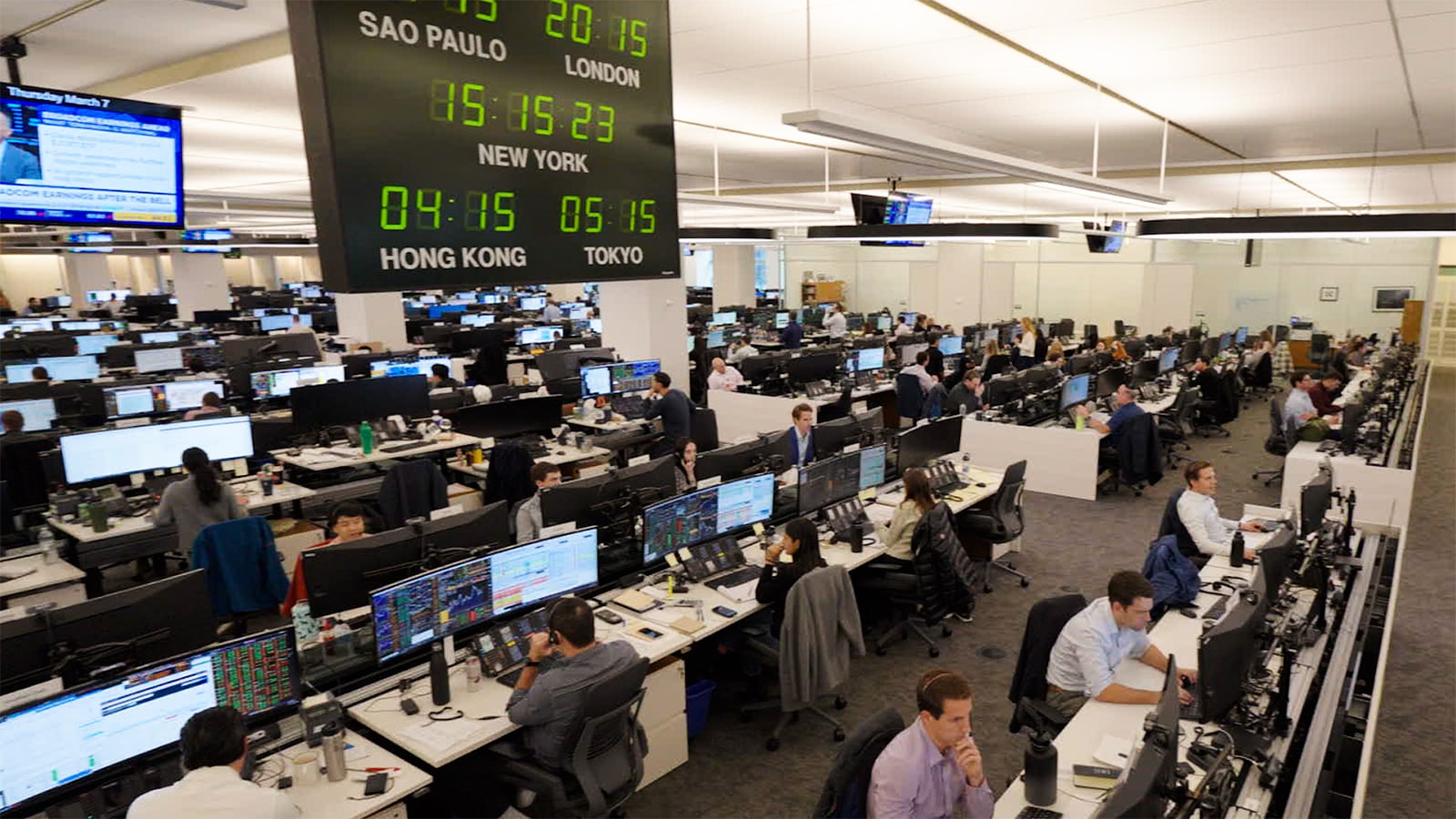
Goldman's retention model does not compete on lifestyle. It competes on prestige, compensation trajectory, and the quality of the professional network the firm provides. Annual performance reviews identify and remove the bottom 3%–5% of performers. The implicit message to everyone who remains is that they have cleared a bar that most applicants never reach — and that sustained high performance here is one of the most career-defining experiences available in finance.
Compensation is the primary retention tool. Coleman described Goldman's philosophy as paying "competitively — especially for our very best people in each domain." The firm treats its wage bill as a precision instrument: total compensation rises with performance and with the scarcity value of specific skills, not simply with tenure or headcount growth.
The trade-off is deliberate and open: Goldman offers access, prestige, and exceptional exit opportunities in exchange for in-person intensity, high performance expectations, and consistent accountability. This is not a model that works for everyone, and Goldman makes no attempt to disguise that.
📄 2025 AI Recruitment Casebook Goldman Sachs's OneGS 3.0 raises a question that now applies across every industry: as AI performs more analytical work, how should your hiring bar change, and which roles still require human judgment at the centre? MokaHR's AI Recruitment Report examines how companies across 10 industries are rethinking hiring in the age of AI — from screening automation to skills-first assessment frameworks. Download the free report →
Trusted by: Tesla · NVIDIA · McDonald's · Nestlé · Schneider Electric
How does Goldman Sachs develop and manage employee performance?
The apprenticeship model in practice
Goldman's development approach is not built around formal training programmes. It is built around the belief that elite talent, placed in close proximity to senior leaders and complex live work, develops faster than any curriculum can produce. The firm's stated model is "apprenticeship, on-the-job coaching and access to leaders" — growth through doing, not through attending.
This model has a specific structural requirement: in-person presence. CEO David Solomon has maintained this position consistently since 2021. He has cited Goldman's apprenticeship model as the primary reason the firm maintained its five-day in-office expectation when many peers shifted to hybrid or remote arrangements. His framing — that in-person presence is a learning infrastructure decision, not a management preference — is more defensible than the vague productivity arguments some executives use. It grounds the policy in a genuine theory of how skills are built rather than making it simply appear like executive control.
A proximity-based development model has also worked well at P&G, which builds leaders through years of structured rotations across functions and markets, with senior mentorship embedded at every stage. The mechanism is different from Goldman's — P&G's is more programmatic, Goldman's more organic — but the underlying conviction that people develop best through sustained contact with more experienced colleagues is the same.
Performance management: high standards, continuous calibration
Goldman's performance management is continuous in practice, even when it is formally periodic. Annual reviews are the official mechanism, but the real calibration happens throughout the year through client feedback, deal outcomes, and the running judgements of senior leaders. The bottom-performer removal process — targeting 3%–5% annually — is not just a cost tool. It is a cultural signal that makes clear to every employee that assessment is ongoing and standards are real.
In 2025, Goldman pulled its annual performance review cycle forward from September to Q2, partly in connection with the OneGS 3.0 restructuring. This signals a broader direction: the firm is moving toward more continuous performance calibration, with underperformance addressed in real time rather than batched into a single annual event.
The compensation-to-revenue ratio has remained stable at approximately 32.5% for the first nine months of 2025, even as revenues grew significantly. That discipline reflects a commitment to ensuring that pay rises with performance and with the firm's overall results — not simply with headcount or seniority.
Metric | Data |
|---|---|
Employees (December 2025) | ~47,400 |
Revenue per employee (FY2025) | ~$1.23 million |
Net earnings (FY2025) | $17.2 billion |
Compensation-to-revenue ratio (9M 2025) | 32.5% |
Summer internship applicants (2025) | ~365,000 |
Lateral applicants annually | 1 million+ |
Acceptance rate (all channels) | <1% |
Alumni in C-suite roles at $1bn+ orgs | 650+ |
The OneGS 3.0 challenge: AI and the future of apprenticeship
The most consequential development in Goldman's talent strategy right now is the tension that OneGS 3.0 creates with the apprenticeship model itself. The initiative — covering every division from investment banking to control functions to engineering — asks teams to identify repeatable human processes that can be digitised or automated. Six internal workstreams are building business cases for AI-driven efficiency, with the stated goal of driving more scale and growth without proportional headcount increases.
The challenge this creates for talent development is genuine. If AI performs the bulk of the financial modelling, analysis, and document drafting that junior bankers have historically used to build their skills, the traditional "learn by doing" model becomes harder to run. Analysts who spend two years supervising AI outputs rather than producing analysis themselves may reach senior roles with thinner foundational capabilities than their predecessors. Goldman has not yet publicly set out how it plans to adapt its development model in response. That gap is worth watching.
The upshot: Goldman's performance culture works because it creates continuous, visible accountability at every level. High standards are consistently enforced, and that clarity of expectation is what allows the apprenticeship model to produce the returns it does. The coming challenge is whether those standards can be maintained as the nature of the underlying work changes.
What can HR leaders learn from Goldman Sachs's approach?
Goldman Sachs operates in a context most organisations cannot replicate: extreme brand prestige, extraordinary compensation budgets, and a labour market where the firm receives more than a million unsolicited applications each year. The specific mechanics of its model are not transferable wholesale. The underlying logic is.
Treat selectivity as a strategic investment, not just a hiring standard. Goldman's sub-1% acceptance rate is not only a consequence of being famous — it is the result of a deliberate decision to maximise the applicant pool and then filter rigorously. Any organisation can apply this logic at its own scale: invest in employer brand to widen the top of the funnel, then tighten the filter through structured interviews and standardised assessment. AI-powered candidate screening tools allow HR teams to maintain a high-quality filter at larger applicant volumes without proportionally increasing recruiter workload.
Make performance standards explicit, visible, and consistently applied. Goldman's bottom-performer removal process is known to every employee from day one. That transparency — uncomfortable as it sounds — produces a culture of accountability that softer mechanisms rarely generate. You do not need to remove 3%–5% of your workforce annually to borrow this principle. But you do need clear, published performance standards applied consistently. Vague standards and inconsistent enforcement undermine the credibility of the entire performance system. The same logic applies to hiring standards: groups with decentralised recruitment operations often discover that their standards diverge significantly across divisions or regions without anyone noticing. China Pacific Insurance (CPIC) — one of China's three largest insurers — faced exactly this challenge at scale. By implementing MokaHR, CPIC unified its group-wide recruitment standards, automated the processing of high-volume campus hiring resumes, and improved candidate quality across the board. The result was more agile talent operations in a large-scale environment — and a consistent hiring bar that could be applied and audited across the entire group. Recruitment automation platforms are the practical infrastructure that makes group-wide standard-setting enforceable rather than aspirational.
Ground your flexibility or in-office policy in your actual development model. Goldman's in-office requirement is often discussed as a cultural preference. Solomon frames it as a learning infrastructure decision. Whether or not you agree with the outcome, that framing is more honest and more useful than generic productivity claims. If your organisation has a genuine development model that depends on proximity and collaboration, make that argument explicitly. If your flexibility policy is disconnected from how you actually develop people, it will not hold up under pressure.
Plan for the AI-development paradox now. Goldman's OneGS 3.0 is the most visible current example of a challenge that will reach most knowledge-work organisations over the next five years: if AI performs entry-level work, who develops junior people, and how? Workforce analytics platforms can help HR teams map which roles are most exposed to automation and model the downstream effects on succession pipelines before those gaps become urgent.
What is it like to work at Goldman Sachs?
Goldman Sachs does not sell an easy culture. Its own public materials make the trade-off clear: in-office intensity, high performance expectations, and demanding hours, in exchange for rare access, fast learning, and career trajectories that are difficult to replicate elsewhere.
The firm's inclusion networks are a genuine structural investment. Goldman runs employee networks across gender, ethnicity, sexual orientation, religion, and disability, framing these not as compliance infrastructure but as community mechanisms that stabilise the culture when hours are long and feedback is constant. A sense of belonging, the firm's materials suggest, is one of the few stabilisers available in a high-intensity environment.
Goldman has also navigated well-publicised challenges. A 2021 survey circulated by a group of junior analysts reported 95-hour working weeks and deteriorating mental health. The firm introduced weekend workload protections in response, though enforcement has been variable. This is an area where Goldman's culture remains under scrutiny — and where HR directors benchmarking against it should note that its talent outcomes are achieved alongside working conditions that many employees and candidates find difficult to sustain.
On compensation transparency, Goldman maintains a deliberate opacity that contrasts with the growing pay-transparency trend. Ranges are not publicly posted; pay is negotiated at an individual level. This reinforces the pay-for-performance culture but creates compliance challenges in jurisdictions where transparency legislation is tightening, particularly across the EU and UK.
Frequently asked questions
Q: How does Goldman Sachs hire employees? Goldman Sachs uses a multi-stage process including competency-based interviews, technical assessments, and senior-led evaluations. The firm receives over one million lateral applications annually and accepts fewer than 1%. Its 2025 summer internship programme drew approximately 365,000 campus applicants at the same acceptance rate.
Q: What is Goldman Sachs's apprenticeship culture? Goldman describes its model as an apprenticeship: junior employees develop by working alongside senior leaders on live deals and client engagements. CEO David Solomon has stated that roughly 65% of staff are fully in-office five days a week, framing in-person presence as a learning infrastructure requirement rather than a cultural preference.
Q: What is Goldman Sachs's OneGS 3.0 initiative? OneGS 3.0 is a multi-year AI transformation announced in late 2025, integrating AI and agentic AI across all divisions to reduce complexity and boost productivity. Six internal workstreams are identifying repeatable processes for automation. The initiative was accompanied by a reduction of more than 1,000 roles.
Q: How does Goldman Sachs manage employee performance? Goldman operates a continuous pay-for-performance model. Annual reviews remove the bottom 3%–5% of performers — a process brought forward from September to Q2 in 2025. The compensation-to-revenue ratio held at approximately 32.5% for the first nine months of 2025, reflecting tight alignment between pay and results.
See also:
Ready to build a more rigorous, data-driven hiring process? See how MokaHR's AI-powered screening and structured recruitment workflows help HR teams raise the quality bar on every hire — without proportionally increasing the workload on your TA team. Book a personalised demo →
From recruiting candidates to onboarding new team members, MokaHR gives your company everything you need to be great at hiring.
Subscribe for more information
© Copyright 2025 MokaHR - All Rights Reserved.