Talent & Culture Strategy at NVIDIA: No Hierachy, No Limits

This article is part of MokaHR's Talent & Culture Strategy series, which profiles how leading companies build their people strategies.
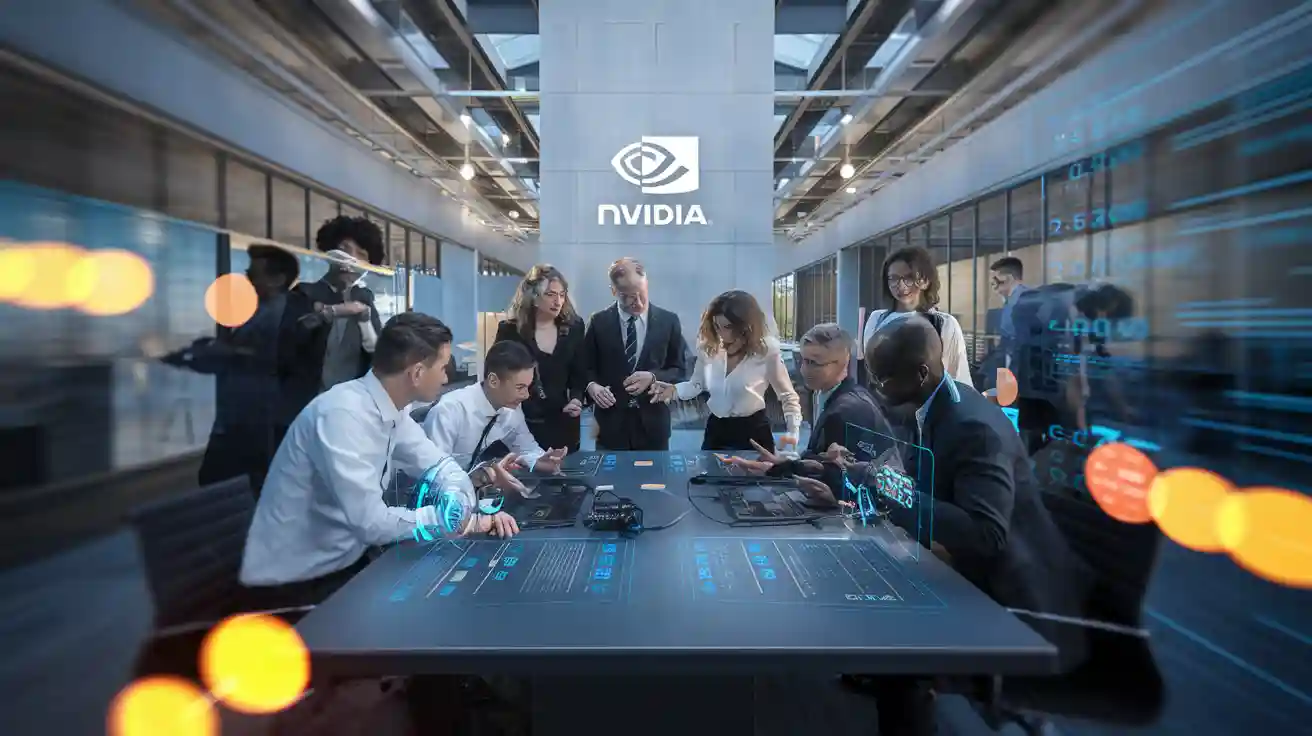
In January 2023, as major technology companies were announcing the largest rounds of workforce reductions since the financial crisis — Meta cutting 11,000 employees, Amazon 18,000, Google 12,000 — Jensen Huang sent his workforce a different kind of message. NVIDIA would not be laying off staff. Instead, the company would be hiring aggressively into the AI infrastructure opportunity it had spent a decade positioning for.
That decision proved to be a defining talent moment. Over the following 18 months, NVIDIA's share price increased by more than 400%, its revenue more than tripled year-over-year, and its voluntary employee turnover rate fell to 2.7% in FY2024 — at a time when the broader technology sector was experiencing average voluntary attrition of approximately 13%. The contrast was not accidental. It was the result of a talent and culture philosophy that NVIDIA had been building since the company's earliest years: hire exceptional people, give them genuine ownership, and operate with a radical transparency that renders internal politics largely impossible.
Understanding NVIDIA's talent and culture strategy matters to HR leaders not because the company is unusually large or wealthy — many large, wealthy companies have undistinguished people practices — but because NVIDIA has solved a problem that defeats most organisations: how to sustain a high-performance, innovation-driven culture as headcount scales rapidly. Between FY2022 and FY2025, NVIDIA grew from approximately 19,000 employees to over 36,000 without a corresponding increase in attrition, a degradation of employer brand scores, or a dilution of the cultural practices that distinguished it as a workplace.
Detail | Data |
|---|---|
Founded | 1993, Santa Clara, California |
Headquarters | Santa Clara, California, USA |
Employees | 36,300+ (FY2025) |
Revenue (FY2025) | $130.5 billion (up 114% YoY) |
Core business | GPU design, AI computing platforms, data centre infrastructure |
Glassdoor rating | 4.6 / 5.0 (2024) |
CEO approval | 98% (Glassdoor, 2024) |
NVIDIA's employer recognition reinforces this picture. The company ranked #5 on Fortune's 100 Best Companies to Work For in 2025, #2 on Fortune's Best Workplaces in Technology in both 2023 and 2024, and #25 on Great Place to Work's World's Best Workplaces in 2024. In Great Place to Work's survey data, 95% of NVIDIA employees describe it as a great place to work, compared to a US average of 57%.
How does NVIDIA attract and hire talent?
A philosophy built around technical depth and cultural alignment
NVIDIA's talent acquisition philosophy reflects a clear hierarchy of priorities: technical capability comes first; cultural alignment — specifically, whether a candidate demonstrates the intellectual curiosity and ownership mentality that defines NVIDIA's operating culture — is assessed in parallel. Academic credentials, company name recognition, and years of experience play a secondary role.
This approach is more common in rhetoric than practice at most technology companies. At NVIDIA, it has structural support. The company's interview process is deliberately designed to surface problem-solving ability under pressure. Candidates for engineering roles typically complete multiple rounds of technical assessment — coding challenges, systems design exercises, and deep-dive discussions with senior researchers or engineers who are themselves active contributors to the domains they are evaluating. The emphasis on peer-level technical review rather than hiring-manager-driven assessment creates a strong signal-to-noise ratio that filters for genuine depth rather than interview coaching.
The result is a workforce composition that is unusually concentrated in advanced technical specialisms. NVIDIA's engineers and researchers have contributed to defining architectures — CUDA, Tensor Cores, the Transformer Engine in H100 — that have set de facto industry standards for AI computing. This technical density is both a product of the hiring approach and a reinforcing driver of candidate attraction: exceptional engineers want to work alongside other exceptional engineers on genuinely hard problems.
Global sourcing and university partnerships
NVIDIA draws talent from a global pipeline, with significant recruiting presence at research universities in North America, Europe, and Asia. The company's University Recruiting programme targets graduate students and recent PhDs working in computer vision, natural language processing, computer architecture, and systems software — fields directly relevant to NVIDIA's product roadmap. This pipeline has become increasingly important as competition for AI research talent has intensified: companies including Google DeepMind, OpenAI, and Meta AI are recruiting from the same graduate cohort.
NVIDIA's research credibility is a material advantage in this competition. The company's publications record in venues such as NeurIPS, CVPR, and ICLR, combined with access to compute infrastructure that few academic environments can match, makes NVIDIA an attractive destination for researchers who want to pursue fundamental work at applied scale. This is a distinct positioning from pure product companies, where research is often subordinated to near-term product objectives.
NVIDIA also maintains a strong internship programme that serves as a primary conversion pipeline for early-career technical hires. Interns work on live projects — not simulated exercises — and are evaluated against the same standards as full-time candidates. Conversion rates from intern to full-time offer are high, and the programme functions as an extended, low-risk audition that reduces hiring uncertainty on both sides.
This approach to structured, relationship-based early-career hiring contrasts with OpenAI's more centralised, mission-led acquisition model, which leans heavily on network referrals and research reputation to attract candidates at smaller headcount targets. NVIDIA's model trades volume for precision, reflecting a company where individual contributors carry unusually high leverage.
Compensation and offer competitiveness
NVIDIA's compensation architecture is deliberately above-market, particularly for senior technical roles. The company uses equity as a primary retention mechanism: restricted stock units vest over multi-year cycles, and as NVIDIA's share price appreciated significantly between 2023 and 2025, the effective value of unvested equity created a powerful financial disincentive to leave. This is not unusual in Silicon Valley, but the magnitude of NVIDIA's appreciation during this period meant that retention through equity was operating at an extraordinary scale — engineers who joined in 2021 or 2022 held unvested packages worth multiples of their annual cash compensation by 2024.
The risk embedded in this model is concentration: a sustained decline in NVIDIA's share price could rapidly erode this retention mechanism. It is worth noting that the company's underlying culture and talent practices predate its current valuation by several years — the employer brand scores that underpin NVIDIA's attraction and retention were consistently high even before the 2023–2025 run-up.
📄 2025 AI Recruitment Casebook NVIDIA's talent strategy — built around technical depth, global sourcing, and structured interview rigour — is increasingly the benchmark for companies competing in the AI talent market. To see how leading companies across 10 industries are redesigning their recruitment practices in response to AI talent competition, download MokaHR's full AI Recruitment Report. Download the free report →
Trusted by: Tesla · NVIDIA · McDonald's · Nestlé · Schneider Electric
How does NVIDIA develop and manage employee performance?
Learning through ownership, not programmes
NVIDIA's approach to employee development is structurally unusual: the company does not operate a formal leadership academy, rotational graduate scheme, or structured management development programme in the manner of, say, P&G's build-from-within model. Instead, development is embedded in the work itself. Engineers and researchers are given substantial ownership of complex, multi-year initiatives and are expected to develop the skills their projects demand — with support from managers and peers, but without a prescribed curriculum.
This model works because NVIDIA's projects are genuinely challenging and consequential. An engineer working on CUDA kernel optimisation, GPU memory hierarchy design, or large language model inference efficiency is developing capabilities through direct application that no training programme could replicate. The learning curve is steep, but the relevance is immediate. Jensen Huang has spoken publicly about the principle that NVIDIA should give its people "the opportunity to do the best work of their lives" — a formulation that positions the work itself as the development vehicle. This philosophy shares common ground with Google DeepMind's research-led development model, where proximity to frontier problems is treated as the primary mechanism for talent growth.
The model also has explicit limits. It selects strongly for people who can self-direct their development and absorb context rapidly. NVIDIA acknowledges this by hiring for intellectual curiosity as a core criterion — candidates who demonstrate a history of learning across domains, not just depth in a single specialisation. New employees are expected to onboard quickly into complex technical environments, and the company's relatively flat organisational structure means there are few intermediate layers to absorb the transition.
Performance management: transparency as a system
NVIDIA's performance culture is shaped significantly by Huang's approach to feedback. Rather than conducting private one-on-one performance conversations, Huang gives feedback in group settings — including to direct reports — so that the broader team can learn from the discussion. This practice, which Huang has described as deliberately avoiding the "manager-as-protector" dynamic, creates a high-transparency environment where performance expectations are visible and consistent across levels.
The company does not use a stack-ranking system, a performance improvement programme architecture, or formal annual review cycles in the conventional sense. Performance is assessed continuously through project outcomes, peer input, and manager observation. This approach aligns with the broader move away from annual performance reviews that companies like Adobe pioneered with its Check-in system, which replaced annual reviews with ongoing structured conversations. NVIDIA's implementation is less formalised — it relies more on cultural norms than on process infrastructure — but the outcome is similar: performance is a continuous conversation rather than a periodic event.
NVIDIA's relatively flat hierarchy means that senior engineers are often directly accessible to junior colleagues, compressing the feedback loop further. A mid-level engineer working on a GPU architecture problem may interact directly with a principal researcher or distinguished engineer within weeks of joining. This access accelerates development and creates a strong sense of intellectual community.
Metric | Value | Source |
|---|---|---|
Voluntary turnover (FY2024) | 2.7% | NVIDIA Sustainability Report 2024 |
Voluntary turnover (FY2023) | 5.3% | NVIDIA Sustainability Report 2023 |
Employee headcount (FY2025) | 36,300+ | NVIDIA Annual Report FY2025 |
Women in workforce | 19% globally | NVIDIA CSR Report 2024 |
Employees from underrepresented groups (US) | 15% | NVIDIA CSR Report 2024 |
Training investment | Not publicly disclosed | — |
Diversity and inclusion
NVIDIA publishes workforce diversity data in its annual CSR report. Women represent 19% of the global workforce — a figure the company acknowledges as below its own targets — and underrepresented groups account for 15% of the US workforce. NVIDIA's 2024 CSR report states that "improving representation at all levels of the organisation remains a priority" and outlines commitments to expand partnerships with historically Black colleges and universities, increase the share of women in technical roles, and improve representation in senior leadership. Progress against these targets has been modest, a pattern common across the semiconductor and AI infrastructure sectors.
What can HR leaders learn from NVIDIA's approach?
NVIDIA's talent and culture model is not fully portable — it depends on a combination of genuinely exceptional technical challenges, near-unlimited compute access, and a share price trajectory that has created extraordinary retention incentives. But the underlying principles are more transferable than the specific context suggests.
Radical transparency reduces the cost of management overhead. NVIDIA operates with roughly eight to nine organisational layers from Jensen Huang to an individual contributor — unusually flat for a company of 36,000 employees. Huang is known for having 40–60 direct reports at any given time, a management span that forces information to flow horizontally rather than being filtered through hierarchical layers. For HR leaders, the practical lesson is that transparency — about strategy, about performance expectations, about the reasoning behind decisions — reduces the political behaviour that drives voluntary attrition in opaque organisations. Structured communication frameworks within an ATS can support this at the hiring stage by ensuring candidates receive consistent, timely information throughout the process, setting a transparency standard from day one.
Hire for intellectual range, not just domain depth. NVIDIA's ability to innovate across GPU architecture, AI software, autonomous vehicles, and robotics simultaneously reflects a workforce that can learn across domains, not just specialists locked into narrow roles. The implication for talent acquisition is that behavioural and cognitive assessments — measuring learning agility, intellectual curiosity, and cross-domain reasoning — should carry material weight alongside technical qualifications. AI-powered candidate matching platforms can help operationalise this by surfacing candidates whose profile data and assessment responses indicate high learning agility, not just specific credential matches.
Equity-linked retention works — but only until it doesn't. NVIDIA's retention metrics are exceptional in part because unvested equity created powerful financial incentives to stay during a period of extraordinary share price appreciation. HR leaders benchmarking against NVIDIA's turnover numbers should be careful to separate cultural drivers — the transparency, the work quality, the intellectual community — from financial ones. Companies without NVIDIA's share price trajectory can still access the cultural drivers; they cannot replicate the equity dynamics. Building retention on cultural foundations is more durable than building it on compensation arbitrage. Recruitment workflow tools that track candidate motivations throughout the hiring process can help identify whether candidates are joining for the mission or the money — a distinction that predicts retention more reliably than most other signals.
Avoid layoffs as a default cost-reduction instrument. NVIDIA's decision not to participate in the 2023 technology sector layoff cycle was a significant cultural signal that reinforced employee trust and reduced attrition. Companies that lay off staff repeatedly — even if the financial rationale is sound — erode the psychological safety that allows high-risk innovation to happen. This does not mean headcount should never be reduced; it means that layoffs should be understood as culture events with long-term employer brand consequences, not just cost line items.
What is it like to work at NVIDIA?
NVIDIA's workplace culture is defined by three characteristics that employees cite with unusual consistency: intellectual intensity, flat access, and a genuine absence of internal politics.
The intellectual intensity is structural. NVIDIA's products sit at the frontier of what is technically possible — GPU architecture, large language model infrastructure, real-time ray tracing, autonomous driving systems. Employees working on these problems are, by definition, working on questions that do not yet have settled answers. This creates an environment where intellectual engagement is the norm rather than an aspiration, and where the gap between research and production is compressed in ways that most organisations cannot replicate.
The flat access is deliberate. Huang's practice of holding large group meetings rather than private one-on-ones, his willingness to share strategic context directly with individual contributors, and the company's policy of providing all employees with equal access to internal information systems means that junior employees frequently engage directly with senior leadership. New graduates have described joining a team meeting in their first month and receiving direct feedback from a vice president or distinguished engineer. The cultural effect of this access — a strong sense that individual contribution is visible and valued — is a meaningful driver of engagement scores that exceed those of companies with more generous benefits packages.
NVIDIA operates primarily from its Santa Clara campus and major engineering hubs in Austin, Durham, and internationally in cities including Taipei, Tel Aviv, and Pune. The company's hybrid working policy emphasises in-person collaboration, particularly for engineering roles, while offering flexibility for roles that do not require physical lab access. Employees in Great Place to Work surveys consistently rate the physical working environment highly, reflecting significant investment in NVIDIA's campus facilities.
The challenges are real. NVIDIA's culture is demanding — the intellectual standards are high, the pace of product cycles is intense, and the flat hierarchy means that ownership without guidance is the default mode. Employees who thrive are self-directed and comfortable with ambiguity; those who need structured management support may find the environment difficult. Glassdoor reviews reflect this duality: the company's overall ratings are exceptional, but a recurring theme in critical reviews is that career progression pathways can be opaque, and that the absence of formal development infrastructure places the burden of growth planning largely on the individual. NVIDIA has acknowledged this in its CSR reporting, committing to improve the clarity of internal mobility processes.
Frequently asked questions
What is NVIDIA's approach to talent acquisition?
NVIDIA prioritises technical depth and cultural alignment over traditional credentials, using a rigorous multi-stage interview process that includes coding assessments, technical deep-dives, and cross-functional panel interviews. The company sources globally, drawing candidates from over 35 countries, and evaluates them against a core set of behavioural principles — intellectual curiosity, directness, and a bias for ownership — in addition to technical qualifications. This approach has supported NVIDIA's headcount growth from approximately 19,000 employees in FY2022 to over 36,000 in FY2025 without a significant increase in voluntary attrition.
Why is NVIDIA's employee turnover rate so low?
NVIDIA's voluntary turnover fell to 2.7% in FY2024 — roughly one-fifth of the technology sector average of around 13% — driven by a combination of competitive compensation, near-total absence of mass layoffs, and a culture built on transparency and shared context. Jensen Huang's practice of conducting group feedback sessions rather than private performance discussions means information spreads horizontally across the organisation, reducing the political friction that drives talent away at peer companies. Employees also cite strong career development pathways and project ownership as retention drivers.
How does NVIDIA develop employees?
NVIDIA's development philosophy centres on learning through high-stakes project work rather than formal training programmes. Engineers and researchers are given significant ownership of complex, multi-year initiatives and expected to develop the skills their projects require. The company supplements this with internal mentorship, access to research collaborations with universities, and structured peer learning. NVIDIA has also expanded its early-career hiring significantly, with a University Recruiting programme that targets graduate students working on AI, graphics, and systems research.
What is it like to work at NVIDIA?
NVIDIA consistently ranks among the best large employers in the United States. The company placed #5 on Fortune's 100 Best Companies to Work For in 2025 and #2 on Fortune's Best Workplaces in Technology in both 2023 and 2024. On Glassdoor, NVIDIA holds a 4.6 out of 5 rating, with 98% of employees approving of Jensen Huang's leadership. Employees commonly cite intellectual challenge, project ownership, and a genuine absence of internal politics as reasons for high job satisfaction. The company operates across hybrid and in-person models, with an emphasis on on-site collaboration in its Santa Clara and global engineering hubs.
Ready to build hiring pipelines with the analytical rigour NVIDIA applies to talent acquisition? MokaHR's AI-powered ATS supports structured interviewing, skills-based screening, and real-time pipeline visibility for enterprise recruitment teams. Book a personalised demo →
See also:
From recruiting candidates to onboarding new team members, MokaHR gives your company everything you need to be great at hiring.
Subscribe for more information
© Copyright 2025 MokaHR - All Rights Reserved.