Talent & Culture Strategy at Walmart China:Personalize Development Journey

This article is part of MokaHR's Talent & Culture Strategy series, which profiles how leading companies build their people strategies.

During a visit to China in October 2024, Walmart's global CEO Doug McMillon made a remark that has since been quoted widely in retail circles: "In digital retail, China is more advanced than any other market we operate in." He was talking about technology. But the statement applies equally to Walmart China's talent strategy — a model that has diverged so significantly from its US parent's playbook that it now operates, in practice, as a largely autonomous people operation built around local leadership, local hiring, and local learning.
The results speak for themselves. Walmart China — encompassing both its hypermarket network and the fast-growing Sam's Club membership business — generated $6.1 billion in net sales in fiscal year 2025, up 21.8% year-on-year, with e-commerce accounting for more than half of total revenue. Comparable sales climbed 13.8%. Nearly 80% of digital orders are fulfilled within one hour. Sam's Club, with 55 operational outlets across 25 cities and 10 new stores planned for 2025 — its busiest expansion year ever — is emerging as one of Walmart's strongest growth engines globally.
Behind those numbers is a workforce of nearly 100,000 associates, of whom 99.9% are local Chinese hires. Every store and club is managed by Chinese talent. Women hold more than 50% of management roles at supervisor level and above. And the talent & culture strategy at Walmart China has been recognised by the Top Employers Institute for two consecutive years, with an overall assessment score that exceeded the average of more than 2,300 certified companies worldwide in 2024.
This article examines how Walmart China has built that workforce — what its hiring, development, and culture model looks like in practice, and what HR leaders can take from it.
Detail | Data |
|---|---|
Market entry | 1996, Shenzhen (first hypermarket and Sam's Club in China) |
Stores and clubs | ~336 (283 Walmart hypermarkets + 53 Sam's Clubs as of end-2024; 55 Sam's Clubs by mid-2025) |
Net sales (FY2025) | $6.1 billion, +21.8% YoY |
E-commerce share | >50% of total sales |
Comparable sales growth (FY2025) | 13.8% |
Workforce composition | 99.9% Chinese associates |
Women in management | >50% at supervisor level and above |
Women as % of total associates | 64% |
Employer recognition | Top Employer China 2023 and 2024; Great Place to Work certified |
Christina Xiaojing Zhu, President and CEO of Walmart China since 2021, has articulated the company's philosophy in terms of its people: "Success is about finding the right talent and helping them unlock their potential. Building an organisation where people can grow is the most valuable thing you do. The rest follows as a natural byproduct." Maryann Xiaohong Xu, Senior Vice President and Chief Human Resources Officer, has similarly framed the talent agenda: "Employees are Walmart's most cherished assets. We aim to build a positive ecosystem for selecting, utilising, nurturing, and retaining talented individuals."
How does Walmart China attract and hire talent?
Localisation as the foundational hiring principle
The single most distinctive feature of Walmart China's talent strategy is the depth of its localisation. The 99.9% local workforce figure is not a diversity metric — it is a structural choice that shapes every aspect of how the company hires, develops, and retains people. All stores and clubs are managed by Chinese associates. Corporate functions are run locally. The practical implication is that Walmart China must source, develop, and promote its own leadership pipeline rather than relying on expatriate talent or headquarters transfers.
This has made campus recruitment a strategic priority rather than a volume exercise. In 2023, Walmart entered 32 universities across 22 cities, running immersive engagement programmes that let students experience Walmart's culture and values directly. The result was an 85% year-on-year increase in campus recruitment applications — a figure that reflects both the growing employer brand strength of Sam's Club and the deliberate investment in early-career pipeline development.
The company recruits through two structured campus channels: the Talent Elite Program for high-potential graduates, and School-Enterprise Cooperation partnerships that build relationships with universities over time. Both programmes feed into Walmart's management trainee track, which is the primary pathway for developing the store and club general managers the company's expansion plan requires.
The management trainee programme
Walmart China's management trainee programme takes university graduates through two years of structured job rotation, cross-departmental experience, and systematic leadership training. The design is intentional: rather than placing trainees into a single function, the rotation model builds operational breadth and exposes participants to how different parts of the retail business connect. Trainees who complete the assessment process are promoted to deputy general manager roles in stores or placed in key functional positions, with further advancement along clearly defined career paths.
This model addresses a specific business problem. Walmart China is opening 10 new Sam's Club locations in 2025 alone — the most in a single year in the club's history in China. Each new club requires a general manager with the operational capability, cultural fluency, and customer orientation to run a premium membership experience. The trainee programme is, in part, a factory for those leaders.
McDonald's has built one of the most studied frontline-to-management career pipelines in global F&B, including its Hamburger University leadership development infrastructure. Walmart China's approach follows the same underlying logic — invest heavily in early-career development to create a self-sustaining internal leadership supply — though adapted for a retail environment with very different product, customer, and operational complexity.
Retention and the listening strategy
Walmart China's approach to retention is built around what it calls its "employee listening strategy" — a systematic effort to create communication channels between associates and leadership across multiple formats. CEO Afternoon Tea sessions allow frontline associates to speak directly with senior leadership. Listening tours take leaders into stores and clubs. Grassroots meetings and pulse surveys complement the annual global engagement survey.
The 2024 Top Employers Institute assessment gave Walmart China a score of 100% on employee listening — a metric that captures both the breadth of listening mechanisms and the degree to which feedback demonstrably influences policy. The company's net employee recommendation score reached its highest recorded level in 2023, suggesting that the listening infrastructure is producing outcomes that associates themselves recognise.
The takeaway on acquisition and retention: Walmart China's talent strategy starts with a structural commitment to local talent that requires the company to build its own pipeline rather than hire it in. That is a more demanding model — but it produces a workforce with deeper organisational and cultural alignment than one assembled through lateral hiring.
📄 2025 AI Recruitment Casebook Walmart China's campus recruitment growth — 85% more applications in a single year — reflects what strategic employer branding combined with structured talent pipelines can achieve. To see how companies across 10 industries are using AI to improve hiring quality, reduce time-to-fill, and build more predictive talent pipelines, download MokaHR's full AI Recruitment Report. Download the free report →
Trusted by: Tesla · NVIDIA · McDonald's · Nestlé · Schneider Electric Trusted by 3,000+ enterprises | 30%+ of Fortune 500 companies
How does Walmart China develop and manage employee performance?
A three-track training architecture
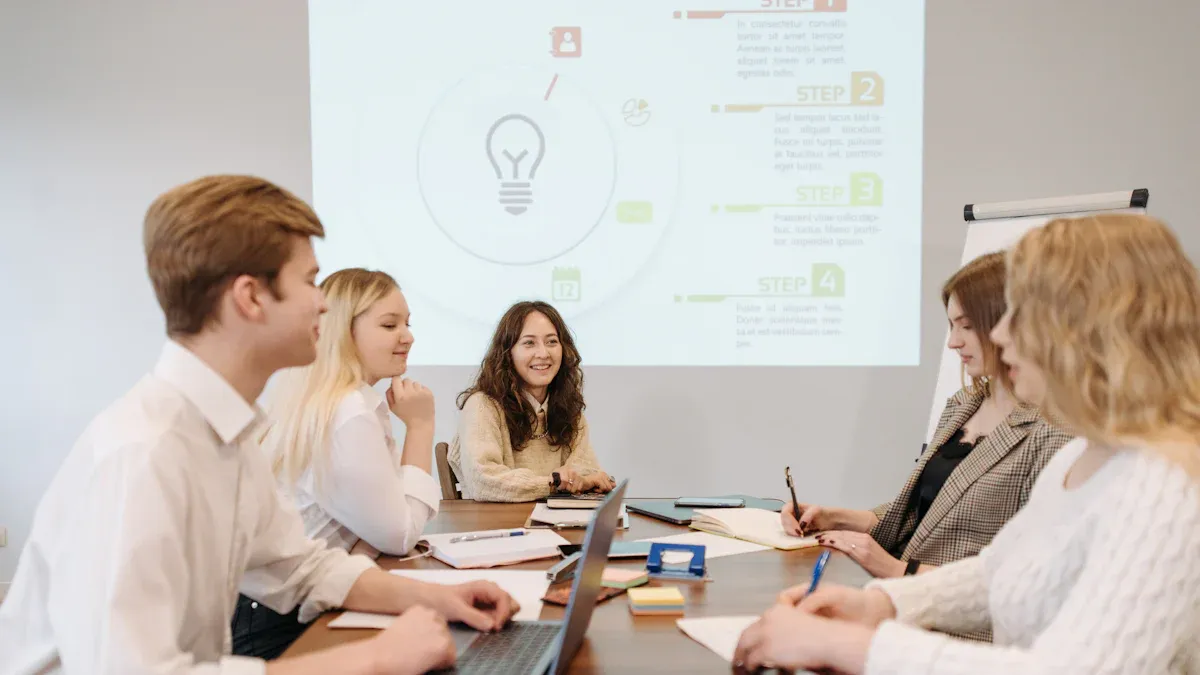
Walmart China has built its learning and development infrastructure around three distinct tracks, each tied to a different stage of career progression. The first is an operations job learning map for new hires — a structured onboarding curriculum that covers the operational fundamentals of running a store or club. The second is business competency training for associates at various levels, focused on the commercial and customer service skills that drive sales and membership retention. The third is leadership training for current and future managers, drawing on both Walmart's global leadership frameworks and locally adapted content.
All three tracks are accessible through a digital mobile learning platform that offers more than 3,000 online courses. Associates can access training according to their position, responsibilities, and individual needs — the platform delivers personalised learning paths rather than one-size-fits-all curricula. In 2023, the average training time per associate increased by 48% year-on-year, and the number of internal instructors — Walmart associates who deliver training to colleagues — nearly doubled. Both figures suggest genuine adoption, not just provision.
The digital platform also supports performance management and succession planning. Managers use reporting dashboards that draw on performance, competency, and development data to inform promotion and assignment decisions. This integration of learning data with talent decision-making is what distinguishes a mature learning infrastructure from a training catalogue.
Diversity and inclusion as a structural feature
Walmart China's diversity outcomes — 64% female associates, 50%+ women in management at supervisor level and above, ~800 employees with disabilities — are not the result of recent DEI initiatives. They reflect sustained institutional commitment over more than two decades.
The Women and Inclusion Leadership Committee, established in 2009, provides structured support for women's career development through empowerment training, leadership forums, and mentorship. The committee's existence since 2009 means it predates the current wave of DEI programming in most multinational organisations by more than a decade. The outcomes are commensurately different: gender parity in management is not an aspiration at Walmart China, it is a baseline.
The employment programme for associates with disabilities is similarly long-standing. Over 70% of Walmart China's approximately 800 disabled associates have been with the company for five or more years — a retention figure that suggests the programme is genuinely embedded in operations rather than performatively maintained.
A comparable commitment to workforce diversity in the FMCG sector can be seen at Nestlé, which has made gender balance in leadership a key component of its China talent strategy — though Walmart China's scale and the depth of its female management representation make its outcomes particularly striking.
Key workforce metrics
Metric | Figure | Source |
|---|---|---|
Local workforce (% Chinese associates) | 99.9% | Walmart corporate.walmart.com |
Women as % of total associates | 64% | Walmart China newsroom, 2023 |
Women in management (supervisor+) | >50% | Walmart China newsroom, 2023 |
Associates with disabilities | ~800 | Walmart China newsroom, 2023 |
Disability associate retention (5+ years) | >70% | Walmart China newsroom, 2023 |
Online training courses available | 3,000+ | Walmart China newsroom, 2024 |
Average training time increase (2023 YoY) | +48% | Walmart China, Top Employer 2024 |
Internal instructor growth (2023) | Nearly doubled | Walmart China, Top Employer 2024 |
Campus recruitment applications (2023 YoY) | +85% | Walmart China, Top Employer 2024 |
Employee listening score (Top Employers 2024) | 100% | Top Employers Institute |
Net sales FY2025 | $6.1 billion (+21.8% YoY) | Walmart Q3 FY2025 earnings |
The takeaway from Walmart China's development model: the combination of structured career pathways, a digital learning platform at genuine scale, and long-standing diversity infrastructure creates a talent development system that compounds over time. The 48% increase in training hours and the near-doubling of internal instructors in a single year are not isolated metrics — they reflect a system that is accelerating, not plateauing.
What can HR leaders learn from Walmart China's approach?
Walmart China's talent model is built for a specific context: a large-format retail business that must simultaneously run thousands of store-level operations, grow a premium membership club, and compete in one of the world's most sophisticated digital retail markets. Not all of its practices are universally applicable. But several of the underlying principles translate directly.
Localisation is not just a hiring policy — it is an organisational design choice. Walmart China's 99.9% local workforce means the company has no option but to invest in its own talent pipeline. It cannot parachute in managers when gaps appear. This constraint has produced a more disciplined approach to succession planning, management trainee development, and internal promotion than many multinationals that rely on lateral hiring to fill leadership roles. If your organisation is expanding into new markets and relying on expats or headquarters transfers to fill management positions, you are deferring a talent development problem, not solving it. Structured recruitment workflows that track internal candidate pipelines alongside external hiring can make the gap visible before it becomes critical.
The listening infrastructure matters as much as the engagement survey. Walmart China's 100% score on employee listening in the Top Employers assessment reflects not just the annual survey but the multiple supplementary channels — CEO Afternoon Tea, listening tours, pulse surveys — that create ongoing dialogue. Most organisations do one thing and call it listening. Walmart China does several things and connects them to action. Recruitment analytics platforms that capture candidate experience data alongside employee engagement signals can extend the listening infrastructure into the hiring process itself — which is often where the most diagnostic data about employer brand perception lives.
Career pathways need to be visible to be useful. Walmart China's management trainee programme works because graduates can see where the two-year investment leads — deputy general manager, then general manager, then further. Vague promises of development do not move needle on retention. Concrete pathways with defined criteria and timelines do. Adobe's Career Discovery tool demonstrates the same principle in a very different industry: making internal mobility visible is one of the highest-leverage things an HR function can do for retention, and it requires data infrastructure more than budget.
Diversity outcomes at Walmart China's level require institutional commitment measured in decades, not quarters. The Women and Inclusion Leadership Committee has been running since 2009. The disability employment programme has retention figures that reflect years of operational integration. Neither outcome is the product of a recent initiative. HR leaders who want to move the needle on representation need to think in terms of structural changes to hiring criteria, career development support, and management accountability — and accept that the results will compound slowly before they become visible.
What is it like to work at Walmart China?

Walmart China's workplace culture is shaped by the company's founding principle — "our people make the difference" — which in the China context translates into a distinctive emphasis on associate recognition, community, and belonging. The company organises more than 3,000 associate events annually nationwide, providing tens of thousands of employees and their family members with activities covering physical health, psychological wellbeing, and personal development. Health corners equipped with blood pressure monitors and pulse oximeters are installed in stores across the country. National walking events attract more than 30,000 associate participants.
The employee assistance programme includes a 24/7 counselling hotline — a benefit that was stress-tested during the COVID-19 pandemic when Walmart China delivered 2,700 food and necessities packages to associates and families in Shanghai and Changchun, and distributed 2,000 health kits to Shenzhen headquarters staff. These are not metrics that appear on a diversity scorecard; they are evidence of how the company behaves when conditions are difficult, which is when employer commitments are most meaningfully revealed.
The workplace is notably female-led at every level. With 64% female associates and more than half of management positions held by women, gender parity at Walmart China is not a programme goal — it is the current state. The Women and Inclusion Leadership Committee runs leadership forums, mentorship, and empowerment training specifically designed to support women's career progression within the retail sector.
The honest tension in Walmart China's employer story is the one facing every large-format retailer: the company is in the middle of a significant strategic transformation from hypermarket to omnichannel, and that transformation has involved restructuring its store network alongside opening Sam's Clubs. The process of closing or converting hypermarkets while simultaneously expanding Sam's Club creates genuine uncertainty for associates whose roles are tied to formats under review. CEO Christina Zhu has spoken candidly about leading in "uncharted waters, without a map, GPS, or weather forecast" — a framing that is honest about the pace of change but may not fully address the lived experience of associates navigating that change at store level.
Frequently asked questions
How does Walmart China attract and develop talent?
Walmart China recruits through the Talent Elite Program and School-Enterprise Cooperation initiatives, entering 32 universities across 22 cities in 2023 — generating an 85% year-on-year increase in campus recruitment applications. New hires and associates receive customised training across operations, business competency, and leadership tracks through a digital mobile learning platform with more than 3,000 online courses. Average training hours per associate increased by 48% in 2023, and the number of internal instructors nearly doubled over the same period.
What is Walmart China's approach to diversity and inclusion?
Walmart China's workforce is 99.9% local, with Chinese associates filling all store and club management roles. Women represent 64% of the total associate base and hold over 50% of management positions at supervisor level and above. The company established its Women and Inclusion Leadership Committee in 2009 and employs approximately 800 associates with disabilities, more than 70% of whom have been with the company for five or more years. Walmart China received Top Employer certification consecutively in 2023 and 2024.
How does Walmart China develop future leaders?
Walmart China's management trainee programme recruits university graduates through two years of job rotation, cross-departmental experience, and systematic leadership training. Trainees who complete the assessment are promoted to deputy general managers in stores or placed in key functional roles, with further advancement through clearly defined career pathways. The company's digital HR platform supports performance management, competency tracking, and succession planning across the organisation.
How does Walmart China measure employee engagement?
Walmart China conducts annual associate engagement surveys as part of Walmart's global programme, supplemented by CEO Afternoon Tea sessions, listening tours, grassroots meetings, and pulse surveys. The company scored 100% on employee listening in the 2024 Top Employers Institute assessment. In recent years, the net employee recommendation score has reached its highest recorded level, with upward trends in engagement scores, integrity index, and willingness to stay.
Walmart China's people strategy has been built over nearly three decades, and it shows. The 99.9% local workforce, the gender parity in management, the disability employment programme, the management trainee pipeline, the 3,000-course digital learning platform — none of these are recent initiatives. They are the compounded result of consistent investment in a specific philosophy: that the people who run the business should be the people who understand the market, and that developing those people from within creates a more resilient organisation than hiring expertise from outside. As Sam's Club accelerates its China expansion, that philosophy is now the engine behind Walmart's fastest-growing retail format in any market globally.
Ready to build the internal talent pipelines and development infrastructure that Walmart China's growth model depends on? MokaHR helps companies across retail, F&B, and enterprise manage structured hiring, succession planning, and workforce analytics at scale. Book a personalised demo →
See also
From recruiting candidates to onboarding new team members, MokaHR gives your company everything you need to be great at hiring.
Subscribe for more information
© Copyright 2025 MokaHR - All Rights Reserved.