Picture a TA lead in Singapore who also hires for Kuala Lumpur, Jakarta and Hong Kong. Candidates reply on WhatsApp. Hiring managers approve offers in Lark or Microsoft Teams. Legal wants to know which country stores candidate data.
Most "best ATS" lists we reviewed for this guide are written for US buyers. They may compare feature counts and skip the questions that decide whether a system works in Southeast Asia.
This guide is written for that TA lead in APAC regions.
Inside, you'll find:
- one table comparing 8 ATS platforms and talent acquisition management solutions
- 6 evaluation criteria adapted for APAC hiring
- starting shortlists for 4 common hiring scenarios
- 10 demo questions that test vendor claims
A note on authorship: Moka AI publishes this blog and appears on the list. Every vendor entry, ours included, draws on public sources such as product, pricing and trust pages, and each one lists what to check in a demo. We last checked these sources in October 2026 and you can apply the same criteria to any vendor, Moka AI included.

Regional hiring teams often review candidates for several markets from one office. Photo: Thant Zin (uploaded by phyo min) on Unsplash, Unsplash License
Contents
- Quick comparison: 8 ATS platforms at a glance
- How to evaluate ATS software for APAC hiring: 6 criteria
- Which ATS fits your team? 4 hiring scenarios in APAC
- The 8 best ATS platforms for APAC enterprises, reviewed
- Questions to ask in an ATS demo (APAC edition)
- FAQs
1. Quick comparison: 8 ATS platforms at a glance
The table compares 8 ATS platforms by who each one suits, its key strengths, what to check and how it is priced. Use it to cut the list to three, then read the full reviews in section 4.
The Type column shows whether a platform is a standalone ATS, an AI-native ATS or a recruiting module inside an HCM suite. If you hire across several APAC markets, read the Watch-outs column first.
| Platform | Type | Best for | Key strengths | Watch-outs | Pricing model |
|---|---|---|---|---|---|
| Greenhouse | Standalone ATS | Structured hiring at mid-to-large companies | Structured hiring and 500+ integrations | Local app integrations: verify in demo | Quote-based (Core, Plus, Pro) |
| Moka AI | AI-native ATS | Mid-to-large enterprises hiring across APAC markets | AI screening, APAC-native integrations and built-in compliance | Confirm HRIS connector scope | Contact the team for a quote |
| Workday Recruiting | HCM module | Large enterprises already on Workday HCM | One system of record with HCM | Paradox agent scope and local channels | Quote-based |
| SAP SuccessFactors Recruiting + SmartRecruiters | HCM module | Large enterprises in the SAP ecosystem | Winston AI assistant for high-volume hiring | Migration path between the two products | Quote-based |
| iCIMS | Standalone ATS | Large enterprises with complex pipelines | Highly configurable system | No WhatsApp campaigns | Quote-based |
| Ashby | Standalone ATS | Tech companies focused on recruiting analytics | ATS, CRM, scheduling and analytics combined | AI features consume usage credits | Foundations published; Plus, Enterprise quoted |
| Workable | Standalone ATS | SMB and sourcing-led teams | 400M+ sourcing profiles, 200+ job boards | APAC data residency: verify in demo | Published plans plus AI credits |
| Darwinbox | HCM module | Enterprises wanting one Asia-based HCM suite | HCM suite with AI screening, WhatsApp alerts | Recruiting depth: verify in demo | Quote-based |
2. How to evaluate ATS software for APAC hiring: 6 criteria
The six criteria follow the order most APAC buying teams meet them: who you hire, how you reach candidates, what legal will approve, how well the AI performs, what the system connects to and what it costs over the contract. Use them to score any ATS software on your shortlist, including the platforms reviewed below.
2.1 Start with your hiring model: volume, roles and markets
Frontline and professional hiring call for different systems. A retail chain filling hundreds of store roles before a seasonal peak needs mobile applications, fast screening and bulk scheduling.
A fintech team hiring 40 engineers needs structured interviews, scorecards and pipeline analytics. Many APAC enterprises do both, so check whether one platform can run separate workflows, approval chains and screening rules by role type and by country.
Count your markets too. A single-country team can work with one language and one set of templates. A team hiring in four markets needs per-country workflows, languages and data rules from day one.
If you hire a few dozen people a year in one market, a lightweight ATS is usually enough. Section 3 maps these patterns to 4 team types.
2.2 Reach candidates where they reply: WhatsApp, LinkedIn or JobStreet?
Find out which channel your candidates answer first. In Southeast Asia that is often WhatsApp, not email. Check whether the ATS supports WhatsApp natively or through an add-on, and whether it posts to the job boards your markets use, such as JobStreet, JobsDB and LinkedIn.
It's essential to check whether the ATS integrates with your primary candidate engagement channels. After all, attracting a strong pool of qualified applicants depends on your ability to reach and engage candidates effectively.
If an ATS doesn't even integrate with the local job boards your team relies on, it may not be the right fit for your recruitment needs.

Test outreach in the channel your candidates actually use. Photo: Ruan Richard Rodrigues on Unsplash, Unsplash License
2.3 Check data privacy, residency and AI governance by market
When a recruiter in Singapore reviews an application from a candidate in Jakarta, candidate data may cross borders. That's why, when evaluating ATS vendors, the first priority should be to confirm that the vendor can support your recruitment operations in compliance with the data protection and AI governance requirements of each market you operate in.
This should take precedence over feature comparisons. Compliance is a go/no-go requirement, not a feature to weigh against convenience. Across APAC, markets differ in their requirements for candidate data processing, cross-border data transfers, and the use of AI in recruitment.
Asking recruiters to research and interpret every market's requirements individually would be unnecessarily complex.
An APAC-focused ATS vendor with a strong compliance framework should help you navigate these regional differences, clarify its compliance capabilities, and provide the information your team needs to assess whether the platform can support your hiring operations across markets.
The following lists key legislation in several markets for reference. Please refer to the latest updates published on the relevant official websites for the most current and authoritative information. This is general information, not legal advice.
- Singapore: Personal Data Protection Act (PDPA), including transfer limitation and data breach notification obligations, plus the PDPC's 2024 advisory guidelines on personal data in AI recommendation and decision systems
- Malaysia: Personal Data Protection Act 2010, amended in 2024, with official guidance on data protection officers and breach notification
- Indonesia: Law No. 27 of 2022 on Personal Data Protection
- Hong Kong: Personal Data (Privacy) Ordinance (Cap. 486)
2.4 Test how well the AI actually performs
Buying an ATS in 2027 is no longer just about finding a legacy system that records every step of the hiring process. Shortlisting ATS platforms with built-in AI capabilities is increasingly becoming the norm.
However, don't be swayed by fancy AI features alone. Test capabilities such as AI screening and AI interviews to determine whether they genuinely address your recruitment challenges and deliver practical value in real-world hiring scenarios.
AI resume screening. When a role draws hundreds of applications, the AI should rank them quickly and accurately. Run the parser on real resumes from your markets, including local-language and mixed-format files. Ask for the agreement rate between AI recommendations and recruiter decisions, and how the vendor measured it: sample size, roles and markets.
AI support in interviews. For first-round interviews, check whether the AI can run or support a structured screen. AI-generated questions and shared scoring rubrics help interviewers in different countries and teams score candidates on the same scale. AI interview summaries keep feedback on record and easy to compare.
Draw one clear line: AI ranks, asks questions and explains its reasoning. People make the final hiring decision.
2.5 Map integrations: HRIS, collaboration tools and e-signature
An ATS sits between your HRIS and the tools hiring managers open every day. Map each connection before the demo:
- HRIS: Do requisitions flow in from Workday, SAP or your local eHR, and do new-hire records flow back for onboarding?
- Collaboration: Can interviews land in Lark or Teams calendars, with video links, approvals and message alerts?
- E-signature: Can candidates sign offers on mobile, and does the signed file return to the candidate record?
Ask how each connection is built. A native integration is built and maintained by the vendor. Middleware or custom API work adds cost and needs a support owner on your side. Ask to see each integration running live, not on a slide.
2.6 Compare total cost of ownership and local support
List price is one line in total cost of ownership. Vendors charge by recruiter seat, open job, employee count or module, and some bill AI features separately through credits or add-ons. Ask for a quote that itemizes:
- implementation and data migration fees
- AI features and usage limits
- add-on modules such as CRM, texting or video interviews
- renewal terms and price caps
Local support belongs in the same calculation. Check whether the vendor has a service team in your region, which time zones it covers and how many weeks it needs to go live in your first market. A long rollout can cancel out a lower subscription fee.
3. Which ATS fits your team? 4 hiring scenarios in APAC
Before comparing vendors, decide which scenario describes your team. It helps you clarify your recruitment needs, making it easier to find the best-fit ATS.
Three questions sort most APAC hiring teams:
1. Hiring model: Your business model shapes your hiring needs. Companies in retail, F&B and logistics often recruit for high-volume frontline roles, making Section 3.2 more relevant. Those in SaaS, fintech and professional services typically focus more on professional or technical roles, making Section 3.3 a better fit.
2. Market coverage: The markets you hire in decide whether you run as a cross-border or a local team. Cross-border teams need per-market languages, data rules and candidate channels whatever their scenario; a local team can run one setup.
3. Current HR system: If Workday or SAP already runs your core HR and its recruiting module falls short, section 3.4 shows how to add a specialist recruiting platform without replacing your system of record.
Company size is a weak signal: size ranges overlap across scenarios, from 200-person tech teams to groups of 5,000+ employees. If you fit several, start with your biggest bottleneck, then add the other scenarios' priorities to your checklist.
 Frontline roles in logistics, retail and F&B need a different hiring setup from professional roles. Photo: Adrian Sulyok on Unsplash, Unsplash License
3.1 Multi-market teams expanding across Southeast Asia
Who this is: Enterprises of 1,000 to 5,000+ employees operating in several markets such as Singapore, Malaysia, Indonesia and Hong Kong. HR teams sit in different countries and need multi-language hiring with regional permissions.
What matters most:
Regional compliance comes first. Hiring across APAC markets means navigating different requirements for candidate data protection, cross-border data transfers, and the use of AI in recruitment (2.3).
Next, assess how well the ATS integrates with local communication channels and job boards to support candidate engagement and cross-market hiring needs (2.2).
Finally, evaluate its AI capabilities, to determine whether they can improve recruiting efficiency and support business expansion (2.4).
Start your shortlist with: Moka AI; Darwinbox if you want recruiting inside one HCM suite; iCIMS if your workflows are highly complex.
Where Moka AI fits: Traveloka runs hiring across 9 APAC markets on Moka AI.
Further reading: Best applicant tracking system in Singapore
3.2 Frontline and high-volume hiring in retail, F&B and logistics
Who this is: Retailers, F&B chains, factories and warehouses filling large numbers of frontline roles across many sites. Hiring spikes before seasonal peaks, and candidates abandon long application forms on their phones.
What matters most: For frontline hiring, speed and scalability are critical. Choose an ATS that can handle seasonal hiring peaks across multiple locations (2.1) and integrate with local channels such as WhatsApp to help candidates apply and engage through simple, mobile-friendly conversations (2.2). Also, check how quickly the system can be deployed and how costs scale during peak hiring periods (2.6).
Start your shortlist with: Moka AI; iCIMS; SAP SuccessFactors and SmartRecruiters if you already run SAP.
Further reading: How a WhatsApp recruiting agent supports Decathlon's frontline hiring
3.3 Tech and professional-services teams that need structured hiring
Who this is: SaaS, internet, fintech and professional-services companies of 200 to 1,000 employees. Applications are plentiful; the challenge is hiring quality. These teams want structured interviews, consistent scoring across interviewers and funnel data that shows where good candidates drop out.
What matters most:
For tech and professional services hiring, candidate quality and assessment consistency matter more than hiring volume. Evaluate how the ATS uses AI to support structured interviews, with standardized questions and scoring rubrics that help interviewers assess candidates consistently (2.4).

Also, make sure it integrates with your existing tools, including calendars, HRIS platforms, and assessment systems, to keep the recruitment workflow connected and efficient (2.5).
Start your shortlist with: Greenhouse; Ashby; Moka AI if you hire across several APAC markets or work in Lark.
Further reading: How AI resume screening works in Moka AI
3.4 Large enterprises whose Workday or SAP recruiting module falls short
Who this is: Large enterprises already using the Workday or SAP recruiting module whose hiring needs remain unmet, such as local APAC channels, AI screening quality or cross-border hiring coordination.
What matters most: Start from what the current module can't do. Test whether a specialist platform's AI closes that gap (2.4), whether its data and AI governance passes legal and IT review (2.3), and how cleanly it syncs with Workday or SAP (2.5).
Start your shortlist with: Keep Workday or SAP as the system of record and evaluate specialist recruiting platforms alongside it, such as Greenhouse, iCIMS and Moka AI. Ask each one to show its connector to your Workday or SAP instance live. SAP customers can also look at SmartRecruiters.
Further reading: How Traveloka connected Moka AI to its existing hiring tools
4. The 8 best ATS platforms for APAC enterprises, reviewed
Each review uses the same fields so you can compare platforms side by side. The eight platforms cover all three platform types, and the order is not a ranking. Moka AI publishes this article; every entry, ours included, draws on the vendor's public pages or news, listed under each card. Verify each point in a demo, since ATS software changes quickly.
4.1 Greenhouse
Best for: Mid-to-large companies that run structured hiring and want documented AI governance.
Key strengths: Structured interview kits and scorecards sit at the core of the product. Greenhouse lists more than 500 integrations in its marketplace and states it holds ISO 27001:2022, ISO 27701:2019 and ISO 42001:2023 certification, the last covering AI management systems. It also undergoes annual SOC 2 Type 2 audits.
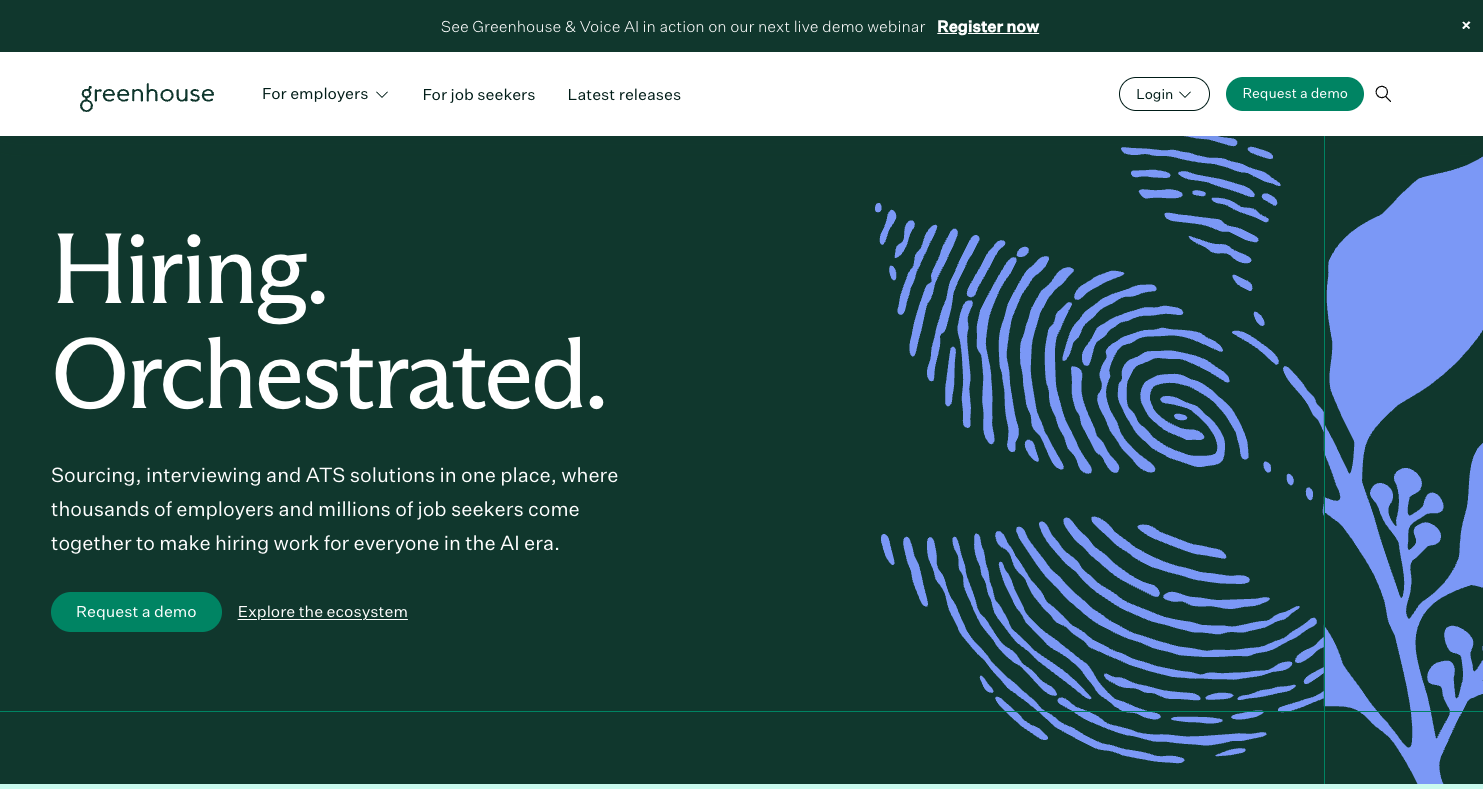
What to check for APAC: WhatsApp and Lark do not appear among its featured integrations, so confirm whether they exist and whether they are native or partner-built. Ask about Southeast Asian language support and which hosting regions are available for candidate data.
Pricing model: Quote-based. Core, Plus and Pro plans are priced on hiring volume, organizational complexity and features.
Source: Greenhouse security, integrations and pricing pages; ISO/IEC 42001 announcement (February 2026).
4.2 Moka AI
Best for: Mid-to-large, high-growth enterprises hiring across multiple APAC markets such as Singapore, Indonesia, Malaysia and Hong Kong.
Key strengths: Moka AI is an AI-native ATS trusted by 3,000+ organizations, designed to support recruitment across APAC markets. Its AI capabilities streamline hiring, while WhatsApp and Lark integrations connect candidate engagement with everyday recruitment workflows. Customer data is hosted on Singapore servers, with region- and role-based access controls and security credentials.
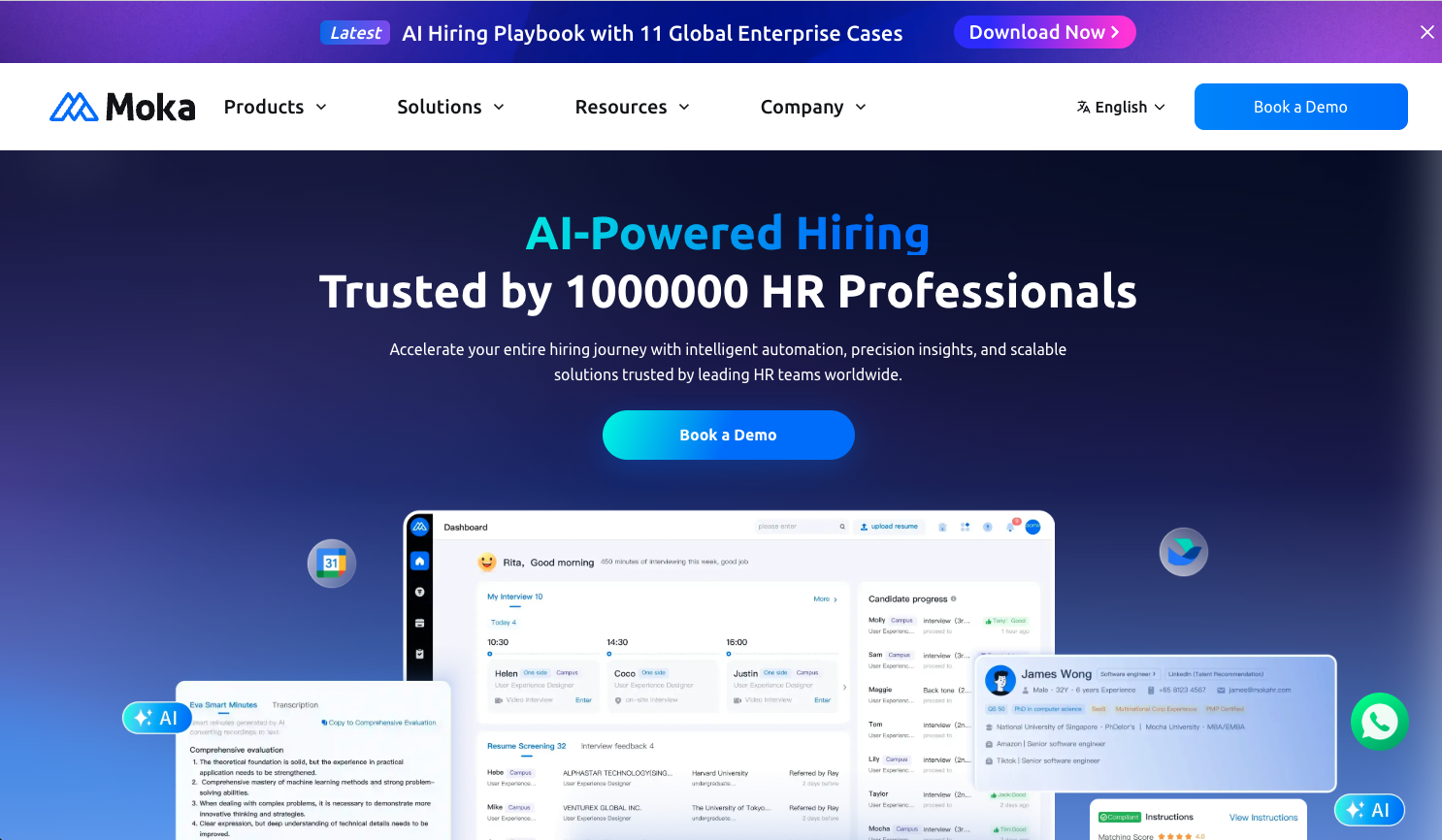
What to check for APAC: Confirm how Moka AI connects to your HRIS or eHR and which data syncs. Review data residency and retention settings for each market, and request the security certifications and AI usage documentation that apply to your markets.
Pricing model: Contact sales for a quote through the Request a Demo page.
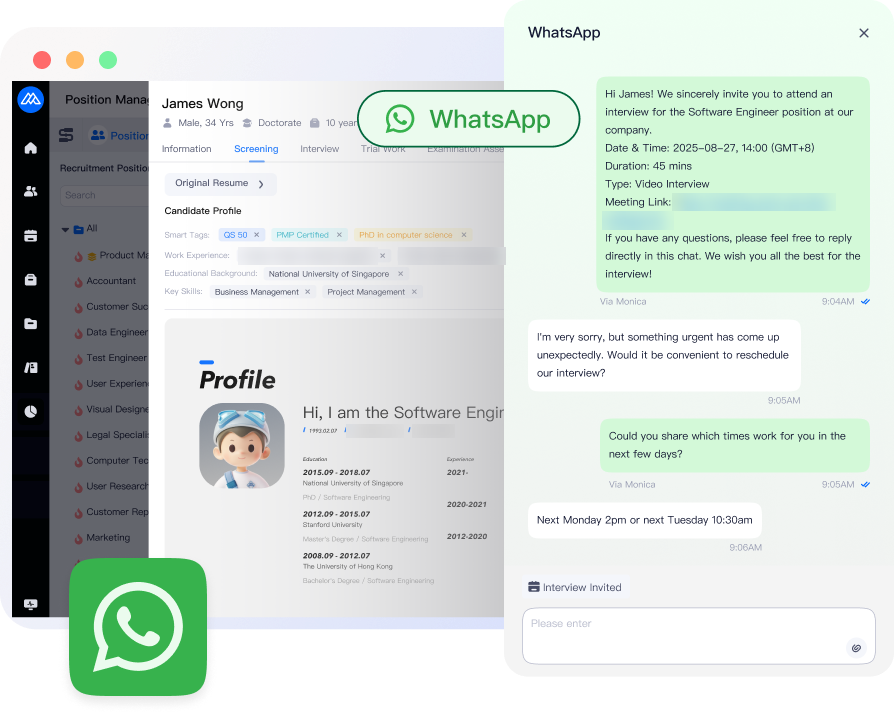
Moka AI's WhatsApp Agent: an interview invitation and reschedule handled in WhatsApp, alongside the candidate profile in Moka ATS (demo data).
Source: Moka AI AI Resume Screening page; Moka AI × Lark integration; WhatsApp recruiting agent; Traveloka case study.
4.3 Workday Recruiting
Best for: Large enterprises already on Workday HCM that want recruiting in the same system of record.
Key strengths: Workday Recruiting shares one data model with Workday HCM, so requisitions, candidates and new hires stay in one place. Workday completed its acquisition of Paradox in October 2025 and presents Workday Recruiting, HiredScore and Paradox together as an AI hiring suite for frontline and high-volume roles.
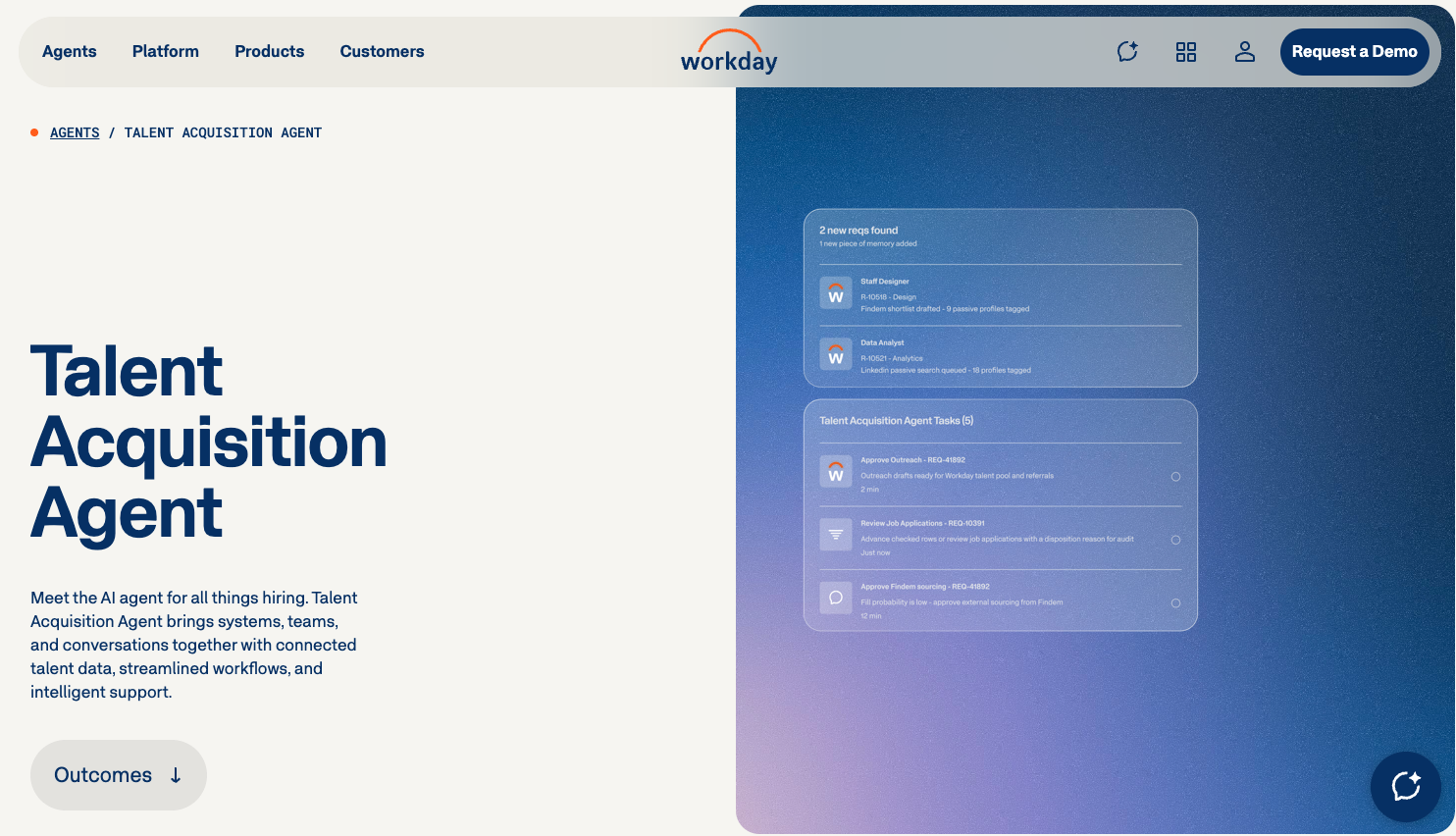
What to check for APAC: Workday says the Paradox agent is sold through Workday or Paradox, so confirm which AI capabilities your subscription includes. Ask about implementation timeline and cost, and which local job boards and messaging apps it supports in your markets.
Pricing model: Quote-based; confirm what your HCM agreement covers.
Source: Workday press release, Workday Completes Acquisition of Paradox (October 2025).
4.4 SAP SuccessFactors Recruiting and SmartRecruiters
Best for: Global enterprises running on SAP.
Key strengths: SAP completed its acquisition of SmartRecruiters in September 2025. SmartRecruiters' AI assistant, Winston, automates screening, interview scheduling and follow-ups and chats with candidates by text, voice and video. SmartRecruiters launched it with a focus on high-volume, high-turnover hiring in sectors such as retail and manufacturing, which suits SAP customers with large frontline workforces.
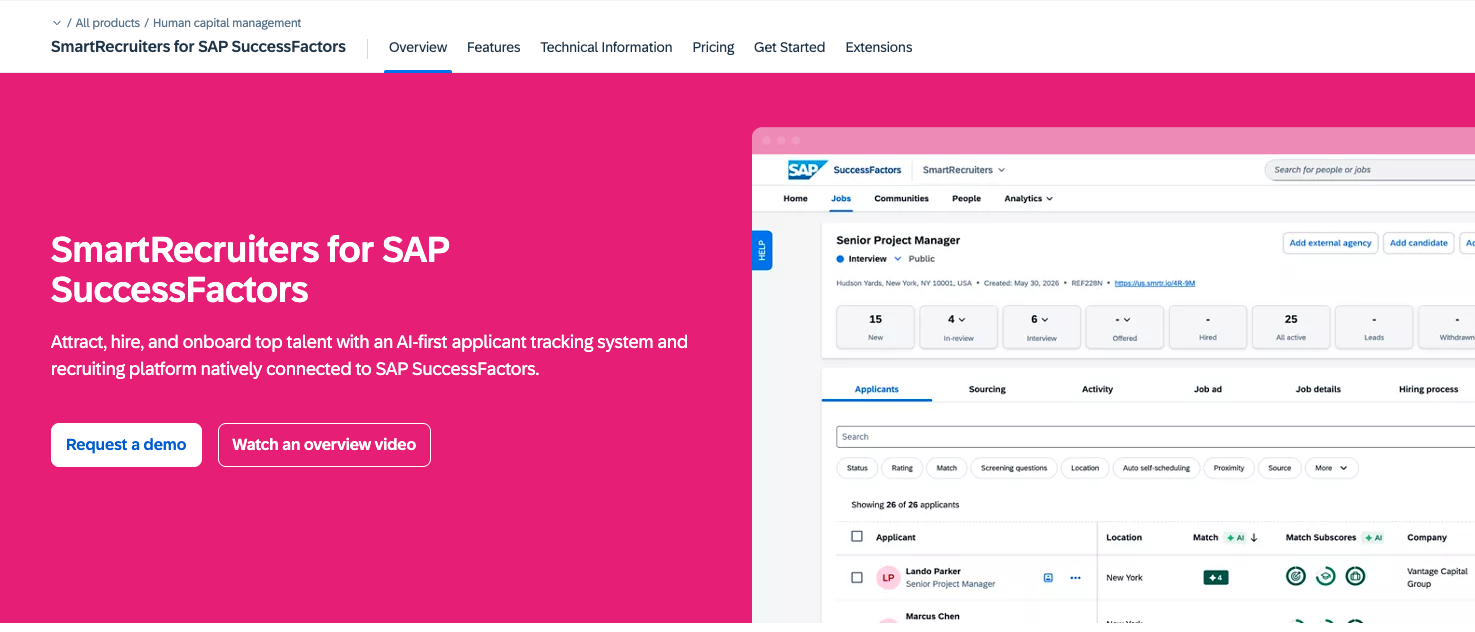
What to check for APAC: SAP's SuccessFactors president told CIO.com that SmartRecruiters will replace the SuccessFactors Recruiting component, with a three-to-five-year migration window for existing customers. Ask which product your contract covers, what the migration path looks like and whether pricing or terms changed after the acquisition. Confirm which candidate channels Winston supports in your markets, including WhatsApp.
Pricing model: Quote-based.
Source: SAP News (September 2025); SmartRecruiters news (October 2024); CIO.com (October 2025).
4.5 iCIMS
Best for: Large enterprises running complex hiring across multiple pipelines.
Key strengths: iCIMS is a modular talent acquisition platform that can be configured workflow by workflow. Its Text Engagement product offers WhatsApp alongside SMS in countries where WhatsApp is available, which iCIMS notes can help when your texting numbers are registered in another country.
What to check for APAC: iCIMS documentation says Text Engagement does not currently support WhatsApp text campaigns, so test bulk outreach before a frontline hiring peak. iCIMS also notes that WhatsApp requires Meta Business Verification and approved templates to start conversations; ask every vendor on your shortlist, not only iCIMS, how it handles both. Check how deep each module's integrations go, the renewal terms and APAC support coverage.
Pricing model: Quote-based; confirm which modules the quote includes.
Source: iCIMS Community, Using WhatsApp with iCIMS Text Engagement.
4.6 Ashby
Best for: Tech companies that want deep recruiting analytics.
Key strengths: Ashby's All-In-One plans combine ATS, CRM, scheduling and analytics in one product. Analytics is central enough that Ashby also sells it as a standalone product for teams that keep another ATS.
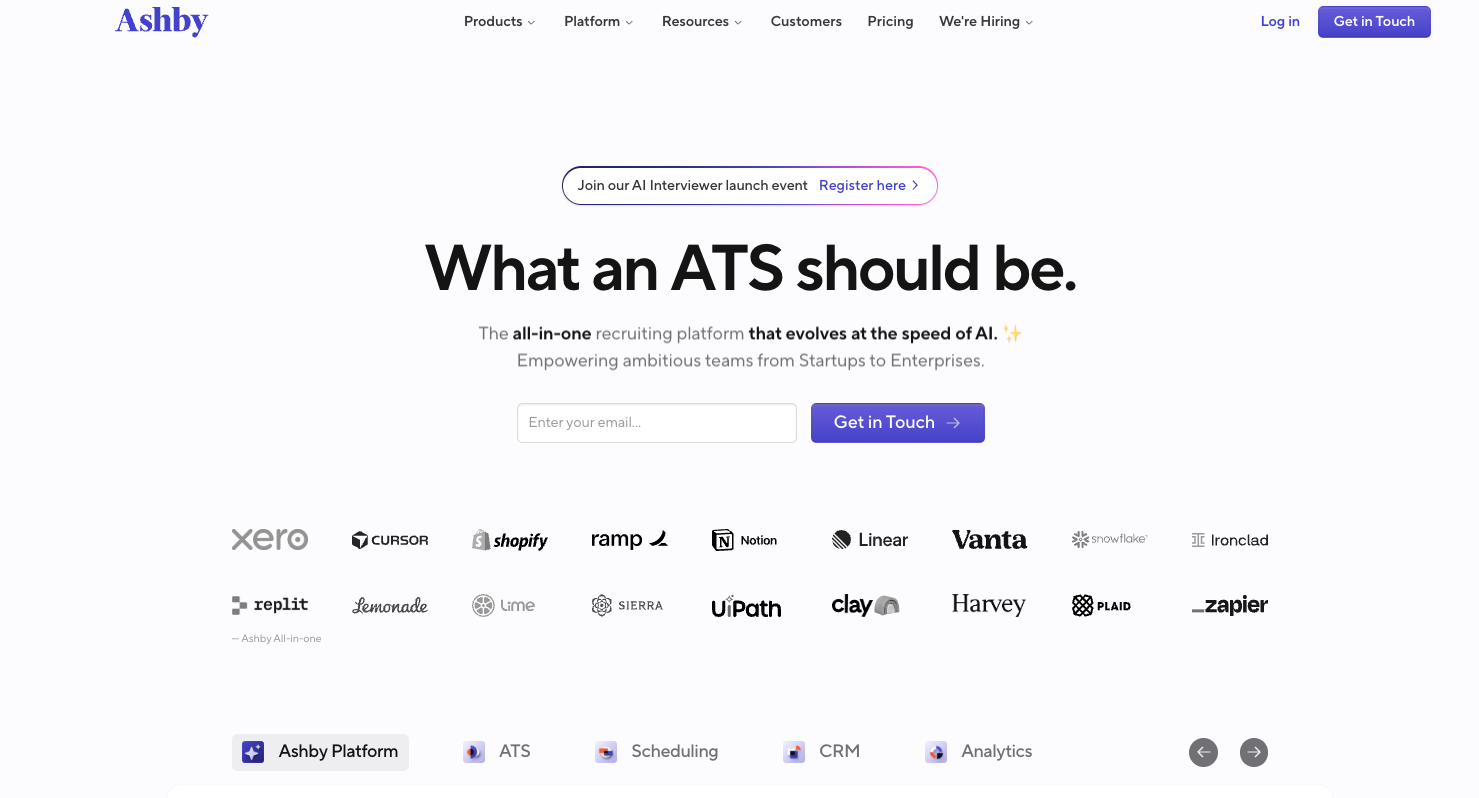
What to check for APAC: AI-assisted application review, candidate fraud detection and AI talent rediscovery consume AI credits, with allowances that differ by plan, and the AI Notetaker is a paid add-on on every tier. Ask about APAC support hours and data hosting regions.
Pricing model: Tiered by company size. Foundations, for companies of up to 100 employees, has a published price; Plus and Enterprise are quoted on company size, usage and commitment.
Source: Ashby pricing page.
4.7 Workable
Best for: Small and mid-sized teams that run sourcing-led hiring.
Key strengths: Workable bundles recruiting with HR features in its plans and offers a 15-day free trial. Its built-in sourcing searches 400M+ profiles, and one posting can reach 200+ job boards.
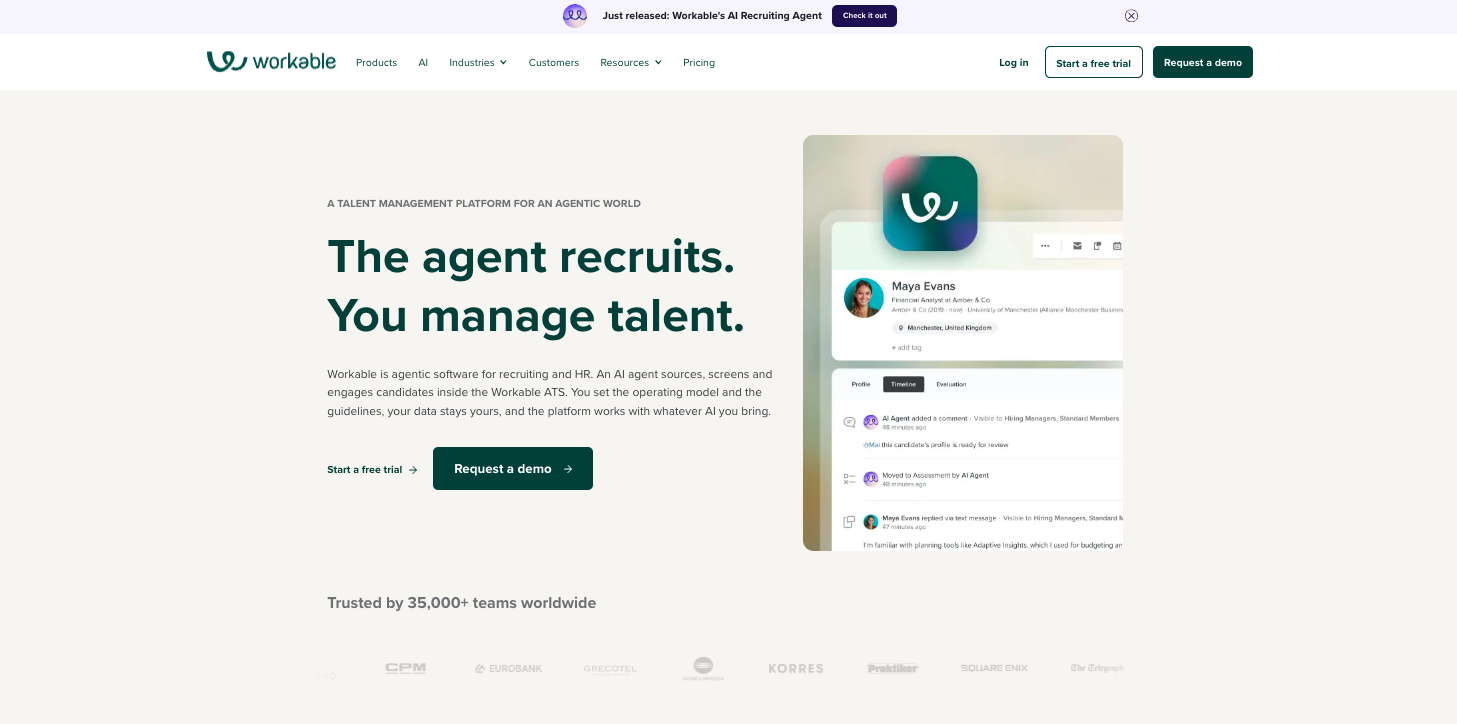
What to check for APAC: Test multi-market permissions, approval chains and workflow depth at your hiring volume. Workable's sourcing page names no APAC job boards, so confirm JobStreet and JobsDB coverage along with data residency.
Pricing model: Published monthly and annual prices for the Standard, Premier and Enterprise plans. The Workable AI agent is an add-on billed through AI credits; paid accounts start with 3,000 free credits, and the free trial excludes the agent.
Source: Workable pricing and sourcing pages.
4.8 Darwinbox
Best for: Enterprises that want one Asia-based HCM suite for core HR, payroll and recruiting.
Key strengths: Darwinbox runs recruiting in the same suite as core HR and onboarding, so requisitions and new-hire data flow between modules. Its recruitment module offers AI-powered scoring and recommendations, an AI job match score, integrated WhatsApp alerts and a voicebot for candidates. The company states that 900+ enterprises use its platform.
What to check for APAC: Test AI screening on your own roles and languages, and confirm whether WhatsApp supports two-way conversations or alerts only. Ask how deep the recruiting workflows go compared with a specialist ATS. Darwinbox lists offices in Singapore, Malaysia, Indonesia, the Philippines and Thailand, so ask which team will run implementation and support in your markets.
Pricing model: Quote-based.
Source: Darwinbox recruitment page.
5. Questions to ask in an ATS demo (APAC edition)
Bring the "What to check" items from each review into the demo and ask vendors to prove every answer live. Each question maps to a criterion in section 2.
- Can you parse real resumes from three of our markets, one in a local language? Good answer: accurate fields, no manual cleanup. (2.4)
- What happens in WhatsApp after the 24-hour customer service window closes? Good answer: approved templates, plus automatic email fallback. (2.2)
- Where is candidate data stored, and can retention be set per country? Good answer: a named hosting region and per-market retention. (2.3)
- How do you calculate the AI-to-recruiter agreement rate? Good answer: sample size, roles, markets and method stated. (2.4)
- Who makes the final hiring decision? Good answer: a person, with AI reasoning logged. (2.3)
- Can you run a first-round interview with AI questions and a rubric? Good answer: one shared rubric, summary saved to the record. (2.4)
- Is the HRIS integration native or middleware? Good answer: a native connector shown live. (2.5)
- How many weeks until our first market goes live? Good answer: a dated plan with named owners. (2.6)
- Where is your support team, and which time zones does it cover? Good answer: in-region, during your working hours. (2.6)
- Are AI features billed separately? Good answer: AI pricing and limits written into the quote. (2.6)

Score each vendor's answers during the demo while they are fresh. Photo: Dylan Gillis on Unsplash, Unsplash License
6. FAQs
How much does ATS software cost?
Pricing for ATS software or a broader talent acquisition management solution is usually based on recruiter seats, open jobs, employee count or modules, and most enterprise plans are quoted individually. Total cost also includes implementation, AI usage, add-on modules and renewal terms. Criterion 2.6 lists what to request in a quote.
Can we use AI screening and still comply with PDPA?
Start with the obligations Singapore's PDPA sets out: notify candidates of the purpose, obtain consent, keep data only as long as needed and protect it.
The PDPC's 2024 advisory guidelines on AI recommendation and decision systems also encourage organizations to explain, in plain terms, how AI uses personal data. For AI screening, keep a person reviewing every recommendation and keep audit logs. Criterion 2.3 lists what to check by market. This is general information, not legal advice.
Next step: build your shortlist
Find your scenario in section 3, then score platforms against the 6 criteria. Bring the demo questions and your own material: real resumes, a live job opening and your markets' compliance requirements. A vendor that runs your test live gives you more evidence than any ranking, this one included.
If you hire across Southeast Asia and Hong Kong, run that test with Moka AI. Request a demo with your resumes and one open role, and see AI Resume Screening, the WhatsApp Agent and the Lark integration work on your own hiring.
Related reading:

Author
Damon Liu
Marketing Manager
Hello everyone! I'm part of the Editorial Team at Moka AI, where I focus on global content, including writing and editing in-depth insight articles. I love exploring new ideas, discovering new tools, and finding fresh perspectives. My goal is to create content that’s genuinely valuable and helpful for HR professionals, while keeping it engaging, relatable, and fun to read!