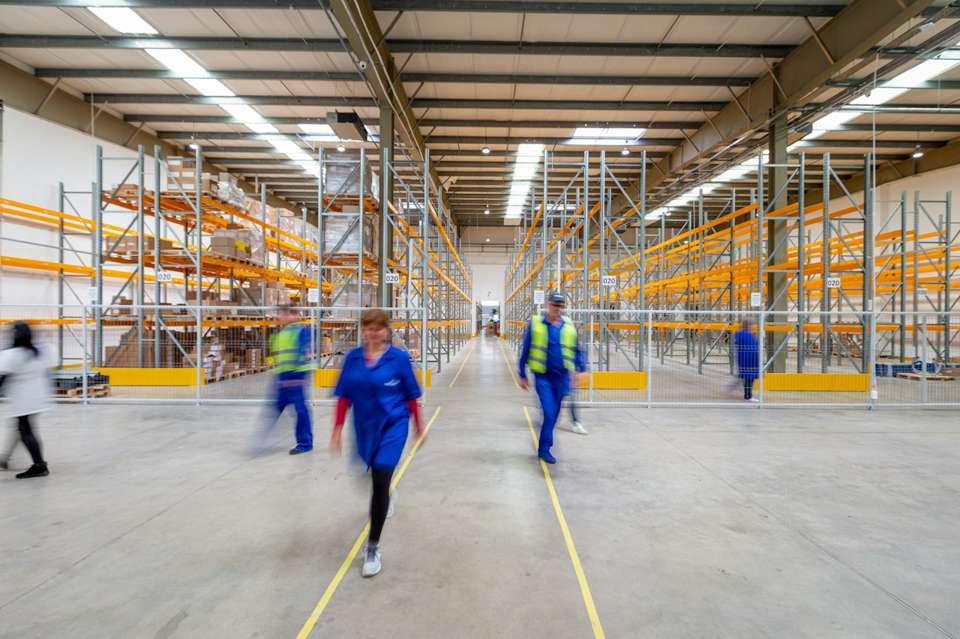
A retail chain opening stores before a holiday peak does not have a sourcing problem. It has hundreds of frontline roles to fill in weeks, candidates who apply from their phones and abandon anything that looks like a form, and store managers who need people on the floor now.
The hiring software built for a 40-person engineering team is the wrong tool for this. Structured interview kits and deep analytics do not help when the job is speed and scale across many sites.
This guide is a buyer's checklist for high-volume frontline hiring in Southeast Asia: what makes it different, the capabilities your ATS actually needs, how cost behaves at peak, and what to confirm before the season starts. It is written for retail, food and beverage, logistics, and manufacturing teams filling frontline roles across many locations.
What makes frontline hiring different
Professional hiring optimizes for quality of hire over weeks. Frontline hiring optimizes for throughput over days, under conditions the other model never meets:
- Volume arrives in spikes. A seasonal peak can mean hundreds of openings at once, then quiet.
- Candidates are mobile-first. They apply on a phone, often on WhatsApp, and drop long application forms.
- It is multi-site. Roles are spread across stores, outlets, or warehouses, each with its own manager.
- Speed decides outcomes. The fastest responder often wins the candidate, because frontline applicants are talking to several employers at once.
A system that cannot absorb a spike, meet candidates on mobile, and move fast will leave shifts unfilled no matter how good its reporting is.
The must-haves
Score any ATS for frontline hiring against these, and ask to see each one live:
Conversational, mobile-first applications. Candidates should be able to apply and answer screening questions in a chat on their phone, without downloading an app or filling a long form. Ask the vendor to complete an application on a phone in the demo.
WhatsApp done properly. WhatsApp is the frontline channel in much of Southeast Asia, but "supports WhatsApp" hides a lot. Four things to verify:
- Approved message templates. Businesses can only start conversations with templates WhatsApp has approved. Ask to see the template approval flow.
- Meta Business Verification. Using WhatsApp for business messaging requires verification with Meta and approved templates to initiate conversations (iCIMS documentation). Ask every vendor how it handles both.
- The 24-hour window. Outside the 24-hour customer service window, you can only reach a candidate with an approved template. Ask what happens after the window closes, and whether there is an email fallback.
- Bulk campaigns. For a peak you need to message many candidates at once. Confirm the platform supports bulk WhatsApp outreach, not only one-to-one chats. Some do not: iCIMS notes that its Text Engagement product does not currently support WhatsApp text campaigns (iCIMS documentation), which is exactly the capability a frontline peak depends on.
Fast screening at volume. The system should rank or filter hundreds of applicants quickly so recruiters spend time on the shortlist, not the pile.
Bulk scheduling. Interviews and group sessions booked in batches, with self-scheduling so candidates pick slots without back-and-forth.
Multi-site permissions. Each store or site manager sees and acts on their own pipeline, while a regional lead sees everything.
What this looks like in practice
Decathlon uses a WhatsApp recruiting agent for frontline hiring and reports a 40% reduction in time to fill and about 685 hours saved per month, with candidates applying and self-scheduling inside WhatsApp (Moka AI Decathlon case study). On the vendor side, Moka AI reports that its WhatsApp Agent reduces manual recruiting work by 82% by handling application, screening, self-scheduling, and offer steps in the chat. The pattern to take from both: the channel candidates already use carries the whole early funnel, so recruiters are not chasing people by hand during a spike.
How cost behaves at peak
Frontline pricing deserves its own look because your volume is not flat. Ask the vendor:
- How pricing scales during a hiring peak. Per-open-job pricing spikes exactly when you post the most roles.
- Whether WhatsApp messaging or AI screening is billed by usage, and what the overage rate is. A peak is when credits run out.
- How quickly the system can be deployed, because a slow rollout can miss the season entirely.
A platform that is cheap at steady state but expensive or slow at peak is the wrong trade for frontline hiring.
Pre-season checklist
Before your next peak, confirm:
- Candidates can apply and be screened on mobile, in a chat, with no app download
- WhatsApp is set up with Meta Business Verification and approved templates
- The platform supports bulk WhatsApp campaigns, not only one-to-one chats
- There is an email or template fallback when the 24-hour window closes
- Screening can rank hundreds of applicants quickly
- Interviews support bulk and self-scheduling
- Each site manager has their own pipeline view
- Pricing and go-live time both work at peak volume, not just at steady state
Next step
Rank your frontline shortlist against the eight checks above, and run the WhatsApp and bulk-scheduling tests on a real peak-season role before you buy. If you hire frontline staff across Southeast Asia, ask Moka AI to show the WhatsApp apply-to-offer flow and a bulk campaign on one of your own openings.

Author
Moka AI Editorial Team
The Moka AI Editorial Team creates insightful, practical, and engaging content on HR, recruitment, and AI innovation. We explore emerging trends, share industry insights, and turn complex ideas into actionable knowledge to help HR professionals navigate the evolving world of work.