Key Takeaways
The question this guide answers: If your team already runs on Lark, how do you choose the right ATS?
The short answer: Not by comparing feature lists alone. The right ATS for Lark users is the one that integrates naturally into the way your team already works.
The four criteria that matter:
- Integration depth — Is it a native Lark integration or middleware?
- User experience — Can you complete the hiring workflow inside Lark?
- Time to value — How fast can you deploy and migrate existing data?
- Compliance readiness — Does the vendor meet data protection requirements in every market where you hire?
Recommendation for Lark users: Moka AI — natively integrated with Lark.
Most "best ATS" rankings compare features in a vacuum: parsing accuracy, pipeline management, and reporting. That approach works if you're buying your first ATS since it treats the ATS as a standalone purchase.
For teams running on Lark, ATS selection requires a broader perspective. If your hiring already happens in Lark, the real question isn't which ATS has the most features. It's which ATS fits into where your team already works.
While Lark provides powerful collaboration tools like Base, Approval, and Calendar, many teams complement their Lark workflow with a dedicated applicant tracking system as their hiring needs grow.
This guide walks through the key criteria Lark users should consider when choosing an ATS. Let's dive in!
Integration Depth — Does It Integrate Natively to Lark?
Most ATS vendors claim they "integrate with Lark." But that statement can mean very different things. Before making a decision, it's important to understand how the integration works and what it means for your team.
An ATS can connect to Lark through three different approaches: native integration, middleware integration or custom integration. Here's how they differ.
Native Integration
A native ATS integration is built to work directly with Lark's Open Platform and is available in the Lark App Directory. The vendor owns and maintains the integration, allowing your team to deploy it with minimal setup.
With a native integration, recruiters can typically access ATS features inside Lark, automate workflows, receive notifications, and synchronize data without additional engineering work.
Middleware Integration
Some ATS vendors connect with Lark through middleware platforms such as Lark AnyCross, Zapier, or Workato. They provide pre-built connectors and no-code workflow builders, so teams can configure integrations without writing code. However, they still require ongoing workflow management, troubleshooting, and maintenance as business needs evolve.
Many middleware integrations rely on AnyCross. While AnyCross is included with all Lark plans, it is not unlimited. Each subscription comes with a monthly execution quota. Teams with higher automation volumes may need to upgrade the plan.
Custom Integration
Self-built API integration offers the greatest flexibility, but it also requires the most engineering effort. Your team is responsible for building and maintaining the integration, including authentication, token refresh, webhook event handling, and ensuring compatibility whenever either Lark or your ATS releases updates.
Here, we focus on comparing native and middleware integrations, as custom API development typically requires significant engineering resources and is rarely a cost-effective option.
| Key Differences | Native | Middleware |
|---|---|---|
| Implementation Effort for Your Team | Install, authorize, and configure business settings. | Configure workflows, map fields, authorize apps, and maintain automations. |
| Setup Complexity | Low | Medium |
| User Experience | Seamless | Good for simple workflows |
| Maintenance Responsibility | The ATS vendor | The third-party platform |
| Workflow Coverage | The full packaged loop: approvals, scheduling, meetings, feedback | Each workflow is a separate build |
| Support & Troubleshooting | Vendor-managed support | Your team may need to diagnose issues across multiple systems |
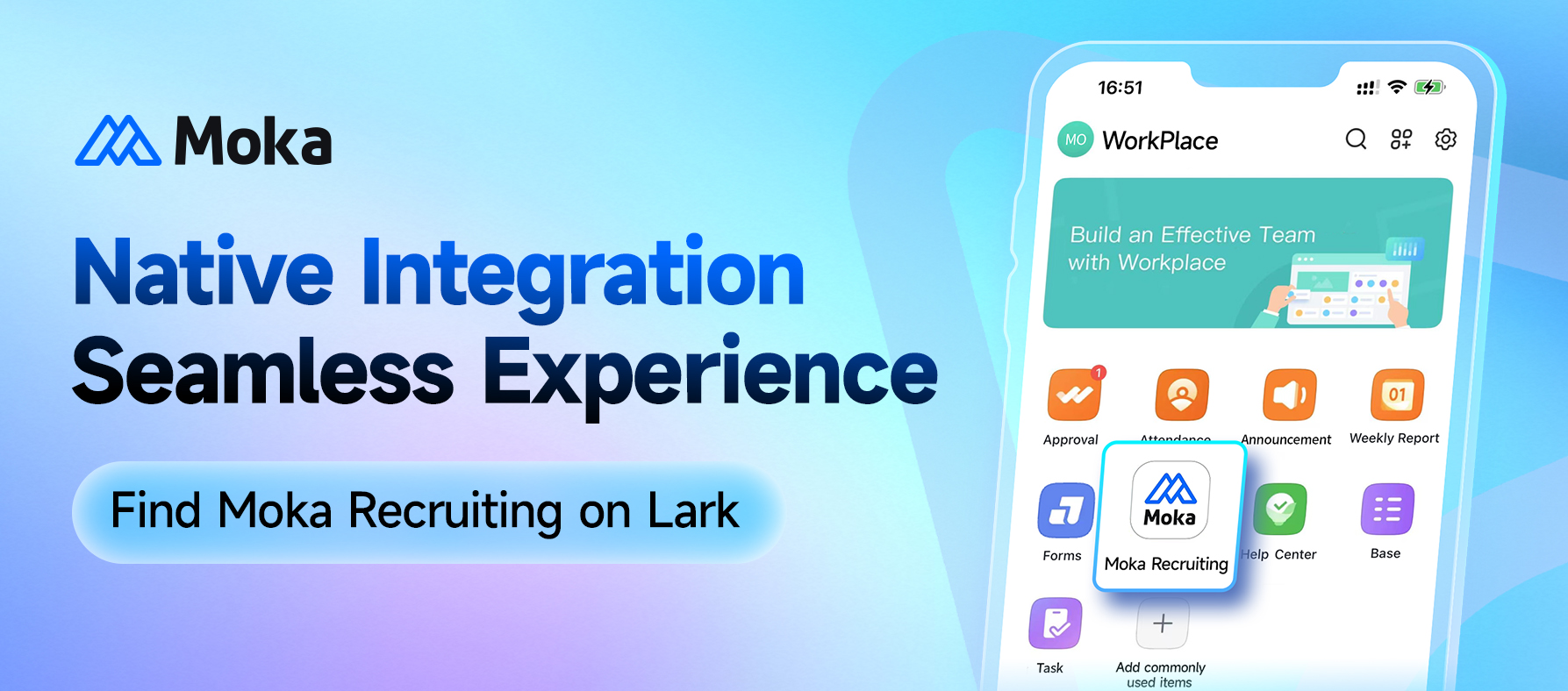
For most organizations, an ATS natively integrated with Lark can deliver a lower total cost of ownership. To verify whether an ATS truly offers a native Lark integration, search for the application in the Lark App Directory. If it isn't listed, ask the vendor how the integration is implemented.
User Experience — Can You Complete the Hiring Workflow in Lark?
A strong Lark integration should let your team complete hiring tasks without leaving Lark. If approval requests, reminders, or updates redirect users back to the ATS, the integration adds friction instead of removing it.
Supporting a few individual actions isn't enough. An effective integration should cover the entire hiring workflow. An effective integration should cover the hiring workflow end to end, rather than forcing recruiters, hiring managers, and interviewers to switch constantly between systems.
Consider whether your team can complete these hiring tasks without leaving Lark:
- Approve a job requisition
- Review candidate profiles and collaborate with hiring managers
- Schedule interviews based on real-time calendar availability
- Launch interview meetings
- Submit and review candidate evaluations from the Lark message cards
- Approve offers
If every card or message simply redirects users to the ATS login page, the integration is a doorbell—not a workflow.
Time to Value — How Fast Can You Deploy and Migrate Your Existing Data?
An ATS's time to value depends largely on two factors: deployment speed and data migration.
A true native integration should go live in days or weeks, not months. If an ATS solution requires custom API development, your implementation will likely take longer. But deployment is only half the battle. If your candidate data remains in Lark Base or spreadsheets, recruiters will have to work in two systems until the migration is complete.
When evaluating ATS vendors, ask for two things:
The implementation plan
- How long from contract signing to active hiring?
- Can you provide a day-by-day implementation timeline?
- Exactly what work is required from our team?
The migration plan
- Who manages the migration—the vendor or your team?
- How will legacy fields be mapped and preserved?
- How is the migrated data validated?
The right ATS makes implementation fast, predictable, and straightforward. It comes with a clear deployment plan and a proven migration process, so your team can get up and running within days.
Compliance Readiness — Will It Pass Your Security Review?
For companies hiring across borders, data compliance is a practical requirement, not just a legal checkbox. Candidate data must be collected, processed, and stored in accordance with the regulations of every market where you hire.
If your team recruits across Singapore, Malaysia, and Indonesia, you're operating under multiple data protection laws. That's why an ATS vendor's infrastructure and data handling practices should be key factors in your evaluation process, not an afterthought.
Ask whether the vendor's data handling meets the requirements of the specific countries where you hire. Then verify:
- Where is candidate data hosted?
- What are the data retention and deletion policies?
- How are cross-border data transfers handled?
Finally, ask for a security documentation pack that you can share directly with your IT and legal teams. A vendor that can provide these documents quickly is usually better prepared for enterprise security and compliance reviews.
Moka AI: Best ATS for Lark Users
Moka AI is an AI-powered applicant tracking system (ATS) with deep, native integration with Lark. We invite you to explore Moka AI and evaluate how it fits your hiring needs.
So, what makes Moka AI the right fit for Lark users? Let's take a closer look.
Native Integration, Seamless Experience
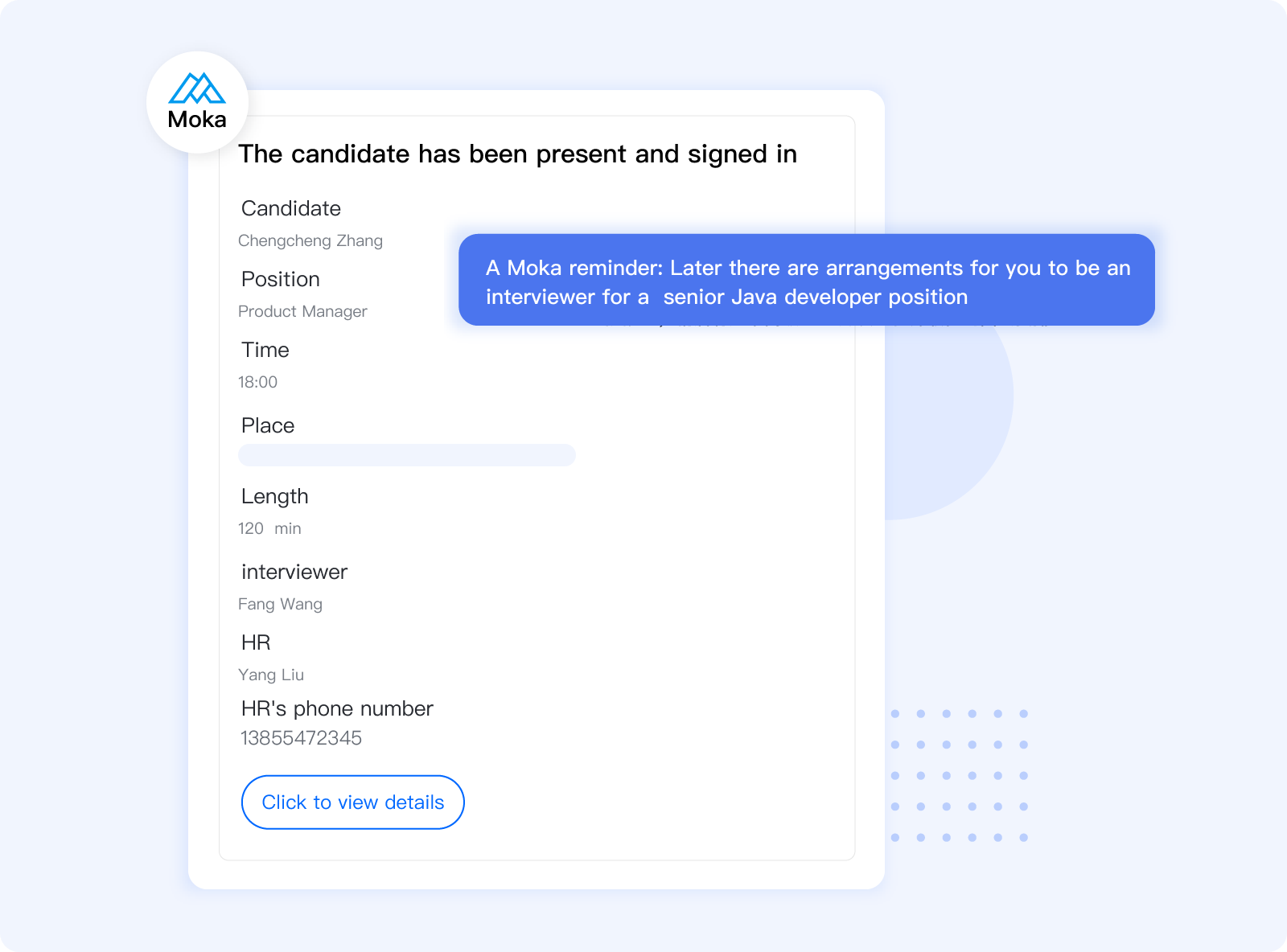
Moka AI integrates deeply with Lark, enabling recruiters and hiring managers to manage the entire hiring lifecycle without ever leaving their workspace.
Your entire hiring workflow—from requisition approvals, candidate reviews to interview scheduling, evaluations, and final offer approvals—happens seamlessly inside Lark. Recruiters and hiring managers also receive real-time notifications via Lark message cards, allowing them to view pending tasks and take action without switching between systems.
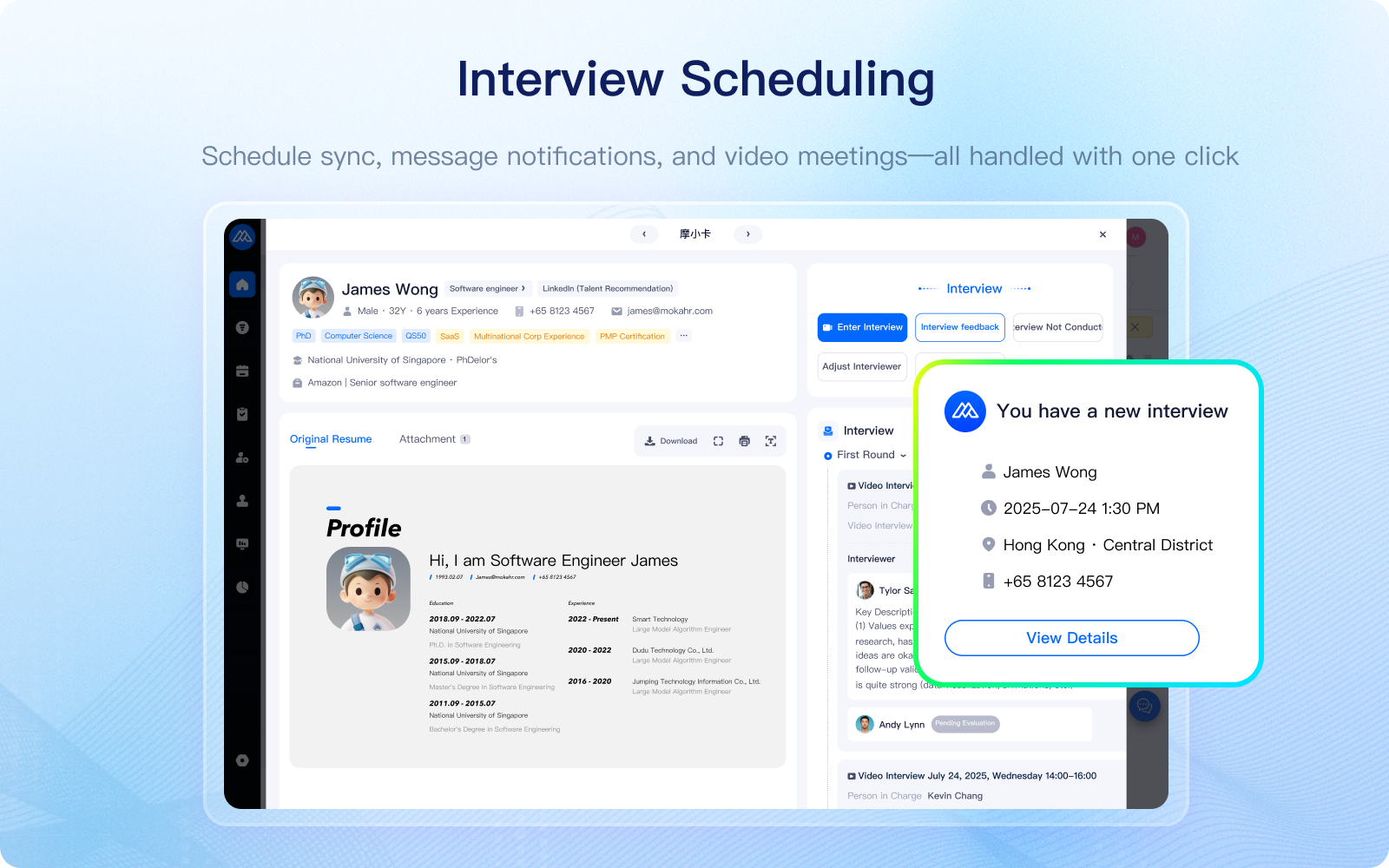
Every action in Lark syncs automatically to Moka AI, keeping candidate records up to date without manual re-entry.
With Moka AI deeply integrated in your team's workflow, recruiters stay focused, hiring managers make faster decisions, and your entire hiring process moves forward with greater speed and precision.
Built for Global Hiring
Global hiring is more than expanding into new markets. It requires teams to overcome time zone differences, and meet local compliance requirements. Moka AI is designed to help distributed teams hire efficiently across borders.
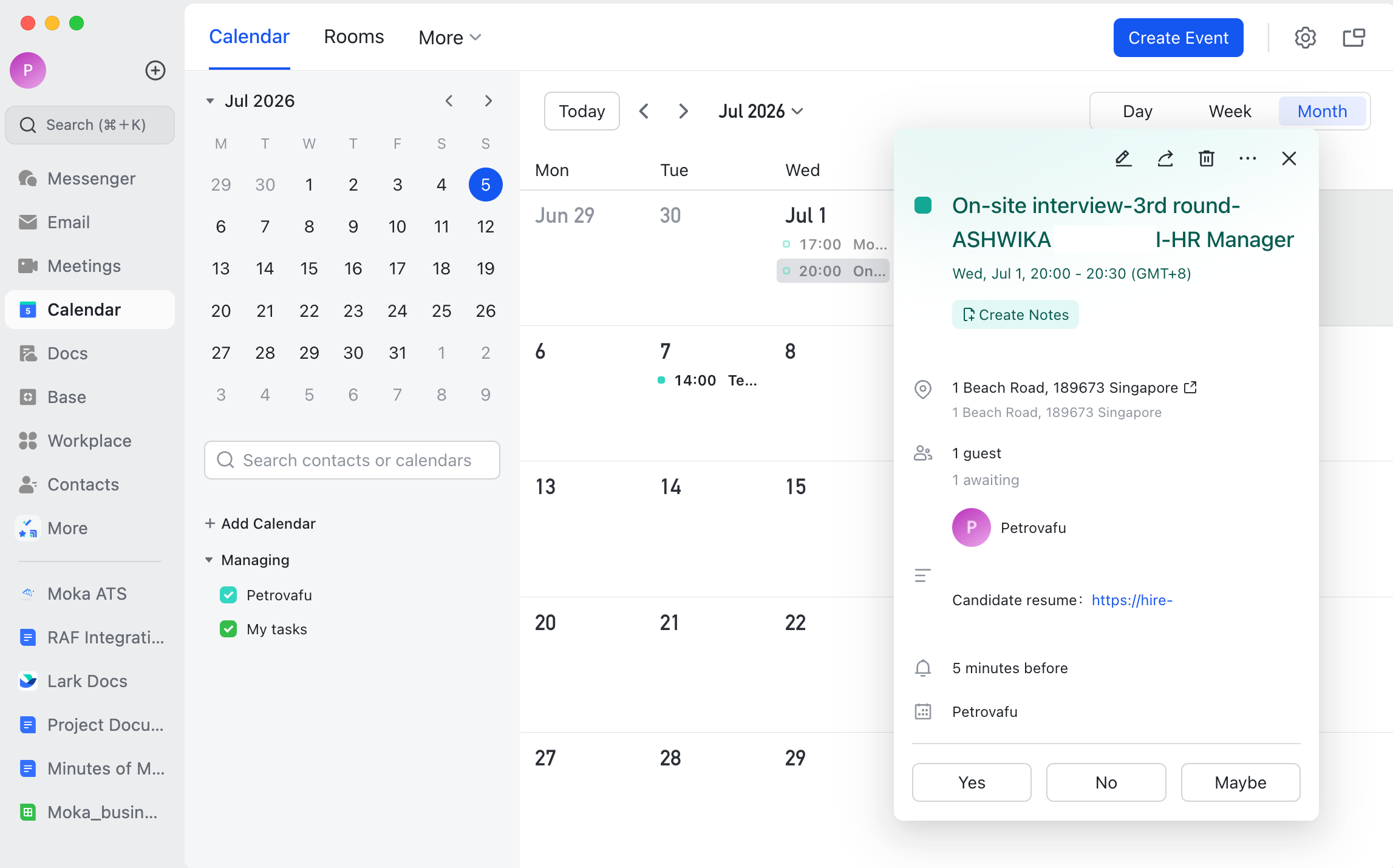
With Moka AI, global teams can collaborate effortlessly across time zones. Automatic time zone conversion and Lark Calendar synchronization make scheduling interviews across countries simple.
Recruiters can quickly identify available slots, coordinate with interviewers worldwide, and keep every appointment updated without unnecessary back-and-forth.
Moka AI also supports global compliance with regional data handling and access controls. Compliance-focused workflows help teams protect candidate information and manage hiring processes securely across markets.
Hire Anywhere, Anytime
Hiring doesn't stop when you're away from your desk.
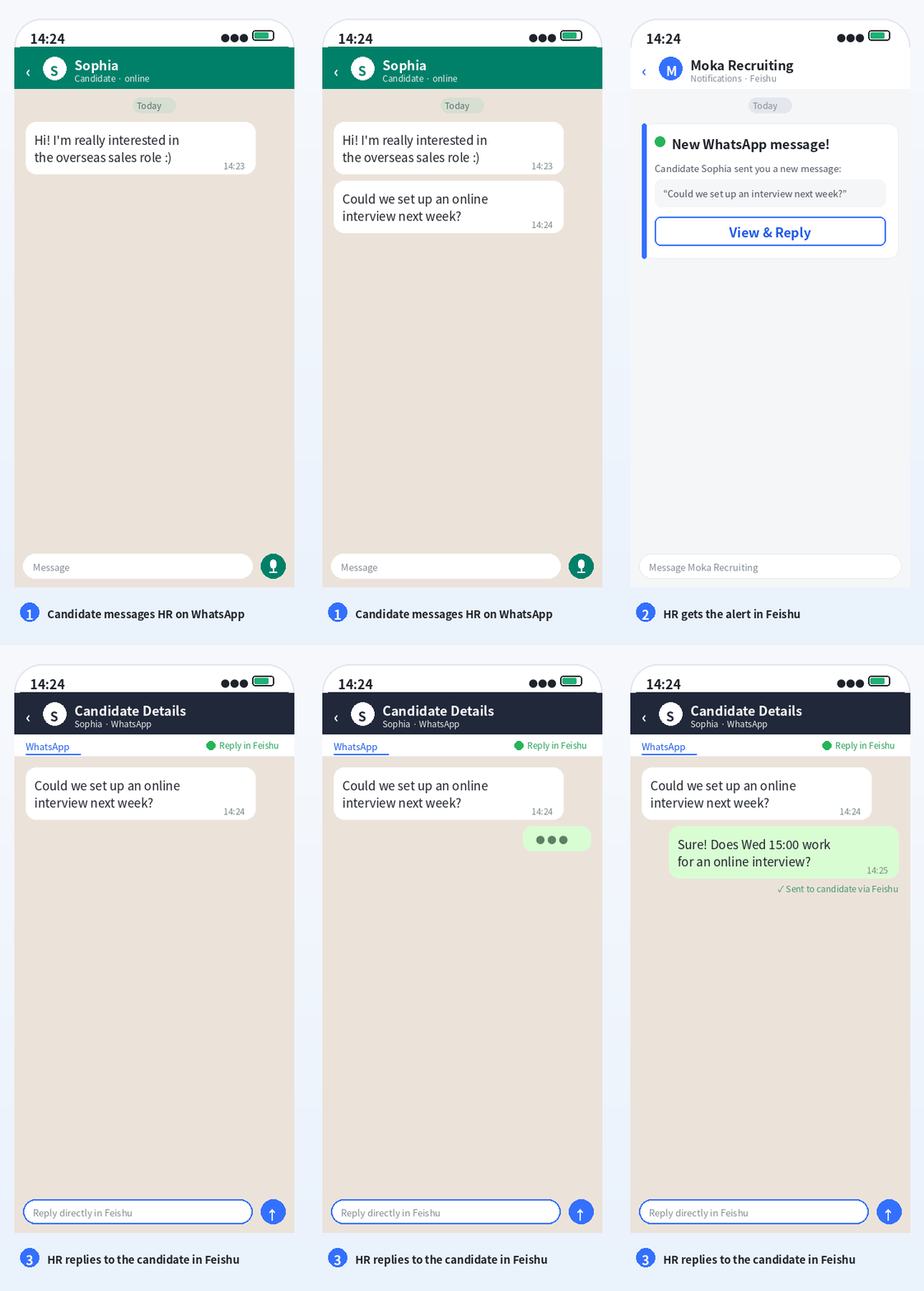
Using Moka AI in the Lark mobile app, recruiters and hiring managers can review candidates, approve requests, complete evaluations, schedule interviews, and keep hiring moving wherever they are.
Moka AI also integrates with WhatsApp to connect recruiters, candidates, and hiring workflows in one seamless experience. Candidates can confirm interview times through WhatsApp, while recruiters receive real-time notifications in Lark Mobile and jump into the conversation when needed.
Every interaction stays synchronized across Moka AI, Lark, and WhatsApp, eliminating manual follow-ups and keeping everyone aligned.
Making the Right Choice for Your Lark Team
The four criteria above are more than an evaluation checklist. They provide a practical framework for understanding what an ATS integration with Lark means in everyday recruiting operations.
They also help you look beyond your current hiring needs. Choosing an ATS is a long-term decision.
The platform you select today will influence how your team hires as your organization grows — how quickly new markets can be launched, how much engineering time gets pulled into HR tooling, and how much friction your recruiters experience throughout the hiring process.
Ultimately, the right ATS should become an extension of your Lark workflow, helping your team hire efficiently today and scale confidently tomorrow.

Author
Damon Liu
Marketing Manager
Hello everyone! I'm part of the Editorial Team at Moka AI, where I focus on global content, including writing and editing in-depth insight articles. I love exploring new ideas, discovering new tools, and finding fresh perspectives. My goal is to create content that’s genuinely valuable and helpful for HR professionals, while keeping it engaging, relatable, and fun to read!