Why ATS Built for Tech Hiring Fails on the Factory Floor (And What to Do Instead)
In June 2022, TSMC made a quiet announcement that should have been the loudest signal in the global ATS industry: the Arizona fab — a $40 billion investment, the largest foreign direct investment in Arizona history — would slip its production target. The official reason was construction delays. The unofficial, repeatedly-reported reason was that TSMC could not hire enough qualified engineers and technicians.
The most advanced chipmaker in the world, with the most sophisticated hiring operation in the semiconductor industry, missed its production date because the hiring infrastructure couldn't keep up with the manufacturing infrastructure.
If TSMC has this problem, so does every manufacturer in APAC. And there is a structural reason most of them are quietly furious with their current ATS: the entire category of ATS software was built for tech hiring. Every default, every workflow, every data model assumes a candidate with a LinkedIn profile, a PDF resume, an English application, and an individual job search. That set of assumptions falls apart on the factory floor.
This is the piece we've been wanting to write for a long time. It draws on Moka's experience with APAC manufacturing customers — semiconductor fabs, EMS providers, automotive plants, electronics assemblers — and the patterns of where standard ATS platforms fail. The headline is direct: manufacturing hiring is not a "vertical" of tech hiring. It is a fundamentally different category of operation, and it needs its own platform thinking.
The scale of the APAC manufacturing hiring problem
Before getting to the architectural mismatches, the demand side is worth understanding at scale. These numbers are not abstract.
Semiconductor demand alone. SEMI projects the global semiconductor industry will need to add 1 million skilled workers by 2030, with the APAC region facing a shortfall exceeding 200,000 engineers — twice the projected shortfall in Europe. (SEMI Global Talent Survey, 2025.)
Malaysia's structural gap. Malaysia has emerged as a critical semiconductor packaging and assembly hub, but the country needs 50,000 skilled engineers and produces only 5,000 engineering graduates annually. The arithmetic doesn't work without aggressive cross-border recruitment, accelerated reskilling, or both. (TG Holding APAC Semiconductor Report, 2025.)
APAC-wide difficulty filling roles. ManpowerGroup's 2025 employment outlook reports 77% of APAC employers report difficulty filling positions — the highest rate globally. The semiconductor sector specifically reports the same 77% figure for engineering roles.
Blue-collar turnover. This is the part the white-collar narrative misses. Manufacturing in APAC isn't only about engineers. Electronics and assembly plants in Malaysia report annual blue-collar turnover of 18-20%. Indian manufacturing sees monthly churn rates exceeding 15% in many sectors. Vietnamese and Indonesian factories face similar dynamics. A 5,000-worker plant in this environment isn't running a hiring "function" — it's running a continuous worker replacement operation.
Reshoring acceleration. Multiple structural forces — US-China decoupling, Indian PLI schemes, Vietnam's EV ambitions, Malaysia's National Semiconductor Strategy — are simultaneously expanding manufacturing capacity across the region. The hiring infrastructure has not kept pace.
The honest read on these numbers: manufacturing hiring in APAC is now the single largest under-served operational HR problem in the region. And the ATS market has barely noticed.
The five architectural mismatches
Here is what actually happens when you deploy a standard tech-oriented ATS at a 3,000-worker electronics plant in Penang or an automotive assembler in Chennai. We've seen each of these failures multiple times across Moka's APAC customer base.

Fig 1. The five architectural assumptions that tech-oriented ATS platforms inherit from their origins, and why each one breaks on the manufacturing floor.
Mismatch 1 — The resume assumption
Tech ATS assumes every candidate has a PDF resume, LinkedIn profile, and a written professional history. Manufacturing reality is different. A skilled SMT operator in Vietnam may have ten years of experience across three factories — and zero text resume that captures it. Many entry-level applicants in Indonesian or Filipino factory contexts apply via WhatsApp message, Line message, or a paper form filled out at the gate.
When a candidate hands a factory recruiter a WhatsApp message saying "I worked at Foxconn Chongqing 2019-2022, then Samsung Vietnam 2022-2024, I can do SMT and AOI inspection" — the standard ATS has no idea what to do with that. It expects a PDF.
The mismatch isn't a small UX inconvenience. It means the entire screening logic that the ATS vendor sold you — "AI-powered semantic resume parsing" — runs on none of your applicants. You bought a Ferrari engine for a road that has no tarmac.
Mismatch 2 — The language assumption
Tech ATS is built English-first, often English-only. Manufacturing in APAC operates in a different reality: a single plant in Johor might receive applications in Bahasa Malaysia, Mandarin, Tamil, English, and occasionally Bahasa Indonesia for cross-border workers. A Vietnamese plant deals with Vietnamese, Mandarin, and English. A Chinese plant sees Mandarin plus a long list of regional languages.
The English-first ATS systematically underrates applications in local languages — sometimes silently dropping them entirely if the parser can't extract enough structured fields. This is exactly the kind of failure that compounds: the ATS thinks application volume is low, the recruiter starts manual screening through WhatsApp, the data goes outside the system, and within six months the official "hiring metrics" have no connection to the actual hiring activity.
Mismatch 3 — The taxonomy assumption
Tech hiring runs on a small set of relatively standard job titles: Software Engineer, Product Manager, Data Scientist. Manufacturing taxonomy is wildly more complex and requires specific certification recognition, not just title matching.
Consider what an SMT operator role might actually require: IPC-A-610 certification level (Class 2 vs Class 3), specific equipment experience (Fuji vs Panasonic vs Yamaha placement machines), AOI vs SPI experience, lead-free soldering certification, ESD safety training currency. A standard ATS sees "SMT operator" and matches to "SMT operator" — and misses every single one of these dimensions that actually determines whether the candidate can do the job on day one.
This isn't a configuration problem. It's a data model problem. Standard ATS skill taxonomies don't have these concepts. You can't tag candidates with proficiency on equipment they've never been asked about.
Mismatch 4 — The volume assumption
Tech hiring is typically 10-50 hires per role per quarter. Manufacturing hiring at scale is 50-500 hires per week in seasonal peaks. An electronics plant ramping up for Q4 might hire 800 operators in two weeks. A Vietnamese garment manufacturer might process 2,000 applications for a single recruitment day.
Tech ATS workflows — designed around 1:1 recruiter-to-candidate conversations, scheduled phone screens, individual offer letters — collapse under this volume. What manufacturing actually needs is more like an event-management system than a candidate-relationship system: bulk WhatsApp/SMS communication, group-interview scheduling, on-site walk-in workflows, batch offer generation, mass onboarding paperwork.
Most ATS platforms can technically handle high volume by throwing more recruiter seats at the problem. They can't handle the workflow change that high volume requires. There's a difference.
Mismatch 5 — The compliance assumption
This is the mismatch most likely to get a manufacturer into legal trouble. Tech ATS handles "compliance" as GDPR-style data privacy. Manufacturing compliance is fundamentally different: factory workers in many APAC jurisdictions require government-issued work permits (Malaysia EP, Singapore S-Pass and Work Permit, Thailand WP3), industry-specific safety certifications (electrical, working-at-height, confined space), medical clearances (especially for semiconductor cleanrooms and chemical handling roles), and increasingly, ESG-related disclosures (foreign worker housing standards, dormitory conditions, wage transparency requirements).
A standard ATS has no fields for any of this. So the compliance work happens in spreadsheets outside the ATS, the audit trail is broken, and when the regulator asks "show me your hiring records for foreign worker recruitment in the last 12 months," the HR team scrambles for two weeks.
What manufacturing-grade hiring actually requires
If you accept that manufacturing hiring is a different category, what does the platform actually need to look like? Five capabilities that should be procurement gates, not nice-to-haves.
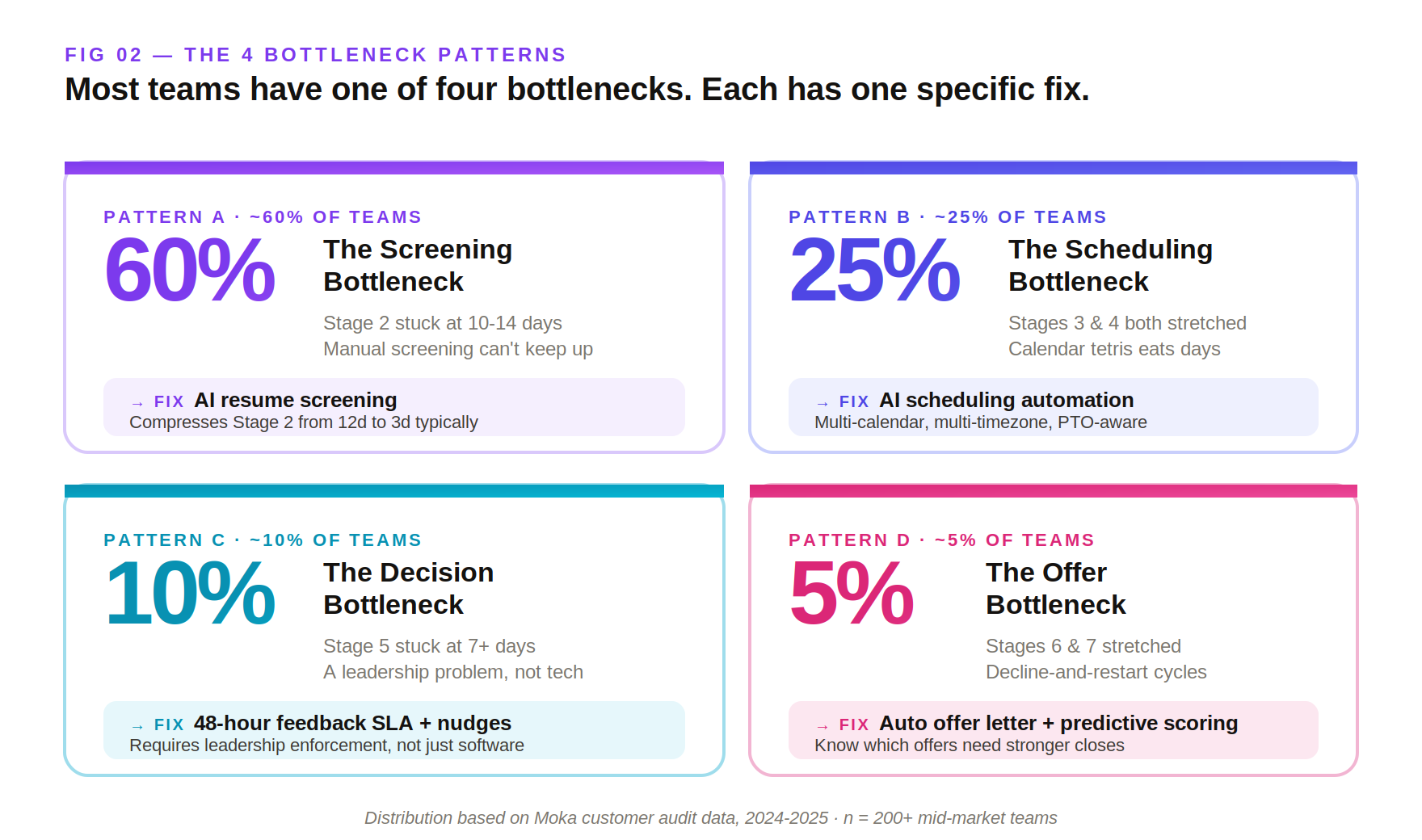
Fig 2. Five capabilities that distinguish manufacturing-grade hiring infrastructure from generic ATS. Each addresses a specific architectural mismatch from Fig 1.
Capability 1 — Multi-channel, low-structure intake
The system has to accept applications from WhatsApp, Line, paper QR codes at gate booths, walk-in registration, agent referrals, and group recruitment drives — not just career sites. It has to extract structured data from unstructured WhatsApp messages, voice notes, scanned ID cards, and partially-filled paper forms.
In practice this means AI that can handle OCR of physical documents, voice-to-text transcription in local languages, and conversational intake via messaging apps as first-class data sources, not edge cases.
Capability 2 — Multi-language, multi-script processing
Native handling of at least: Bahasa Malaysia, Bahasa Indonesia, Mandarin (Simplified and Traditional), Vietnamese, Thai, Tamil, Tagalog, and English — with cross-language matching when a JD is in English but applications arrive in Bahasa Indonesia.
The harder requirement: the semantic understanding has to work across languages. A candidate who describes their experience in Vietnamese should score the same as one who describes the same experience in English. Most current platforms fail this test because their training data is English-dominant.
Capability 3 — Industrial skill taxonomy
A real manufacturing taxonomy includes: equipment-specific proficiencies (specific machine models, not just categories), industry certifications with currency tracking (IPC, AWS, NEBOSH, ISO auditor levels), regulatory clearances by jurisdiction, language proficiencies relevant to operations (a foreman role in Malaysia often needs Bahasa Malaysia plus Mandarin), and cross-trained capabilities (a worker who can operate three different lines).
This taxonomy needs to be built into the system, not added through custom fields. A platform where you have to use free-text custom fields for equipment proficiency will not produce reliable matching at scale.
Capability 4 — High-volume operational workflows
The system has to support batch operations that simply don't exist in standard ATS: mass interview scheduling for walk-in days, batch background-check initiation, group medical-clearance tracking, batch work-permit application submission, and mass onboarding pack generation. The interface has to assume the recruiter is processing 200 candidates today, not 8.
A useful proxy: ask the vendor to show you what a "bulk action" workflow looks like for 500 candidates. If the answer involves a CSV export, it's not built for manufacturing.
Capability 5 — Sector-specific compliance modules
Pre-built modules for the actual compliance regimes manufacturers face: foreign worker permit tracking with expiry alerts, certification currency monitoring with automatic re-cert workflows, medical clearance management, dormitory and housing compliance documentation, ESG reporting fields wired into the candidate record.
These compliance modules are what separate "ATS that you can use for manufacturing" from "ATS built for manufacturing." The first one will run; the second one will pass audits.
A real story from a Penang electronics plant
A semiconductor assembly and test (OSAT) operation in Penang — 4,200 workers, hiring roughly 80 operators per month plus a steady pipeline of equipment technicians and process engineers — switched from a global tech-oriented ATS to a manufacturing-focused platform in late 2024.
The before-state was telling. The "official" ATS had data on roughly 35% of actual hires. The other 65% of activity happened in WhatsApp groups, Excel sheets, and the personal phone of the senior recruiting officer. The official time-to-fill metric reported 18 days for operator roles. The actual time, measured against when the operator started physical work, was 31 days. Nobody internally trusted the dashboards.
The first six months after migration produced changes that are characteristic of properly-fit infrastructure rather than process magic:
- Time-to-fill for operator roles compressed from 31 days to 14 days, mostly through bulk-volume workflow improvements (group interview scheduling, batch medical-clearance initiation, parallel work-permit submission).
- Application volume captured in-system went from 35% to 94% — because the platform actually accepted WhatsApp and walk-in applications without forcing them into a resume-shaped hole.
- The HR director reported being able to produce regulatory hiring reports in 3 hours instead of 3 weeks — because the data was finally in one place.
- Operator turnover in the first 90 days dropped from 18% to 11%, attributed mainly to better fit-matching from the equipment-specific skill taxonomy.
The general lesson is not about Moka specifically. It's about what happens when the infrastructure matches the work. The same factory operating on the same workforce with the same recruiters produced dramatically different results once the tooling stopped fighting them.
Three predictions for APAC manufacturing hiring through 2027
Prediction 1 — Manufacturing-specific ATS becomes a distinct category
The current ATS market has roughly five segments: enterprise (Workday, SAP), mid-market (Greenhouse, Lever, Moka, Workable), high-volume (Phenom, iCIMS), agency (Bullhorn), and SMB (BambooHR, JazzHR). "Manufacturing" today is treated as a vertical of mid-market or high-volume. By 2027, we expect it to emerge as a distinct sixth category — because the architectural requirements above are too different to retrofit cleanly.
Prediction 2 — Cross-border worker mobility becomes the dominant compliance story
As APAC manufacturing expands and intra-regional labour mobility accelerates (Malaysia hiring Indonesian and Bangladeshi workers, Vietnam hiring Filipinos, Singapore hiring across ASEAN), the compliance burden on cross-border worker recruitment will rise sharply. Platforms without built-in handling of the MOM Work Permit ecosystem in Singapore, PERKESO and Foreign Worker Management in Malaysia, and equivalents elsewhere will lose enterprise deals.
Prediction 3 — Frontline worker experience becomes a differentiator
For decades, factory worker recruitment was a buyer's market in much of APAC. That is no longer true in Malaysia, Vietnam, or increasingly Indonesia. Workers can compare employers on factory conditions, dormitory quality, and pay transparency on TikTok and WhatsApp groups within minutes. The manufacturers that win the next five years of competition for skilled operators will be the ones that treat candidate experience the way tech companies started treating it ten years ago — with the same quality of communication, speed, and dignity.
What this means for manufacturing CHROs right now
Three priorities worth holding onto.
First, audit how much of your actual hiring activity is in your ATS. If the answer is "less than 80%," you don't have a hiring system — you have a hiring database that misses most of your hiring. The shadow operation in WhatsApp and Excel is where the real work happens, and you can't manage what you can't see.
Second, treat language and certification as core platform requirements, not custom configuration. If a vendor offers to "build custom fields" for IPC certification tracking or Bahasa support, you're being sold something that will partially work and fully break at audit time. These need to be native.
Third, stop benchmarking against tech hiring metrics. Time-to-hire targets borrowed from Silicon Valley are unhelpful here. Manufacturing hiring is volume-led, retention-sensitive, and compliance-bound. The right metrics are time-to-productive-worker (not just time-to-fill), 90-day retention rate, certification currency rate, and audit-readiness score. Use those instead.
Frequently asked questions
Why don't standard ATS platforms work for manufacturing?
Standard ATS platforms inherited their architecture from tech hiring — they assume PDF resumes, English language, LinkedIn-style career histories, and individual application flows. Manufacturing hiring is fundamentally different: WhatsApp and paper applications, multilingual intake, equipment-specific certifications, batch operations at high volume, and complex foreign-worker compliance. The mismatch is architectural, not configurational.
What's the time-to-hire benchmark for manufacturing in APAC?
Realistic benchmarks vary by role. Frontline operators: 7-14 days from application to first day, in markets where the candidate pool is healthy. Skilled technicians (e.g., SMT operators, equipment maintenance): 21-30 days. Process engineers: 35-50 days. Cross-border hires with work permit requirements: add 4-6 weeks for permit processing. These are meaningfully different from tech hiring benchmarks (typically 30-45 days), and the constraints are different too.
How do I evaluate an ATS for a manufacturing context?
Five gating questions: (1) Can it ingest applications from WhatsApp, paper QR codes, and walk-ins as first-class sources? (2) Does it have native multi-language semantic matching, not just translated UI? (3) Does the skill taxonomy include equipment-specific proficiencies and industry certifications natively? (4) Can it handle batch operations on 500+ candidates simultaneously, including bulk interview scheduling and mass onboarding? (5) Does it have pre-built compliance modules for the work-permit and certification regimes in your jurisdictions? Any "no" or "we can customise that" is a red flag.
Is this just a problem for blue-collar hiring?
No. The semiconductor engineer shortage in APAC follows the same pattern: a tech-style ATS optimised for software engineers doesn't handle process-engineering certifications, cleanroom medical clearances, equipment-specific experience taxonomy, or the cross-border mobility that's now standard at the engineer level. The blue-collar mismatches are more visible because the volume is higher, but the architectural problems apply across manufacturing roles.
How urgent is this for APAC manufacturers?
The combined dynamics — semiconductor expansion, EV manufacturing growth, reshoring acceleration, blue-collar turnover at 15-20% annually, increasing cross-border worker mobility, and tightening compliance regimes — mean manufacturing hiring infrastructure will be a board-level operational risk by 2027. Manufacturers that treat their ATS as adequate-for-now today will find themselves trying to upgrade infrastructure during the worst possible moment — peak hiring demand at a tight labour market.
Continue exploring
- AI Applicant Tracking System: The 2026 Guide — the deep guide to the six AI capabilities mentioned across this article
- State of AI Recruiting in Asia 2026 — the regional adoption data behind these workflow shifts
- The Modern Recruiter's Day — the daily workflow shift that AI ATS enables, applicable to manufacturing recruiters processing high-volume applications
- The Hidden Cost of a 47-Day Hire — the pipeline audit framework adapted for manufacturing contexts
This Insights piece was prepared by Moka's research team. The patterns and data described here are drawn from Moka's APAC manufacturing customer base — semiconductor OSAT operations, EMS providers, automotive assemblers, and electronics manufacturers across Malaysia, Singapore, Vietnam, Indonesia, and Greater China — supplemented by SEMI, ManpowerGroup, TG Holding APAC, and CSIS workforce research. To discuss manufacturing-specific hiring infrastructure, book a consultation with our APAC manufacturing team.

Author
Moka AI Editorial Team
The Moka AI Editorial Team creates insightful, practical, and engaging content on HR, recruitment, and AI innovation. We explore emerging trends, share industry insights, and turn complex ideas into actionable knowledge to help HR professionals navigate the evolving world of work.