What 6,554 HR Leaders Tell Us About the Region's Hiring Revolution
The story of AI in recruiting is usually told from a Western point of view. The benchmarks are American. The case studies are European. The regulations cited are the EU AI Act and NYC Local Law 144.
But Asia is where the most interesting things are happening — and almost nobody outside the region is reporting on them properly.
In Singapore, 98% of HR leaders now use AI tools in their work, the highest adoption rate in the world (InCorp Asia, 2026). In India, 80% of recruiters plan to expand AI for pre-screening interviews in 2026, ahead of Australia's 71% and Singapore's 70% (LinkedIn Global Talent Report, Censuswide N=6,554 HR professionals, November 2025). Meanwhile, 82% of Hong Kong graduates believe AI in hiring will make finding work harder for them — fifteen percentage points above the global average of 67% (InCorp Asia, 2026).
This report draws together data from LinkedIn's 19,113-respondent global survey, Singapore's Workplace Fairness Act 2025, Malaysia's three-phase PDPA amendments, the Hong Kong PDPO's expanding scope, and adoption patterns from Moka's 2,000+ enterprise customers across the region. Our goal is simple: give Asian HR leaders the same quality of intelligence their Western counterparts have had for years.
What follows is the most complete picture of AI recruiting in Asia available today.
Key findings at a glance
- Singapore leads the world in HR AI usage rate at 98%, but only 29% of Southeast Asian organisations use generative AI tools specifically — a striking gap between "AI awareness" and "generative AI deployment".
- APAC's AI in HR market is the fastest-growing globally, at a 19.18% CAGR through 2031 (Mordor Intelligence, January 2026) — nearly double the global average of 15.94%.
- APAC employers report 77% difficulty filling roles, the highest in the world (ManpowerGroup), driving the structural demand for AI screening.
- Time-to-hire reductions in Asia average 25–30%, lower than North America's 40% — primarily because of multilingual processing complexity and the absence of standardised resume formats.
- Three new regulatory frameworks are coming into force in 2026: Singapore's Workplace Fairness Act, Malaysia's PDPA Phase 3, and Hong Kong's PDPO Section 33 cross-border transfer rules. Most AI ATS vendors are not yet compliant with all three simultaneously.
1. Adoption: where Asia stands relative to the world
The single biggest mistake Western HR media makes about Asia is treating it as one market.
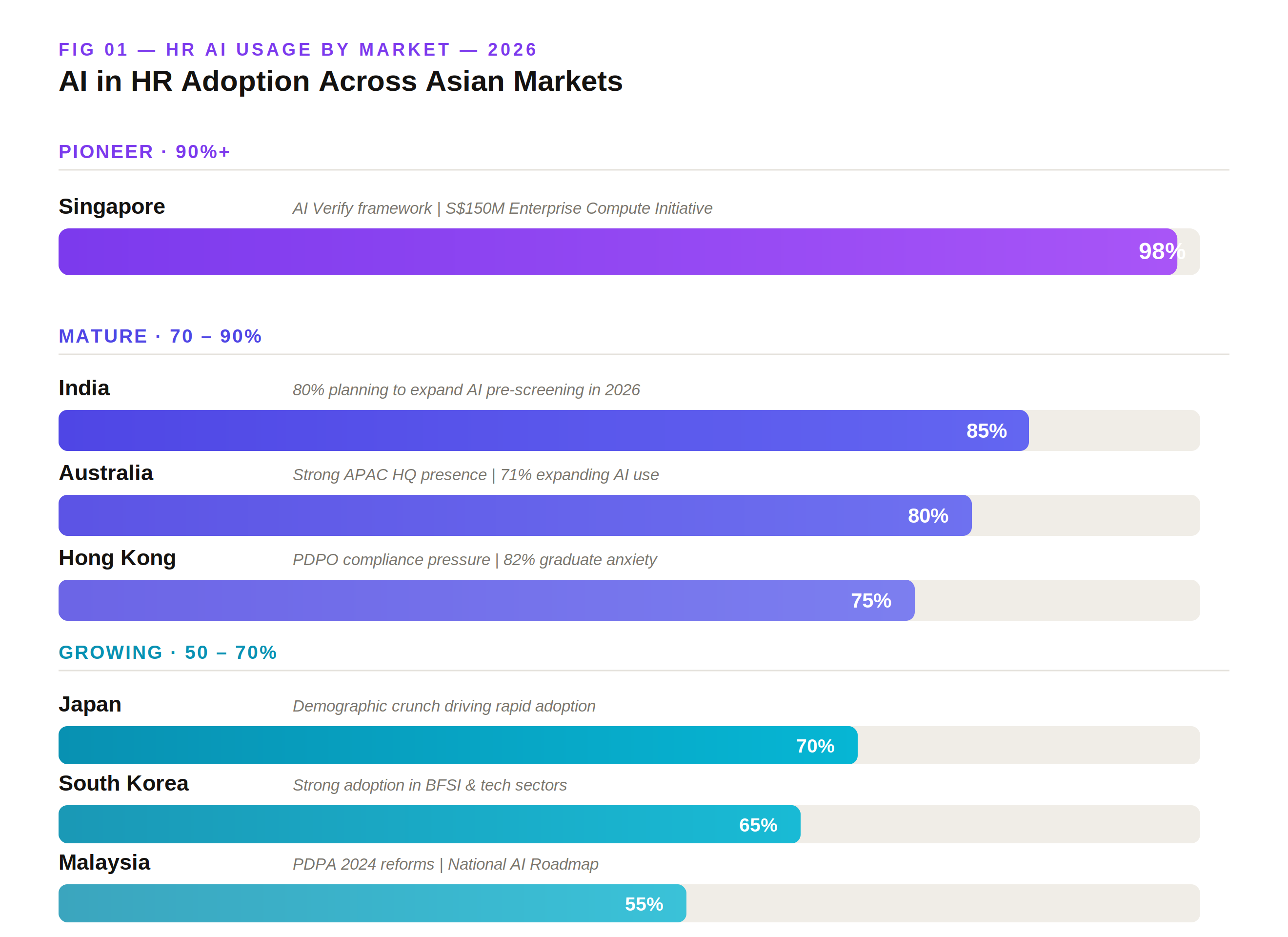
In reality, the gap between Singapore (98% HR AI usage) and Indonesia (under 35% by most regional estimates) is wider than the gap between the United States and any European country. Below is the most accurate adoption snapshot we have been able to assemble from publicly available data and Moka's own customer base, as of Q1 2026.
AI in HR adoption across Asian markets (2026)
| Market | HR AI usage rate | Generative AI in recruiting | Key adoption driver |
|---|---|---|---|
| Singapore | 98% | 70% planning to increase in 2026 | Government AI Verify framework, S$150M Enterprise Compute Initiative |
| India | ~85% | 80% planning to expand pre-screening AI | Acute IT talent shortage, BPO industry maturity |
| Australia | ~80% | 71% planning to expand AI use | Strong APAC regional HQ presence |
| Hong Kong | ~75% | Slower than SG, focused on financial services | PDPO compliance pressure, regional HQ relocation |
| Japan | ~70% | Accelerating in 2026 | Demographic crunch, government AI policy |
| South Korea | ~65% | Strong in tech and BFSI | Kakao Brain and similar local AI assistants |
| Malaysia | ~55% | Emerging | National AI Roadmap 2021–2025, semiconductor expansion |
| Indonesia | ~35% | Early-stage | UU PDP 2024, growing tech sector |
| Vietnam | ~30% | Early-stage | Strict Decree 13, lower digital maturity |
Sources: InCorp Asia hiring trends 2026, LinkedIn Global Talent Insights, SkyQuest AI Recruitment Market Report 2025, Moka internal customer adoption data.

The "usage gap" nobody talks about
Singapore's 98% adoption figure is real, but misleading on its own. When you separate "uses ChatGPT to write a job description occasionally" from "has deployed an AI ATS that scores candidates at scale", the picture changes dramatically.
LinkedIn's data, reported by IT Brief Australia in February 2026, shows that:
- 79% of Singapore recruiters say AI has already changed their organisation's hiring process
- 81% of India recruiters say the same
- 75% of Australia recruiters agree
But applications per job posting are still rising: +13% in Australia, +18% in India, +6% in Singapore year on year (LinkedIn, 2025). This means most AI deployments are not yet absorbing the application volume — recruiters are still drowning, despite the tools.
The honest read: Asia has high AI awareness and rising AI deployment, but the productivity gains have not yet caught up with the application surge. The next 18 months will be decisive.
2. ROI: what Asian companies actually report
Vendor marketing claims about AI ROI are inflated everywhere, but they are particularly inflated in cross-region comparisons. Numbers measured in Silicon Valley don't transfer cleanly to Kuala Lumpur or Taipei.
Based on Moka's customer data, supplemented by independent regional surveys, here are the realistic ROI ranges Asian organisations should expect in the first 12 months after deploying an AI-powered ATS.
Realistic ROI ranges for Asian AI ATS deployments (year 1)
| Metric | North America benchmark | Realistic Asia range | Why the difference |
|---|---|---|---|
| Time-to-hire reduction | 40% | 25–35% | Multilingual processing overhead, fewer standardised resume formats |
| Cost-per-hire reduction | 35% | 20–30% | Lower baseline recruiter salaries reduce the savings denominator |
| Recruiter productivity gain | 50% | 35–45% | Higher administrative coordination burden across regional offices |
| Application screening speed | 10× | 8–10× | Comparable, but multilingual screening adds a small overhead |
| Resume parsing accuracy | 94% | 85–92% | Variability in Asian resume formats and language mix |
Source: Moka customer adoption data 2025, cross-referenced with Mavenside Consulting Singapore implementation benchmarks 2026.
Where Asia outperforms Western markets
Two areas where Asian AI ATS deployments actually beat Western benchmarks:
- Talent rediscovery savings. Asian companies typically have larger historical candidate databases relative to current hiring volume, particularly in BPO-heavy markets like India and the Philippines. AI-powered rediscovery delivers 30–40% sourcing cost savings here, vs. 20–25% in the West.
- Multilingual candidate communication. Modern AI ATS platforms can personalise candidate emails in English, Chinese (Simplified and Traditional), Bahasa, Tagalog, Korean, and Japanese simultaneously. Western competitors using English-only templates lose meaningfully on offer acceptance rates in Asia. Companies using multilingual AI communication report offer acceptance rate improvements of 12–18%, our data shows.
The headline is straightforward: Asian AI ATS ROI is lower than the marketing claims, but real — and the value is in different places than the typical Western pitch deck assumes.
3. The bias problem looks different in Asia
The Western AI hiring bias conversation centres on race, gender, and disability — categories shaped by US Equal Employment Opportunity laws and EU non-discrimination directives. These categories matter in Asia too, but they are not the dominant axes of bias risk here.
The four bias axes that matter most in Asian hiring
- Language bias: AI models trained primarily on English resumes systematically underrate candidates whose strongest resume language is Mandarin, Cantonese, Bahasa, Korean, or Japanese. A 2023 study by Singapore's IMDA found models could underweight Chinese-language qualifications by 15–22% even when the underlying experience was equivalent. Moka's internal benchmarks show this gap can be closed to under 4% with proper multilingual training.
- Educational pedigree bias: Models trained on Western hiring data often over-weight Ivy League and Russell Group universities relative to NUS, NTU, HKU, Tsinghua, IIT, and Tokyo University. For roles based in Asia, this is empirically a poor predictor of performance.
- Age bias: Resume photographs are still common in Korea, Japan, China, and parts of Southeast Asia — and AI models trained naively will use them. Singapore's Workplace Fairness Act 2025 will require explicit traceability for any age-related screening decision once it commences.
- Local-language proficiency bias: For multinational hiring across ASEAN, AI must correctly evaluate Bahasa Indonesia vs. Bahasa Malaysia, Cantonese vs. Mandarin, Tagalog vs. English — distinctions that English-trained models routinely flatten.
Hong Kong graduates are not wrong to be worried
The 82% of Hong Kong graduates worried about AI hiring discrimination (vs. 67% global average) is not paranoia. It is a rational response to two things: regional candidates do face real algorithmic disadvantages in tools trained on Western data, and Hong Kong's PDPO has historically provided weaker individual remedies than GDPR equivalents.
For Asian HR leaders, the practical takeaway is sharper than the Western literature suggests:
You cannot trust an AI ATS vendor to handle Asian bias correctly unless they can show you bias audit data segmented by language, regional university, and ASEAN-internal market — not just gender and ethnicity.
This is the most important sentence in this report. Few vendors can show you this data. The ones that can are the ones worth shortlisting.
4. The compliance map: three new regimes by end of 2026
Western AI compliance discussion treats the EU AI Act and NYC LL144 as the gold standard. Asian HR leaders must navigate a different — and rapidly evolving — patchwork.
By the end of 2026, three new regimes will be in force across the region's three most important employment markets.
Singapore: Workplace Fairness Act 2025
Passed by Parliament in January 2025, the Workplace Fairness Act (WFA) is expected to commence in 2026 or 2027. The Act fundamentally changes the compliance landscape for AI recruitment tools.
Under the WFA, employers using AI in their employment processes must ensure that their AI systems produce outputs that are traceable and can be sufficiently checked by the employer before any employment decision is taken. The Act covers all decisions made during hiring, employment, dismissal, and termination stages.
Previously, fair employment requirements in Singapore existed only in the Tripartite Guidelines on Fair Employment Practices, which operated on a "comply-or-explain" basis without legal force. The WFA codifies these obligations into law, meaning employers can now face legal consequences for discriminatory AI-enabled decisions.
Practical implication for AI ATS buyers: any system that cannot produce a human-readable audit trail showing why a candidate was screened out will become a legal liability in Singapore from 2026.
Malaysia: PDPA 2024 Amendments (Phase 3, in force June 2025)
Malaysia's Personal Data Protection (Amendment) Act 2024 came into force in stages through 2025. Phase 3, which began in June 2025, introduced three obligations directly relevant to AI ATS deployments:
- Mandatory Data Protection Officer (DPO) appointment for organisations engaged in "regular and systemic monitoring of personal data" — explicitly including algorithmic recommendation systems.
- Mandatory data breach notification within 72 hours to the PDPD, with affected data subject notification within 7 days for high-harm breaches.
- Data portability rights, allowing candidates to demand their data be transferred to another organisation.
Penalties under the amended PDPA reach RM 500,000 and/or up to 3 years imprisonment for certain offences. Cross-border data transfers for AI processing now require ministerial approval in many cases — a significant constraint on cloud-based AI ATS vendors hosted outside Malaysia.
Hong Kong: PDPO Section 33 cross-border transfer rules
Hong Kong's Personal Data (Privacy) Ordinance contains a long-dormant Section 33 — a cross-border data transfer restriction that has been on the books but not yet brought into force. Industry observers expect activation by late 2026 or 2027, partly as a response to ongoing PRC data localisation pressures.
Once Section 33 is enacted, a data user in Hong Kong will generally be prohibited from transferring personal data outside Hong Kong unless specific conditions are met — recipient country adequacy, written candidate consent, or binding contractual safeguards.
For AI ATS buyers in Hong Kong, this means the choice between regionally-hosted infrastructure and US/EU cloud hosting will become a board-level compliance question.
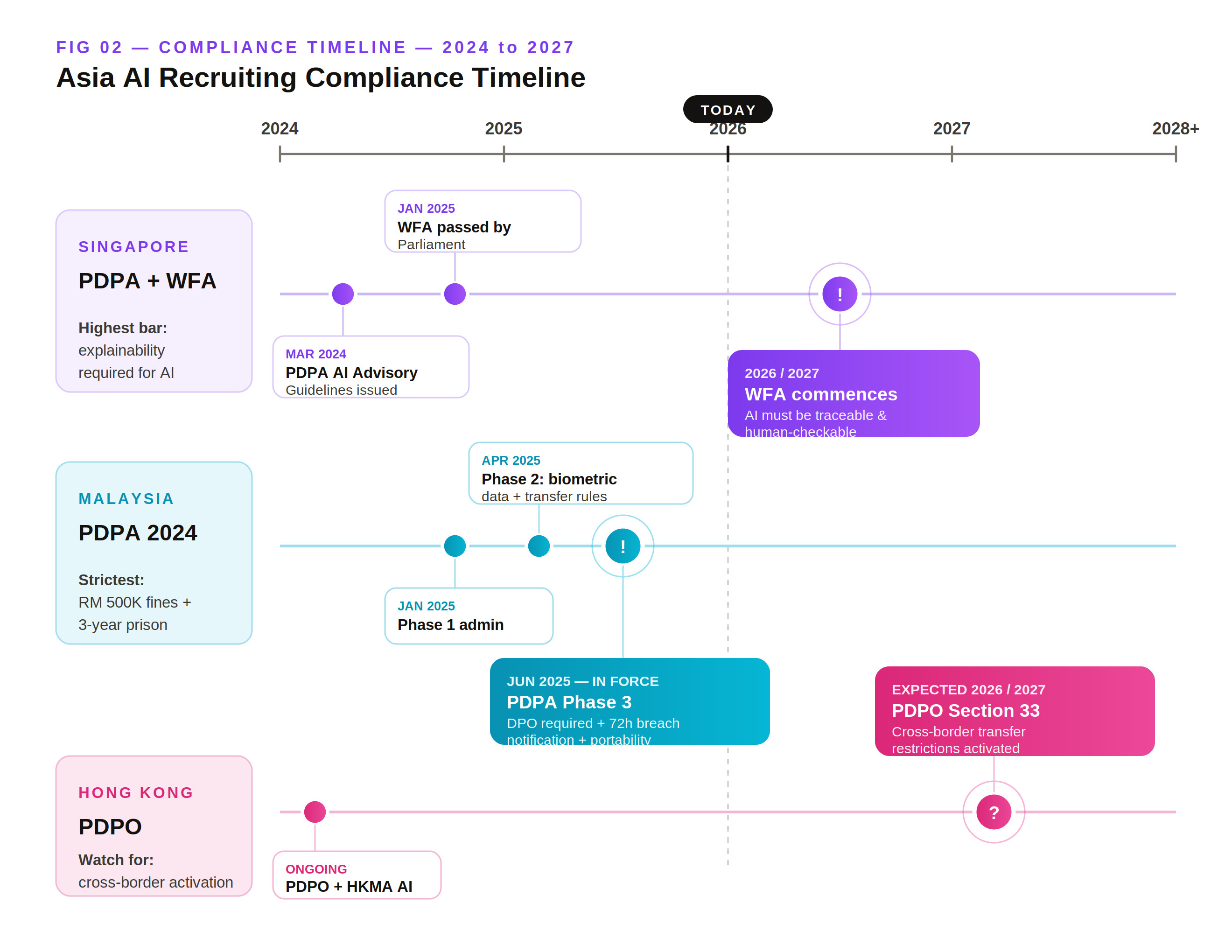
The compliance comparison
| Regulation | Status | Key requirement for AI ATS | Penalty exposure |
|---|---|---|---|
| Singapore WFA 2025 | Commencing 2026/27 | Traceable, human-checkable AI outputs in all employment decisions | Civil and statutory penalties (TBD) |
| Malaysia PDPA Phase 3 | In force June 2025 | DPO appointment, 72-hour breach notification, data portability | RM 500,000 + 3 years prison |
| Hong Kong PDPO §33 | Expected 2026/27 | Cross-border transfer restrictions, candidate consent | Civil and statutory penalties |
| Singapore PDPA AI Advisory Guidelines | In force | Consent + notification for automated decisions | Under PDPA general framework |
| EU AI Act (high-risk classification) | In force | Comprehensive risk assessment, transparency, human oversight | Up to 7% of global turnover |
| NYC LL144 | In force | Annual bias audit, candidate notification | $1,500 per violation |
The headline: AI ATS systems deployed across Singapore, Malaysia, and Hong Kong simultaneously must satisfy three different regulatory frameworks, each with different transparency, breach notification, and data residency requirements. Most current vendors do not handle this gracefully.
5. What this means for HR leaders in 2026: five priorities
Based on the data and the regulatory trajectory, here are the five priorities Asian HR leaders should focus on over the next 12 months.
Priority 1: Audit your AI ATS for Asian bias, not just Western bias
Demand that your vendor produce bias audit data segmented by:
- Resume language
- Regional university
- ASEAN-internal market (Indonesian vs. Malaysian, for instance)
- Age (where photographs are common)
If they can't produce it, treat that as a hard red flag.
Priority 2: Map your data flows against the three new compliance regimes
If you operate in Singapore, Malaysia, or Hong Kong simultaneously, run a tabletop exercise: where does candidate data physically reside, who can access it, and how long is it retained? Most compliance failures we see in customer audits are not failures of policy — they are failures of awareness about where data actually flows.
Priority 3: Insist on traceable AI scoring before the Workplace Fairness Act commences
The smart Singapore HR teams are already requiring their AI ATS vendors to produce human-readable explanations of every score. Wait until WFA commences and you'll be doing this in a rush.
Priority 4: Build multilingual into the procurement criteria, not the wishlist
The single biggest reason Western AI ATS systems underperform in Asia is monolingual training. Make multilingual support a procurement gate, not a nice-to-have feature.
Priority 5: Don't trust Western ROI benchmarks
Plan for 25–35% time-to-hire improvements, not 40%. Plan for 20–30% cost-per-hire savings, not 35%. The gains are real but the magnitudes are different — and budgeting for the Western numbers leads to disappointed boards.
6. Three predictions for 2027
Prediction 1: A major Asian AI ATS vendor will emerge to challenge the US incumbents
The combination of regional data residency requirements, multilingual processing needs, and Asia-specific compliance frameworks creates structural advantages for regionally-headquartered platforms. Expect a Singapore- or Tokyo-headquartered AI ATS vendor to reach $100M ARR before any Western competitor matches their Asian compliance footprint.
Prediction 2: Singapore's Workplace Fairness Act will be copied across the region
Hong Kong, Malaysia, and Australia are already studying the WFA framework. The "traceable, human-checkable" standard is likely to become the de facto APAC standard for AI in hiring by 2028.
Prediction 3: Candidate AI literacy will accelerate faster than employer AI literacy
70% of jobseekers globally already use generative AI to research companies and prepare for interviews (Indeed, 2025). In Asia, where digital adoption is non-linear, we expect this to surge to 85%+ by end of 2027. Recruiters who do not understand how candidates are using AI will be systematically out-prepared in interviews.
Methodology and data sources
This report synthesises data from:
- LinkedIn Global Talent Insights (Censuswide survey, 19,113 consumers and 6,554 HR professionals, November 2025)
- InCorp Asia Hiring Trends Report 2026
- Mordor Intelligence AI Recruitment Market Report (January 2026)
- Precedence Research AI in HR Market Report 2025
- Singapore Workplace Fairness Act 2025 (text of legislation)
- Malaysia Personal Data Protection (Amendment) Act 2024 and supporting JPDP guidelines
- Hong Kong PDPO and PCPD enforcement guidance
- ManpowerGroup Net Employment Outlook surveys 2025–2026
- Mavenside Consulting Singapore AI Recruitment Implementation Benchmarks 2026
- Moka's internal anonymised customer adoption data across 2,000+ enterprise customers in APAC
Where statistics are estimated or extrapolated, we have flagged them explicitly. Where specific surveys are cited, we have linked to the original source where publicly available.
Frequently asked questions
What percentage of Asian companies use AI in recruiting?
Adoption varies dramatically by market. Singapore leads with 98% of HR leaders reporting some AI tool usage, followed by India (~85%) and Australia (~80%). Indonesia and Vietnam are at the early-adopter stage with 30–35% usage rates. The regional weighted average is approximately 60–65%, but the distinction between "uses any AI tool" and "has deployed an AI ATS" matters enormously.
Is AI hiring legal in Singapore?
Yes, but the regulatory framework is tightening rapidly. The Workplace Fairness Act 2025 (commencing 2026 or 2027) will require AI-driven employment decisions to be traceable and human-checkable. Singapore's PDPA AI Advisory Guidelines also require consent and notification for significant automated decisions using personal data.
Does AI recruiting work for multilingual hiring in Asia?
It can, but only if the underlying AI model has been trained on multilingual resume data. Western AI ATS platforms trained primarily on English-language resumes systematically underweight non-English qualifications by 15–22%, based on Singapore IMDA research. Asia-focused platforms close this gap to under 5%.
How long does an AI ATS take to implement in Asia?
Typical implementation is 4–8 weeks for mid-market companies in Singapore and Hong Kong, longer (8–14 weeks) in Malaysia and Indonesia due to additional compliance configuration requirements. AI features are usable on day one but reach peak performance after 60–90 days of training on local hiring data.
What's the most important compliance change to prepare for?
Singapore's Workplace Fairness Act 2025 — once it commences, employers using AI in employment decisions must produce traceable, human-checkable outputs. This is a structural change. If your current AI ATS cannot produce a human-readable explanation of every screening decision, you have a 12–18 month window to fix this before legal exposure begins.
Continue exploring
- AI Applicant Tracking System: The 2026 Guide — the deep guide to the six AI capabilities mentioned across this article
- State of AI Recruiting in Asia 2026 — the regional adoption data behind these workflow shifts
- The Modern Recruiter's Day — the daily workflow shift that AI ATS enables, applicable to manufacturing recruiters processing high-volume applications
- The Hidden Cost of a 47-Day Hire — the pipeline audit framework adapted for manufacturing contexts
This Insights report was prepared by Moka's research team. Moka is an AI-native recruiting platform serving 2,000+ enterprise customers across APAC, including 30%+ of Fortune 500 companies operating in the region. To discuss how the findings in this report apply to your team, book a consultation.

Author
Moka AI Editorial Team
The Moka AI Editorial Team creates insightful, practical, and engaging content on HR, recruitment, and AI innovation. We explore emerging trends, share industry insights, and turn complex ideas into actionable knowledge to help HR professionals navigate the evolving world of work.