What Happened
Retirement and Re-employment Ages Increased from July 2026
According to international employment law alliance L&E Global, through its Singapore member firm Clyde & Co Clasis, Singapore's Minister for Manpower, Tan See Leng, announced during the 2026 Committee of Supply Debate on 3 March 2026 that, effective 1 July 2026:
- The statutory retirement age has increased from 63 to 64.
- The statutory re-employment age has increased from 68 to 69.
These changes represent another step toward Singapore's long-term roadmap of raising the retirement age to 65 and the re-employment age to 70 by 2030.
Several supporting workforce measures have also been extended:
-
Senior Employment Credit (SEC): Extended until December 2027, with the highest wage support tier of up to 7% available to employers hiring workers aged 69 and above.
-
Part-Time Re-employment Grant (PTRG): Also extended until December 2027 to encourage employers to offer part-time re-employment, flexible work arrangements, and structured career planning for older employees.
-
Central Provident Fund (CPF) contribution rates: Beginning in 2027, CPF contribution rates will increase by 1.5 percentage points for employees aged 55–60 and 1 percentage point for those aged 60–65.
Workplace Fairness Act: Legislation Completed, Effective by End-2027
According to the Ministry of Manpower (MOM), the Workplace Fairness framework consists of two separate pieces of legislation:
-
The first bill, which defines the scope of workplace discrimination protections and employers' obligations, was passed by Parliament on 8 January 2025.
-
The second bill, the Workplace Fairness (Dispute Resolution) Bill, was passed on 4 November 2025, establishing a formal dispute resolution framework that emphasizes internal resolution, mediation, and finally adjudication.
Importantly, MOM has made it clear that the government aims to bring the Workplace Fairness Act into force by the end of 2027, allowing employers and employees sufficient time to prepare for implementation. In other words, although the legislative process has been completed, the Act has not yet taken legal effect. Employers should rely on the official implementation timeline published by MOM rather than secondary reports.
To support implementation, MOM will work together with the Tripartite Alliance for Fair and Progressive Employment Practices (TAFEP), the National Trades Union Congress (NTUC), and the Singapore National Employers Federation (SNEF) to provide employers and employees with policy templates, guidance materials, and training workshops ahead of the Act's commencement.
For full details, see the official announcement
What This Means for Companies and HR Team?
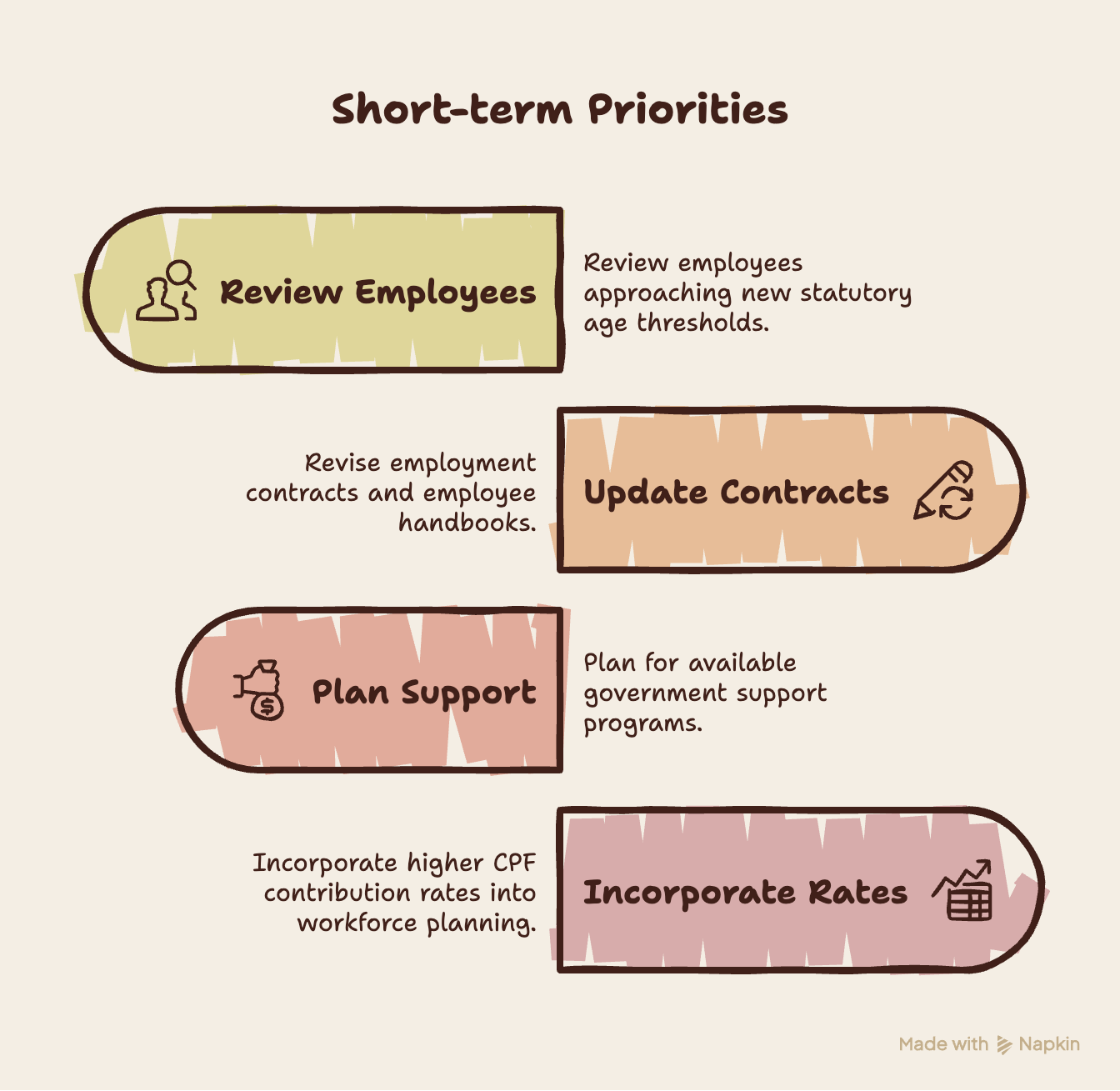
Short-term Priorities (Now to 1 July 2026)
Employers should complete the following compliance actions immediately:
Review employees approaching the new statutory age thresholds.
Employees who turn 64 on or after 1 July 2026 can no longer be retired solely because they have reached retirement age. Employers must continue employing them or offer eligible re-employment arrangements until they reach 69, subject to statutory requirements.
Update employment contracts and employee handbooks.
Revise all retirement and re-employment provisions to reflect the new statutory ages, removing outdated references such as retirement at age 63.
Plan for available government support.
Since both the Senior Employment Credit (SEC) and the Part-Time Re-employment Grant (PTRG) have been extended through December 2027, employers should proactively apply for available subsidies to help offset the costs of retaining or re-employing older workers.
Incorporate higher CPF contribution rates into workforce planning.
Businesses with relatively older workforces—particularly in sectors such as manufacturing and services—should account for the scheduled CPF contribution increases in their 2027 payroll budgets and cash flow forecasts.
Medium- to Long-term Priorities (Now to End-2027)
The Workplace Fairness Act (WFA) has an 18-month lead time. Employers should use this window to strengthen compliance and mitigate litigation risk through these steps:
Establish or strengthen internal grievance mechanisms.
Once the Act takes effect, internal dispute resolution and mediation will become mandatory preliminary steps before employees may pursue formal workplace discrimination claims.
Review recruitment, promotion, and termination practices.
Audit job advertisements, interview evaluation forms, promotion criteria, and dismissal documentation to identify any potentially discriminatory language or decision-making based on protected characteristics, including age, nationality, sex, marital or family status, race, religion, disability, and mental health condition. These documents may become key evidence in future proceedings before the ECT or the courts.
Provide fair employment training.
HR professionals, hiring managers, interviewers, and frontline supervisors should receive training on fair employment obligations. Employers should also monitor future guidance, templates, and implementation materials issued by MOM and TAFEP to ensure internal policies remain aligned with regulatory expectations.
Reassess legal, financial, and reputational risks.
With the ECT able to hear workplace discrimination claims of up to SGD 250,000, combined with confidential proceedings and simplified procedures, employees may find it easier to pursue workplace discrimination claims. Fair employment compliance should therefore be treated as a long-term governance priority, alongside payroll, tax, and social security compliance, rather than as a one-time compliance exercise.

Author
Moka AI Editorial Team
The Moka AI Editorial Team creates insightful, practical, and engaging content on HR, recruitment, and AI innovation. We explore emerging trends, share industry insights, and turn complex ideas into actionable knowledge to help HR professionals navigate the evolving world of work.