The recruitment trends 2027 research we reviewed agrees on one thing: AI now sits on both sides of hiring. Employers use it to screen and interview; candidates use it to write resumes. This article reads those reports from the employer side, for in-house hiring teams and TA leaders planning HR and hiring in APAC.

The global signals come from five reports: Korn Ferry's Talent Trends 2027, LinkedIn's Future of Talent Report 2026, Employ's 2026 Recruiter Nation report, Gartner's November 2026 AI jobs forecast and Zinc's The Bigger Picture. Most of their samples are global, US or European, so the APAC section draws on SNEF, ManpowerGroup, WTW and government notices. Below: seven global signals, four APAC differences and five moves for 2027.
Key takeaways
- AI is rewriting more work than it removes, so the 2027 gap is capability, not headcount.
- With AI on both sides of hiring, resumes and keywords carry less signal. Evidence-based assessment and openness about AI use become the basis of trust.
- In Singapore, hiring stays cautious and selective and cost pressure has not eased, even though the wider region's outlook is stronger than the global average.
- Higher work-pass salary floors in Singapore and Malaysia, plus Singapore's coming fairness law, mean more hiring decisions need a documented, job-related basis.
- The edge in 2027 goes to teams that run one shared hiring core across markets and localize rules and channels at the edges.
Contents
- 7 global HR and recruitment trends shaping 2027
- Recruitment trends in APAC: where the region differs in 2027
- How APAC hiring teams can plan for 2027: five moves
- The planning question for 2027
1.7 global HR and recruitment trends shaping 2027
The seven signals below come from five reports published in 2025 and 2026, with samples that are mostly global, US or European. Each follows the same pattern: what the data says, what it means for hiring teams, and how to use it in 2027 plans. The moves themselves are in section 3.
1.1 Entry-level work is being redesigned, not removed
Korn Ferry's Talent Trends 2027 report, published October 22, 2026 and based on more than 1,300 talent and senior leaders in over 75 countries, finds that 63% expect AI agents to take over routine tasks. Yet 40% plan to hold entry-level hiring volumes and redesign those roles around higher-value work. Respondents also report moving to skills-based early-career hiring (29%), hiring experienced talent instead (21%) or cutting entry-level roles and leaning on AI agents (19%).
So more employers are redesigning junior roles than cutting them. That changes the job description, the assessment and the training path. The risk sits with those that cut entry-level hiring outright: fewer juniors today means fewer ready team leads in a few years.
For 2027 plans, keep entry-level headcount where the work still exists, but rewrite each role around the tasks AI won't take over (see move 1).
1.2 Recruiters are becoming talent advisors
LinkedIn's Future of Talent Report 2026 tracks the skills employers ask for in recruiter job postings. Comparing January to July 2026 with the same months of 2025, "management" appeared in 13.2% of those postings, up from 1.3%, about 10 times more often. "Business" rose from 1.9% to 8.8%. Strategic Talent Advisor is now the largest senior talent category, and its share of postings doubled.
The job description is moving faster than the job. In Employ's 2026 Recruiter Nation report, Recruiter Recalibration (more than 1,200 US recruiters and HR managers, released October 2026), only 18% say over half their time has shifted from admin to higher-value work. Korn Ferry adds that 69% expect hiring, learning and development, and workforce planning teams to work more closely together.
For 2027 plans, treat recruiter time as a budget line and move it from process tasks to hiring decisions (see move 5).
1.3 Resumes need more proof than polish
In the same Employ survey, 33% of US recruiters name AI-polished resumes as their top stressor, the first time AI has led the list in the study's 19 years. Another 30% say identifying and prioritizing qualified candidates is their biggest challenge, and 43% call improving candidate quality their top priority. Gartner predicts that by 2028, one in four candidate profiles worldwide will be fake.
Candidates using AI is not the issue. Resumes no longer separate one applicant from another. When every application is polished and keyword-matched, the resume becomes a lead to follow up, not proof of skill. Screening has to move toward what a candidate can show: a work sample, an answer to a structured interview question, a checked reference.
For 2027 plans, move the weight of assessment from the resume to work samples and structured interviews, and write job ads from the real work so the right people apply (see move 3).
1.4 Candidates expect to know when AI assesses them
Candidates are wary of AI judging them. In Gartner's July 2025 survey, only 26% of job applicants said they trust AI to evaluate them fairly, so telling them where AI is used becomes part of earning that trust.
Transparency is becoming a compliance issue, not just a candidate experience one. The EU AI Act treats AI used to screen or evaluate job candidates as high risk. After the Council of the EU gave final approval to the Digital Omnibus on June 29, 2026, those obligations apply from December 2, 2027. APAC employers with EU headquarters or EU candidates should plan for that date.
For 2027 plans, tell candidates where AI is involved and keep a person on the final decision (see move 4).
1.5 Capability gaps may outpace talent shortages
In Korn Ferry's survey, 77% of leaders say capability gaps will be a bigger challenge than talent shortages, and 78% say too few people are prepared for how work will be done in the future. Adaptability ranks as the top workforce skill, followed by critical thinking and collaboration. Separately, 65% expect shortages of skilled manual and technical labor.
The gap is less about finding people and more about finding people who can do the work as it changes. That moves hiring plans from a count of roles to a list of capabilities. It also raises an assessment question. "Adaptable" written into a job description tells you nothing; it has to show up in interview questions and scoring, such as how a candidate learned a new tool under a deadline.
For 2027 plans, build headcount plans around the capabilities you need, not the number of seats (see move 1).
1.6 AI will reshape more jobs than it eliminates
Gartner's forecast, released November 10, 2026, expects AI to create 10.6 million jobs and remove 8.9 million worldwide by 2030, a net gain of 1.7 million. Just over 20% of workers, about 435.5 million people, will see their roles redesigned. In 2026, executives postponed creating and hiring about 1.3 million positions, and by 2030 a total of 5 million people will have experienced delayed hiring.
For hiring teams, the deferred roles matter more than the removed ones. Gartner's John Lovelock makes the point that deferred jobs are not lost jobs; they simply haven't been created yet. Our reading is that many of those requisitions will be released close together once companies see what AI delivers, which could squeeze months of demand into a single quarter.
For 2027 plans, keep recruiting capacity in reserve for roles paused in 2026 that may reopen at short notice (see move 1).
1.7 Global hiring needs a shared core
Zinc's The Bigger Picture report, based on a Censuswide survey of 500 senior HR and TA leaders at international companies in July and August 2026, finds that a third of businesses have experienced hiring delays from inconsistent processes in the past two years.
Multi-country employers in APAC will recognize the pattern. Each market defines stages differently, uses its own scorecard and routes approvals through its own chain. Candidates wait, and leaders cannot compare time to fill or stage conversion across markets because the data doesn't line up. Talent supply explains only part of the delay.
For 2027 plans, agree on one hiring core before you localize anything (see move 2).
1.8 What the seven signals add up to
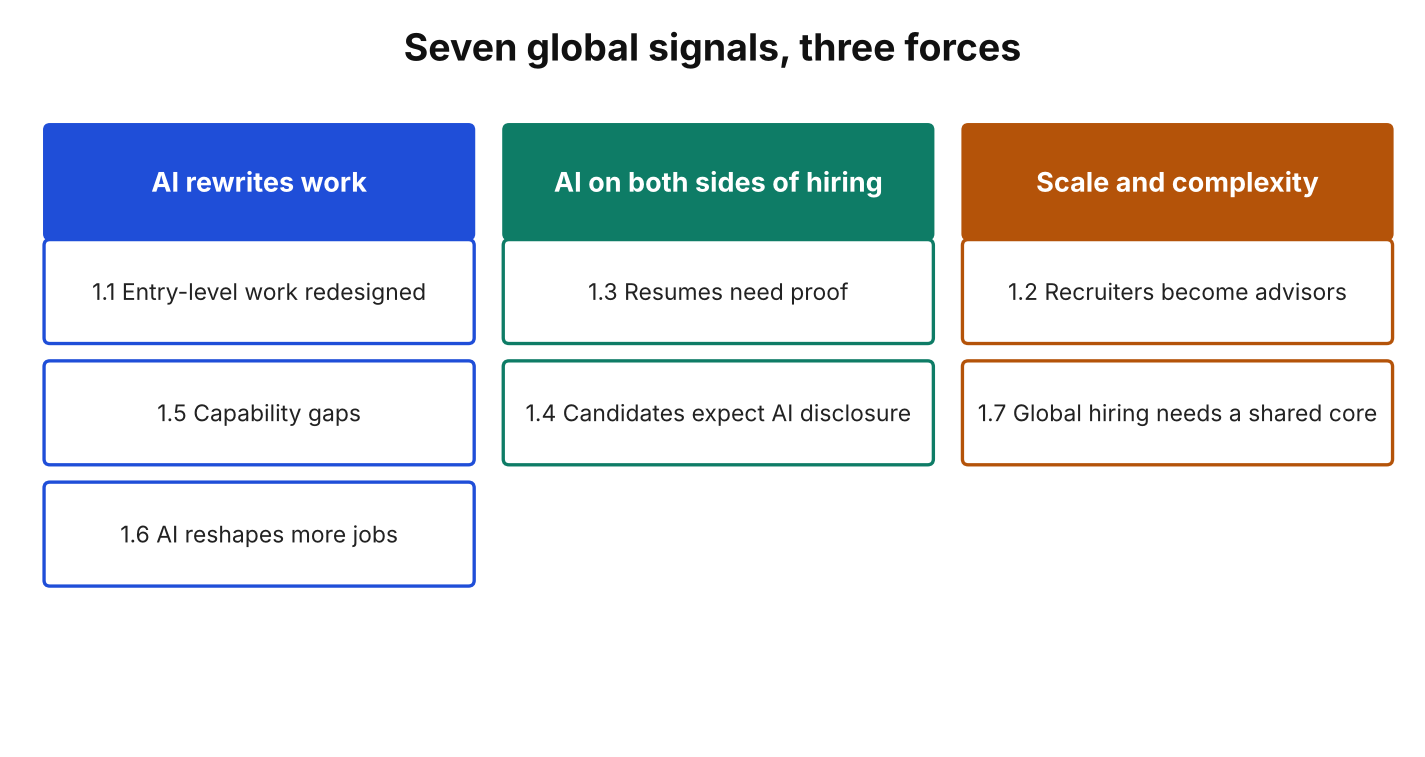
Taken together, the data suggests three forces. First, AI is rewriting work, which shows up as capability gaps and redesigned entry-level roles (1.1, 1.5, 1.6). Second, AI now sits on both sides of hiring, so resumes lose value and trust depends on transparency (1.3, 1.4). Third, scale and complexity are changing the recruiter's role and exposing inconsistent processes (1.2, 1.7).
One caution before applying any of this: none of these reports breaks out APAC results. The next section uses regional surveys and government notices to show where APAC follows the global pattern and where it doesn't.
2. Recruitment trends in APAC: where the region differs in 2027
Global reports rarely split out APAC, so the four differences below rely on regional data: SNEF's employer survey, ManpowerGroup's quarterly outlook, WTW's salary budgets, LinkedIn research and government notices in Singapore and Malaysia.

Photo: Sua Truong / Unsplash
2.1 Singapore hiring stays selective as cost pressure holds
Singapore employers will keep hiring in 2027, but slowly and selectively, even as the wider region looks stronger. SNEF's Survey on Wage and Employment Outlook 2026/2027 (over 300 Singapore companies, fielded June to August 2026) finds 40% plan to increase headcount in 2027, 54% do not and 6% plan to cut. Half (51%) plan to freeze or moderate wages, and 83% name rising manpower cost as their top challenge.
ManpowerGroup's Q4 2026 Employment Outlook Survey puts Singapore's net employment outlook at +13%, against +33% for Asia Pacific and the Middle East and +29% globally. The regional figure is lifted by other markets, so the cautious pattern is a Singapore story more than a regional one. Hong Kong recovered to +14% from minus 9% the previous quarter. A third of Singapore employers say filling vacancies takes longer than a year ago, mainly because of a mismatch between candidates and roles (43%) and a lack of required skills (35%).
WTW's July 2026 salary budget planning report projects these median increases (regional comparisons from its Philippines release):
| Market | 2027 projected salary increase |
|---|---|
| Indonesia | 6.0% |
| Malaysia | 4.7% |
| Singapore | 4.0% |
| Hong Kong | 3.8% |
| APAC average | 4.9% |
Mismatch is how the global capability gap (1.5) shows up in APAC. With budgets tight, rank roles by how hard they are to fill and how much they matter to the business, and spend there first.
2.2 Work-pass and fairness rules raise the bar for hiring decisions
Two of the region's main hiring hubs are raising the bar for foreign hires, and Singapore is adding a fairness law that covers hiring decisions. These rules sit on top of the global transparency signal (1.4) and the case for a shared core (1.7).
| Rule | Effective | What it changes for hiring |
|---|---|---|
| Singapore Employment Pass minimum salary: S$5,600 to S$6,000 (financial services S$6,200 to S$6,600) | New applications from January 1, 2027; renewals for passes expiring from January 1, 2028 | A higher bar for mid-level foreign hires |
| Malaysia Employment Pass minimum salaries: Category I RM10,000 to RM20,000, Category II RM5,000 to RM10,000, Category III RM3,000 to RM5,000, with tenure limits | June 1, 2026; succession plans required for ESD and MDEC companies from January 1, 2027 | Fewer roles qualify, and local successors must be planned |
| Singapore Workplace Fairness Act | Expected end-2027; employers with fewer than 25 staff exempt at first | Hiring decisions need documented, job-related reasons |
The same role may follow a different path in each market, while the standard for judging candidates must be more consistent and better recorded.
A hiring manager in Kuala Lumpur and one in Singapore may face different pass rules, but both need a scorecard that explains why one candidate was chosen over another. This table covers thresholds and dates only, so check the official source before acting. For more on the Singapore law, see our Workplace Fairness Act update.
2.3 Early-career hiring is holding up better than the headlines suggest
The regional data points the other way from the headlines about AI ending entry-level jobs. In ManpowerGroup's Q4 2026 survey, 45% of Asia Pacific and Middle East employers say early-career hiring has increased from a year ago, while 18% report a decline. In Singapore, 37% report an increase and 22% a decline.
Among Singapore employers that reduced early-career hiring, 38% cite AI-driven automation and 34% cite cost pressure pushing them toward experienced talent. Where cuts happen, AI is the leading reason, but cuts are not yet the dominant pattern.
These are quarterly hiring intentions, not annual results, so read them as a direction rather than a forecast. They still fit the global finding in 1.1: roles are being redesigned more often than removed. For 2027, APAC teams still need a working early-career pipeline, for graduate programs as much as for frontline roles in retail and logistics. What changes is the assessment. Learning speed and real output count for more than the degree on the resume.

Photo: Van Tay Media / Unsplash
2.4 AI adoption is running ahead of proof
APAC employers are adopting AI faster than most, but few can yet show it working in hiring. ManpowerGroup's Q2 2026 survey found that 80% in Asia Pacific use AI in hiring, onboarding or training, against 67% globally.
In the same survey, just 8% of employers worldwide say AI fully meets their expectations in hiring and training. One is regional adoption and the other global satisfaction, so neither explains the other, but together they show a gap between use and results.
SNEF finds 48% of Singapore employers rank exploring, adopting or strengthening AI as a 2027 priority, up from 39% for 2026.
LinkedIn research (Censuswide, November 2025), reported in February 2026, found 74% of Singapore recruiters say qualified talent has become harder to find, and 61% of those using AI say it surfaced candidates that traditional methods would likely have missed.
Building on the global signals on recruiter roles (1.2) and transparency (1.4), our reading is that faster adoption brings pressure to measure results and explain AI use here sooner.
For 2027, the questions are where AI sits in the process, how you measure it and how you tell candidates. Our State of AI Recruiting in Asia 2026 goes deeper.
3. How APAC hiring teams can plan for 2027: five moves
The five moves run in order. Set the headcount logic first, then align the process, then change how you assess and how you explain AI to candidates. Freeing up recruiter time comes last, because it makes the rest stick.
3.1 Plan headcount by capability, not by requisition
List 2027 headcount by the capabilities the business needs, not by job titles carried over from last year. For each capability, decide whether you will hire for it, build it internally or hand the routine parts to AI. This answers the capability gap (1.5), the redesign of entry-level work (1.1, 2.3), the roles deferred in 2026 (1.6) and tight budgets (2.1).
The common mistake is to take last year's requisition list and adjust the numbers.
First step for Q1: pick the three to five hardest-to-fill job families and, for each market, record time to fill and the main cause of mismatch.
3.2 Build one hiring core and localize the edges
Agree on what every market shares: stage definitions, scorecards, reporting definitions and data access rules. Then localize only what has to differ: work-pass and fairness rules (2.2), language, approval chains and the channels candidates use. If candidates in one market tend to reply on WhatsApp and those in another prefer email, the channel belongs at the edge, not in the core. Inconsistent processes are a known source of delay (1.7), so the core comes first.
First step for Q1: map where each market's process differs. Any step nobody can justify with a legal or business reason moves back into the shared core.
 Map each market's process before deciding what stays local.
Photo: UX Indonesia / Unsplash
3.3 Screen for evidence, not polish
Write job ads from the work the person will actually do, and have the hiring manager and someone already in the role check them. In screening and interviews, use structured questions, work samples and one shared scorecard, and treat the resume as a lead rather than a verdict (1.3). Moka AI's AI Interview follows the same logic: it produces a structured report with evidence behind each score, and a person makes the final call.
First step for Q1: rewrite the ad and scorecard for one high-volume role, then compare interview pass rates over a quarter.
3.4 Tell candidates where AI is used, and keep people on the decision
On the application page and in interview invitations, say which steps use AI, what data it looks at and who makes the final decision. Set up human review and a way for candidates to query an outcome, and record the reason behind each key decision. That prepares you for candidate expectations (1.4), Singapore's fairness law (2.2) and the scrutiny that follows fast AI adoption (2.4).
The common mistake is to mention AI once in the privacy policy and stop there.
First step for Q1: list every point where AI touches your process and write a one-page notice for candidates.
3.5 Turn recruiter hours into advisory time, and measure the shift
Hand scheduling, status updates and first-pass screening checks to automation, and spend the freed hours with the business on capability needs and hiring decisions (1.2, 2.4). Track the shift with time to fill, stage conversion rates and hiring manager satisfaction.
Moka AI handles AI Resume Screening, AI Interview and AI Interview Summary inside Moka ATS, while a WhatsApp Agent lets candidates apply, complete screening and book interviews without leaving WhatsApp. Recruitment analytics and reporting then tracks time to fill and stage conversion across markets in one place.
First step for Q1: measure how many hours each recruiter spends on admin in a typical week. That number is your 2027 baseline.
The planning question for 2027
The question for 2027 is not how many people to hire. It is how to hire people with the capabilities you need, in every market, against one standard, through a process candidates can trust. The global reports describe the pressure. APAC's rules, budgets and channels decide how it lands.
If you do one thing this quarter, start with move 1; it sets the priorities for the other four. To see a shared hiring core running across markets, request a demo.
For regional context, read The State of AI Recruiting in Asia 2026.

Author
Damon Liu
Marketing Manager
Hello everyone! I'm part of the Editorial Team at Moka AI, where I focus on global content, including writing and editing in-depth insight articles. I love exploring new ideas, discovering new tools, and finding fresh perspectives. My goal is to create content that’s genuinely valuable and helpful for HR professionals, while keeping it engaging, relatable, and fun to read!