How MokaHR ATS Helped a Global Fashion Unicorn Streamline 19,000+ Interviews
Read how a global fashion unicorn leveraged MokaHR ATS to build a structured interview process across 150+ countries.
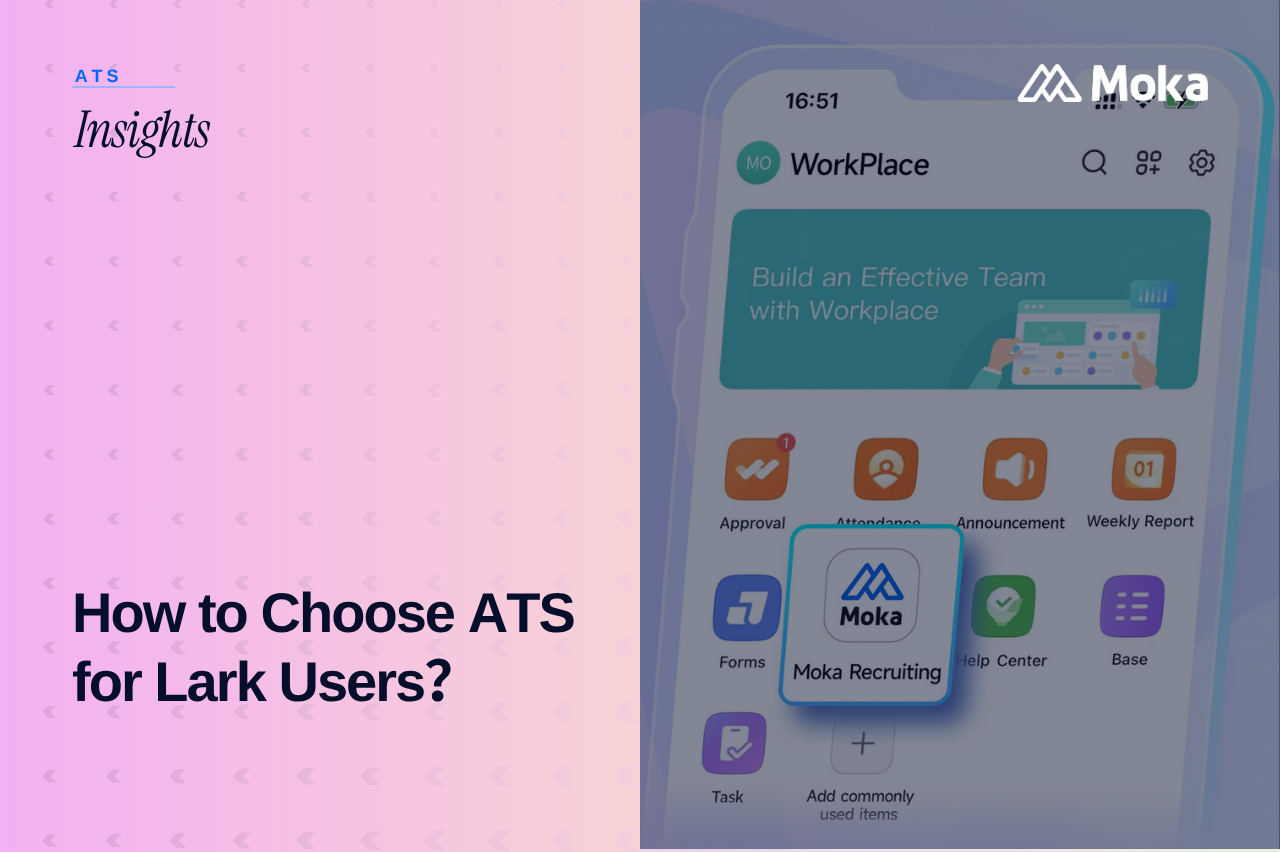
Learn how Klook streamlined global hiring and talent acquisition with Moka ATS. By integrating with Lark, Klook unified interview workflows, centralized candidate pipelines, and improved recruitment efficiency across multiple markets.

Free report
APAC AI Hiring Trends 2026 · 32-page in-depth research font-medium

Read how a global fashion unicorn leveraged MokaHR ATS to build a structured interview process across 150+ countries.

Most articles about AI in recruiting are abstract. This one is concrete: we walk through the actual working day of a mid-level recruiter at a 500-person company, hour by hour, showing exactly which tasks AI ATS automates, where the time savings come from, and what the recruiter does with the reclaimed hours. Based on aggregated workflow data from Moka customers in 2024–2025.

A definitional Insights piece introducing the concept of the "Candidate Digital Twin" — the dynamic, AI-maintained representation of every candidate in an organisation's hiring ecosystem. Examines the four layers of a Candidate Digital Twin, why traditional ATS systems cannot build one, the three use cases this unlocks (Talent Rediscovery 2.0, predictive offer acceptance, bias-corrected outcome modelling), and the ethical line between candidate intelligence and candidate surveillance.

Read how a global fashion unicorn leveraged MokaHR ATS to build a structured interview process across 150+ countries.

Most articles about AI in recruiting are abstract. This one is concrete: we walk through the actual working day of a mid-level recruiter at a 500-person company, hour by hour, showing exactly which tasks AI ATS automates, where the time savings come from, and what the recruiter does with the reclaimed hours. Based on aggregated workflow data from Moka customers in 2024–2025.

A definitional Insights piece introducing the concept of the "Candidate Digital Twin" — the dynamic, AI-maintained representation of every candidate in an organisation's hiring ecosystem. Examines the four layers of a Candidate Digital Twin, why traditional ATS systems cannot build one, the three use cases this unlocks (Talent Rediscovery 2.0, predictive offer acceptance, bias-corrected outcome modelling), and the ethical line between candidate intelligence and candidate surveillance.

AI-native organizations represent the next stage of enterprise transformation. This article explains why AI adoption alone is not enough, how companies can build queryable context systems, deploy AI agents, and redesign workflows, roles, and decision-making structures for the AI era.

Fake candidates and deepfake interviews are becoming real hiring risks. Learn how recruiters can detect fake candidates, improve candidate verification, and protect hiring quality.

Learn what an applicant tracking system is, how it works, its key features, benefits, and how to choose the right ATS for your hiring team.

AI interviews can speed up candidate screening, but structure makes them reliable. Learn how TA teams can combine AI interviews, scorecards, and structured hiring workflows.

AI interviews boost recruiting efficiency but only if candidates trust the process. Discover how transparency, human oversight, and structured design improve candidate experience and protect your pipeline.

Asian manufacturing — from Penang semiconductor fabs to Vietnamese electronics plants to Indonesian EV factories — operates under hiring conditions that the standard tech-focused ATS was never designed for. This piece explains the five fundamental mismatches, why standard platforms fail at scale, and what manufacturing-grade hiring actually requires across screening, language, certification, and high-volume blue-collar operations.

Once AI ATS removes the screening and scheduling friction, the slowest part of every hiring process becomes the hiring manager — feedback latency, decision indecision, calibration drift. This Insights piece introduces a 5-dimension Hiring Manager Engagement Score (with a 20-item self-assessment), profiles four common problem-manager archetypes, and gives Heads of TA a concrete 90-day enablement roadmap.

Global average time-to-hire reached 44 days in 2025 — up from 31 in 2023. The problem isn't that hiring is slower everywhere; it's that most teams can't see exactly where their own pipeline is failing. This piece introduces a 7-stage audit framework with industry benchmarks, four diagnostic patterns matched to specific automation interventions, and a 21-day pipeline scorecard teams can start using on Monday